Loading...

4,068 posters, 219 videos, 101 topics, 69 sessions, 14,365 authors, 6,128 institutions

ePostersLive by SciGen Technologies S.A. All rights reserved.

Alzheimer's Association International Conference 2026

July 12-15, 2026 | London, United Kingdom, and Online

Alzheimer's Association International Conference 2026 banner

2323

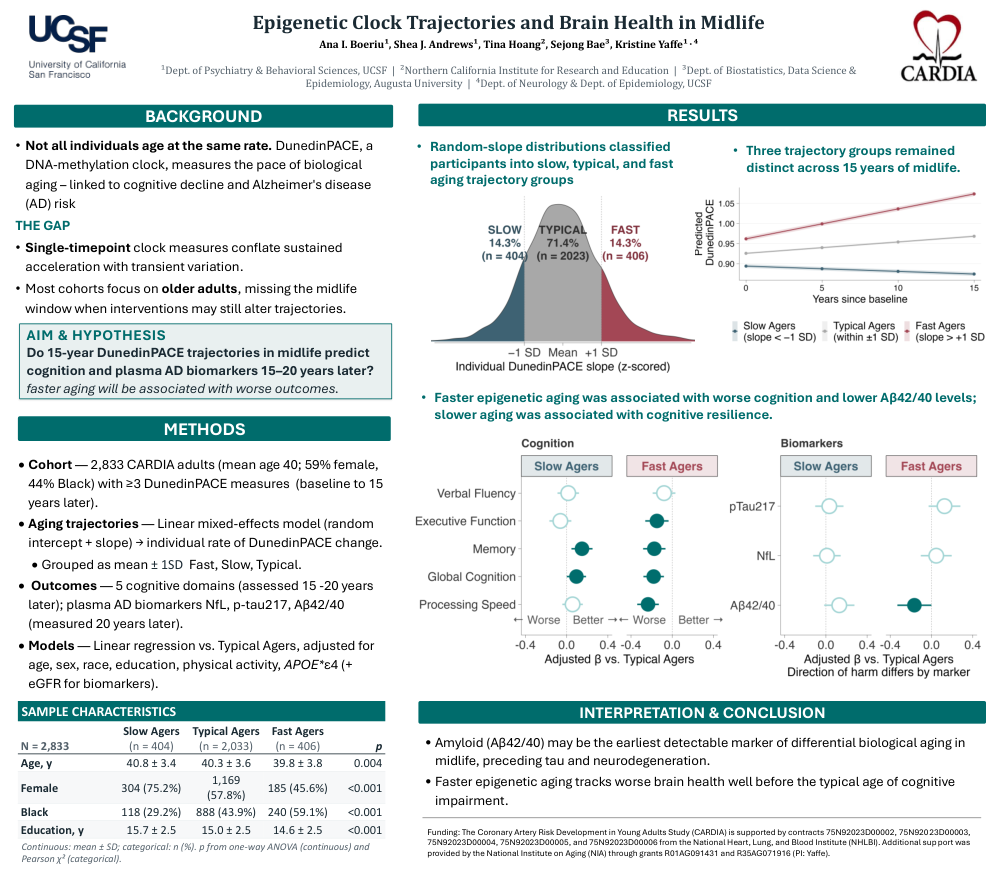
Epigenetic Clock Trajectories And Brain Health In Midlife
Part of Topic

BACKGROUND 

•Not all individuals age at the same rate. DunedinPACE, a DNA-methylation clock, measures the pace of biological aging – linked to cognitive decline and Alzheimer's disease (AD) risk

THE GAP

•Single-timepoint clock measures conflate sustained acceleration with transient variation.
•Most cohorts focus on older adults, missing the midlife window when interventions may still alter trajectories.
 

AIM & HYPOTHESIS

Do 15-year DunedinPACE trajectories in midlife predict cognition and plasma AD biomarkers 15–20 years later? faster aging will be associated with worse outcomes.


METHODS

·Cohort — 2,833 CARDIA adults (mean age 40; 59% female, 44% Black) with ≥3 DunedinPACE measures  (baseline to 15 years later).
·Aging trajectories — Linear mixed-effects model (random intercept + slope) → individual rate of DunedinPACE change.
·Grouped as mean ± 1SD  Fast, Slow, Typical.
· Outcomes — 5 cognitive domains (assessed 15 -20 years later); plasma AD biomarkers NfL, p-tau217, Aβ42/40 (measured 20 years later).
·Models — Linear regression vs. Typical Agers, adjusted for age, sex, race, education, physical activity, APOE*ε4 (+ eGFR for biomarkers).
 
RESULTS
•Random-slope distributions classified participants into slow, typical, and fast aging trajectory groups
•Three trajectory groups remained distinct across 15 years of midlife.
•Faster epigenetic aging was associated with worse cognition and lower Aβ42/40 levels; slower aging was associated with cognitive resilience.

INTERPRETATION & CONCLUSION

•Amyloid (Aβ42/40) may be the earliest detectable marker of differential biological aging in midlife, preceding tau and neurodegeneration.
•Faster epigenetic aging tracks worse brain health well before the typical age of cognitive impairment.

Comments

Email is required but is not shown publicly.

Loading comments...

aaic2026 banner
Copyright © 2015-2026, ePostersLive® SciGen is a registered trademark of SciGen Technologies S.A. Patent pending.

This website and third-party tools we use rely on cookies for the best user experience. By selecting "I agree", you agree to cookie usage as described in our Privacy Policy.