4,068 posters, 219 videos, 101 topics, 69 sessions, 14,365 authors, 6,128 institutions
ePostersLive by SciGen Technologies S.A. All rights reserved.
Alzheimer's Association International Conference 2026
July 12-15, 2026 | London, United Kingdom, and Online

10734
Using Green Tea Extract To Modulate Neuroinflammation From Diesel Exhaust In A Murine Model Of Chronic Cerebral Hypoperfusion
Poster Presenter
Authors
Manuel Morales, Kristina Shkirkova, Lifu Zhao, Salma Durra, Sindhu Daggupati, Angela Tang-Tan, Yashar Aghaei, Mohammad Mahdi Badami, Sahar Fazelvalipour, Constantinos Sioutas, Rayudu Gopalakrishna, William J Mack
Affiliations
Keck School of Medicine, Department of Neurological Surgery, University of Southern California, Los Angeles, USA, Viterbi School of Engineering, University of Southern California, Los Angeles, USA
Part of Topic
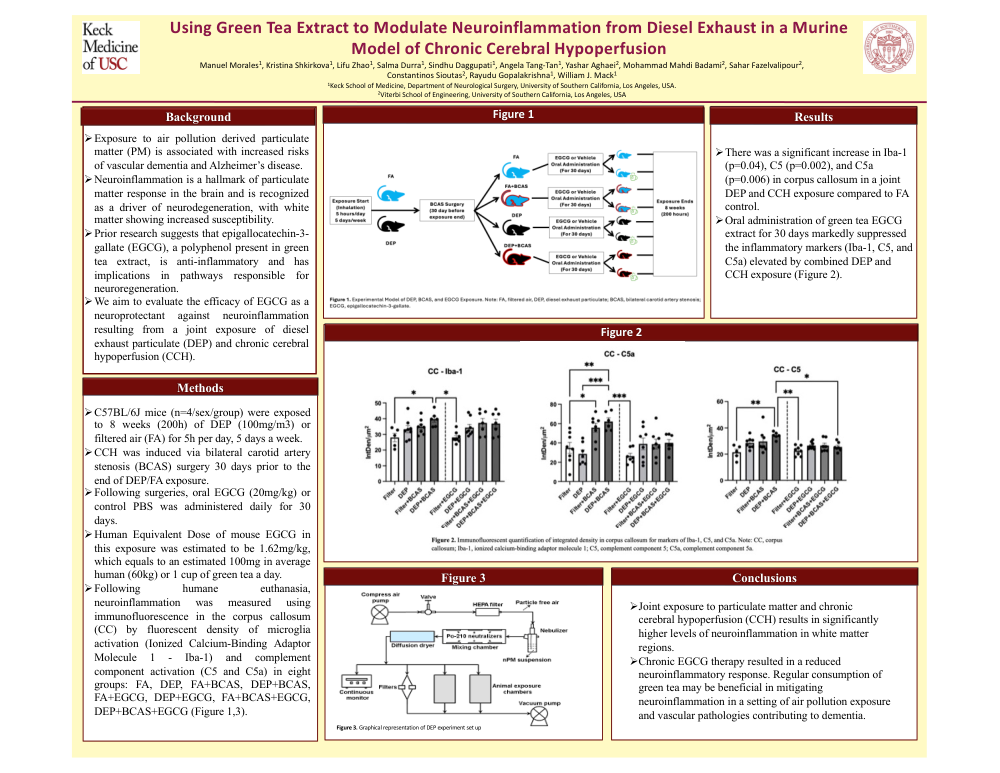
Background: Exposure to air pollution derived particulate matter (PM) is associated with increased risks of vascular dementia and Alzheimer’s disease. Neuroinflammation is a hallmark of particulate matter response in the brain and is recognized as a driver of neurodegeneration, with white matter showing increased susceptibility. Prior research suggests that epigallocatechin-3-gallate (EGCG), a polyphenol present in green tea extract, is anti-inflammatory and has implications in pathways responsible for neuroregeneration. We aim to evaluate the efficacy of EGCG as a neuroprotectant against neuroinflammation resulting from a joint exposure of diesel exhaust particulate (DEP) and chronic cerebral hypoperfusion (CCH).
Methods: C57BL/6J mice (n=4/sex/group) were exposed to 8 weeks (200h) of DEP (100mg/m3) or filtered air (FA) for 5h per day, 5 days a week. CCH was induced via bilateral carotid artery stenosis (BCAS) surgery 30 days prior to the end of DEP/FA exposure. Following surgeries, oral EGCG (20mg/kg) or control PBS was administered daily for 30 days. Human Equivalent Dose of mouse EGCG in this exposure was estimated to be 1.62mg/kg, which equals to an estimated 100mg in average human (60kg) or 1 cup of green tea a day. Following humane euthanasia, neuroinflammation was measured using immunofluorescence in the corpus callosum (CC) by fluorescent density of microglia activation (Ionized Calcium-Binding Adaptor Molecule 1 - Iba-1) and complement component activation (C5 and C5a) in eight groups: FA, DEP, FA+BCAS, DEP+BCAS, FA+EGCG, DEP+EGCG, FA+BCAS+EGCG, DEP+BCAS+EGCG (Figure 1).
Results: There was a significant increase in Iba-1 (p=0.04), C5 (p=0.002), and C5a (p=0.006) in corpus callosum in a joint DEP and CCH exposure compared to FA control. Oral administration of green tea EGCG extract for 30 days markedly suppressed the inflammatory markers (Iba-1, C5, and C5a) elevated by combined DEP and CCH exposure (Figure 2).
Conclusion: Joint exposure to particulate matter and chronic cerebral hypoperfusion (CCH) results in significantly higher levels of neuroinflammation in white matter regions. Chronic EGCG therapy resulted in a reduced neuroinflammatory response. Regular consumption of green tea may be beneficial in mitigating neuroinflammation in a setting of air pollution exposure and vascular pathologies contributing to dementia.
Comments
Email is required but is not shown publicly.
Loading comments...