4,068 posters, 219 videos, 101 topics, 69 sessions, 14,365 authors, 6,128 institutions
ePostersLive by SciGen Technologies S.A. All rights reserved.
Alzheimer's Association International Conference 2026
July 12-15, 2026 | London, United Kingdom, and Online

5616
Context-dependent Epigenomic Regulatory Networks (cEpiNets) In Microglia Reveal Cis- And Trans-regulations In Alzheimer's Disease
Poster Presenter
Part of Topic
Abstract:
Interpreting how disease-associated variants contribute to complex disorders such as Alzheimer’s disease (AD) is challenging due to their context-dependent effects from genetic or environmental risk factors. Human microglia are highly enriched for AD genetic risk and exhibit AD-associated cellular states across postmortem samples and in vitro cellular models. Although extensive single-nucleus transcriptomic and epigenomic studies have characterized these states, it remains unclear how genetic risk interacts with environmental cues, such as inflammation, to shape microglial regulatory programs and modulate state transitions. Here, we construct context-dependent epigenomic networks (cEpiNets) for microglia by integrating bulk and single-nucleus ATAC-seq data across diverse genetic and perturbation contexts relevant to AD. Using an embedding-based framework to model relationships among transcription factor (TF), cis-regulatory element (CRE), and target genes, we observe regulatory circuits mediated by ETS, Fos, and Jun TF families shared across AD-related contexts and identify candidate repressors, such as ZBTB14, that contribute to the transition from acute to chronic microglial inflammation. Finally, we apply cEpiNets to prioritize context-dependent regulatory mechanisms underlying AD risk variants at the SORL1 locus, exemplifying that our framework can link genetic risk, regulatory architecture, and AD-associated microglial states. Collectively, we present a systematic approach to facilitate context and regulatory circuit-aware annotations of AD risk variants and to reveal the epigenomic link between genetics and inflammation in microglia implicated in AD pathogenesis.
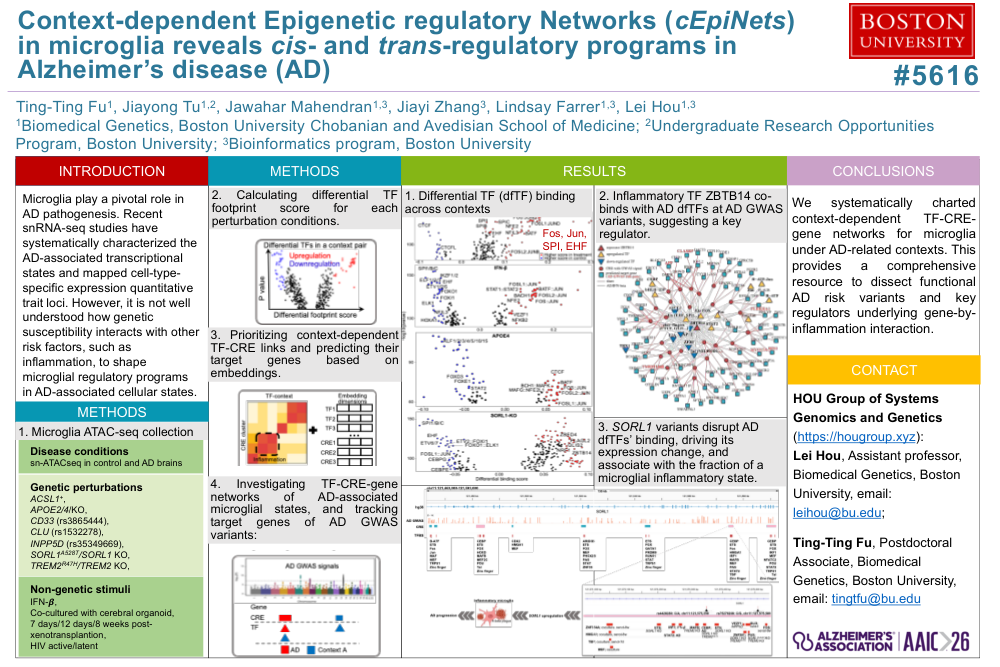
1. Differential TF (dfTF) binding across contexts
2. Inflammatory TF ZBTB14 co-binds with AD dfTFs at AD GWAS variants, suggesting a key regulator.
3. SORL1 variants disrupt AD dfTFs’ binding, driving its expression change, and associate with the fraction of a microglial inflammatory state.
Conclusions:
We systematically charted context-dependent TF-CRE-gene networks for microglia under AD-related contexts. This provides a comprehensive resource to dissect functional AD risk variants and key regulators underlying gene-by-inflammation interaction.
Comments
Email is required but is not shown publicly.
Loading comments...