4,068 posters, 219 videos, 101 topics, 69 sessions, 14,365 authors, 6,128 institutions
ePostersLive by SciGen Technologies S.A. All rights reserved.
Alzheimer's Association International Conference 2026
July 12-15, 2026 | London, United Kingdom, and Online

542
Quercetin Mitigates AlNP-induced Cognitive And Hippocampal Damage Via Akt/GSK3ί Pathway Modulation
Poster Presenter
Part of Topic
Quercetin Mitigates ALNP-Induced Cognitive and Hippocampal Damage via Akt/GSK3β Pathway Modulation
Background:
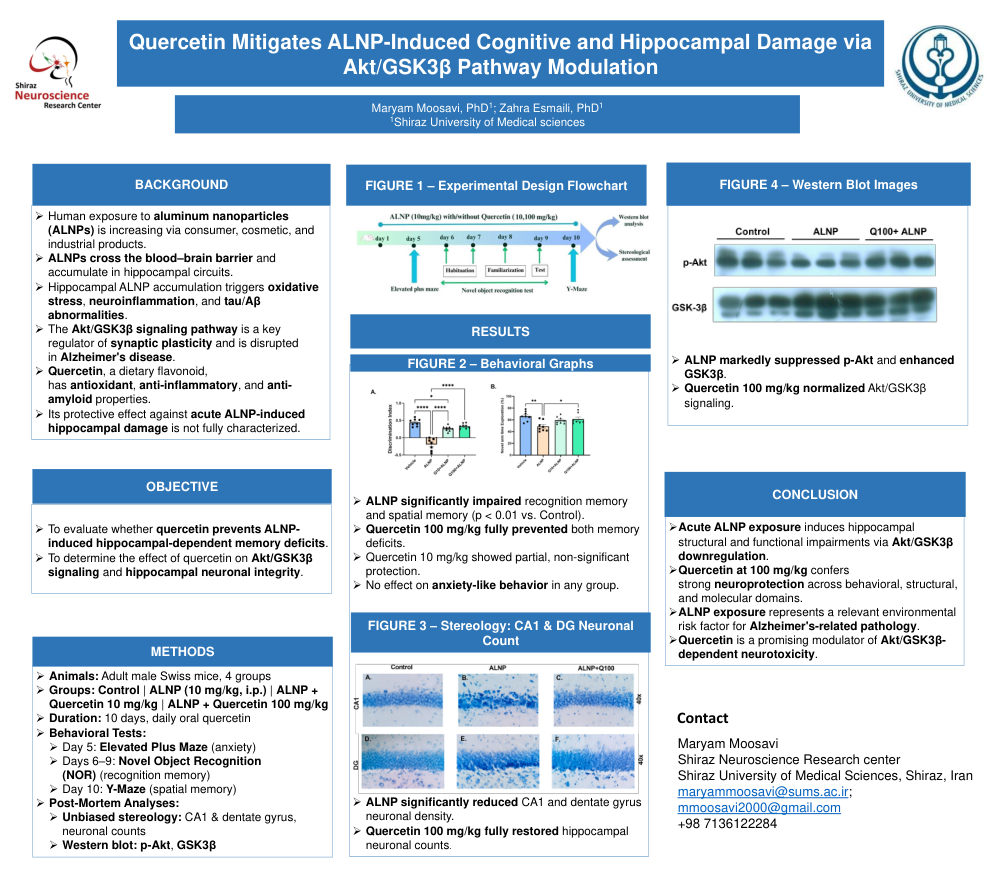
Human exposure to engineered aluminum nanoparticles (ALNPs) is steadily increasing due to their extensive use in industrial, cosmetic, and household products. ALNPs readily cross the blood–brain barrier and accumulate within hippocampal circuits, where they induce oxidative stress, neuroinflammation, and tau/Aβ-related abnormalities. Dysregulation of the Akt/GSK3β signaling pathway—a core regulator of synaptic plasticity and a key molecular contributor to Alzheimer’s disease pathology—has been strongly implicated in aluminum-induced neurotoxicity. Quercetin, a dietary flavonoid with antioxidant, anti-inflammatory, and anti-amyloid properties, has shown neuroprotective potential in several models of cognitive impairment. However, its efficacy against acute ALNP-induced hippocampal dysfunction has not been fully characterized.
Objective:
To evaluate whether quercetin prevents ALNP-induced deficits in hippocampal-dependent memory and to determine its effect on Akt/GSK3β signaling and hippocampal neuronal integrity.
Methods:
Adult male Swiss mice were assigned to control, ALNP (10 mg/kg, i.p.), ALNP+Q10, and ALNP+Q100 groups for 10 days. Quercetin (10 or 100 mg/kg, oral) was administered daily. Behavioral assessments included the elevated plus maze (day 5), novel object recognition test (days 6–9), and Y-maze (day 10). Following behavioral testing, hippocampi were collected for unbiased stereology (CA1 and dentate gyrus volumes and neuronal counts) and Western blot analysis of phosphorylated-Akt and phosphorylated-GSK3β.
Results:
ALNP exposure impaired recognition memory and spatial memory without affecting anxiety-like behavior. Stereological analyses showed significant ALNP-induced reductions in CA1 and dentate gyrus volume and neuronal density. ALNP markedly suppressed Akt phosphorylation while enhancing GSK3β activity. Quercetin at 100 mg/kg robustly prevented memory deficits, restored hippocampal volumes and neuronal counts, and normalized Akt/GSK3β signaling. The 10 mg/kg dose showed partial but non-significant protective effects.
Conclusion:
Acute exposure to ALNP induces substantial hippocampal structural and functional impairments accompanied by downregulation of the Akt/GSK3β pathway. Quercetin, particularly at 100 mg/kg, confers strong neuroprotection across behavioral, structural, and molecular domains. These findings highlight acute ALNP exposure as a relevant environmental risk factor for Alzheimer-related pathology and identify quercetin as a promising modulator of Akt/GSK3β-dependent neurotoxicity.
Comments
Email is required but is not shown publicly.
Loading comments...