4,068 posters, 219 videos, 101 topics, 69 sessions, 14,365 authors, 6,128 institutions
ePostersLive by SciGen Technologies S.A. All rights reserved.
Alzheimer's Association International Conference 2026
July 12-15, 2026 | London, United Kingdom, and Online

3942
OxLDL-induced Endothelial Extracellular Vesicles Drive Axonal Degeneration And Cognitive Impairment Independent Ofamyloidί
Poster Presenter
Authors
Affiliations
Part of Topic
Title
OxLDL-induced endothelial extracellular vesicles drive axonal degeneration and cognitive impairment independent of Aβ
Background
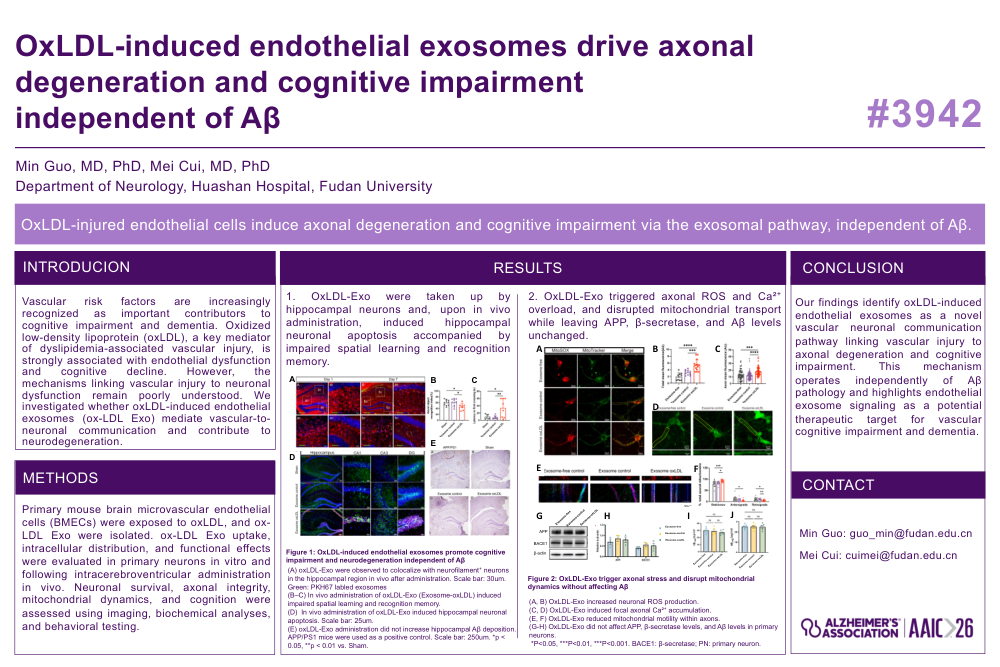
Vascular risk factors are increasingly recognized as active contributors to cognitive impairment and dementia. Oxidized low-density lipoprotein (oxLDL), a central mediator of dyslipidemia-associated vascular injury, has been strongly associated with endothelial dysfunction and cognitive decline. However, it remains unclear how oxLDL-induced endothelial injury is translated into neuron-specific vulnerability and cognitive impairment. Here, we investigated whether oxLDL-induced endothelial extracellular vesicles mediate neuron injury and cognitive impairment.
Method
Primary mouse brain microvascular endothelial cells (BMECs) were exposed to oxidized low-density lipoprotein (oxLDL) to model dyslipidemia-associated vascular injury. Endothelial-derived extracellular vesicles (EEVs) were isolated and characterized biochemically and biophysically. EEV uptake, subcellular distribution, and functional effects were assessed in primary neurons in vitro and in vivo following intracerebroventricular administration. Neuronal survival, synaptic function, and cognition were evaluated using behavioral testing, imaging, and biochemical assays.
Result
OxLDL exposure markedly increased endothelial extracellular vesicle release, generating a distinct population of oxLDL-induced EEVs (oxLDL-EEVs). These vesicles were efficiently internalized by hippocampal neurons and preferentially accumulated within axons both in vitro and in vivo. In vivo administration of oxLDL-EEVs caused significant hippocampal neuronal loss and impaired spatial learning and recognition memory, while motor function was preserved. At the cellular level, oxLDL-EEVs induced focal axonal calcium overload and synaptic dysfunction, consistent with axonal injury. Mechanistically, oxLDL-EEVs disrupted axonal mitochondrial transport and increased mitochondrial colocalization with the axonal anchoring protein syntaphilin (SNPH), indicating enhanced mitochondrial immobilization, which coincided with impaired synaptic energy homeostasis. Lipidomic analyses showed that oxLDL-EEVs were enriched in cholesteryl esters (CE), a lipid species normally present at low levels in the mitochondrial outer membrane, providing a potential link between EEV lipid cargo and mitochondria-associated anchoring. Importantly, these neurodegenerative effects occurred without alterations in amyloid precursor protein processing, β-secretase activity, or Aβ production.
Conclusions
This study identifies oxLDL-EEVs as a previously unrecognized mechanism linking vascular injury to selective axonal degeneration and cognitive dysfunction, independent of Aβ pathology. By defining a direct vascular–neuronal communication axis, our findings position EEVs as a central pathway through which vascular risk factors can actively drive neurodegenerative processes.
Comments
Email is required but is not shown publicly.
Loading comments...