4,068 posters, 219 videos, 101 topics, 69 sessions, 14,365 authors, 6,128 institutions
ePostersLive by SciGen Technologies S.A. All rights reserved.
Alzheimer's Association International Conference 2026
July 12-15, 2026 | London, United Kingdom, and Online

6090
Biomarker And Pathologic Evidence For Synucleinopathy And Co-pathologies In The Lewy Body Dementias
Poster Presenter
Authors
Purvi Patel, Lynn M. Bekris, Karl Brown, Katie Wilson, Sarah P. Berman, Andrea Bozoki, David Coughlin, Jori E. Fleisher, James E. Galvin, David J. Irwin, Carol Lippa, Irene Litvan, Jagan A Pillai, Marwan N. Sabbagh, Babak Tousi, Cyrus Zabetian, Oscar Lopez, Douglas Galasko, Debby W. Tsuang, James B. Leverenz
Affiliations
University of Miami, University of Pittsburgh, Cleveland Clinic, University of Washington, University of California San Diego, University of Pennsylvania, Barrow Neurological Institute, Thomas Jefferson University, Central Illinois Pathology, St Francis Medical Center, University of North Carolina, RUSH Univesity Medical Center, University of Wasington
Part of Topic
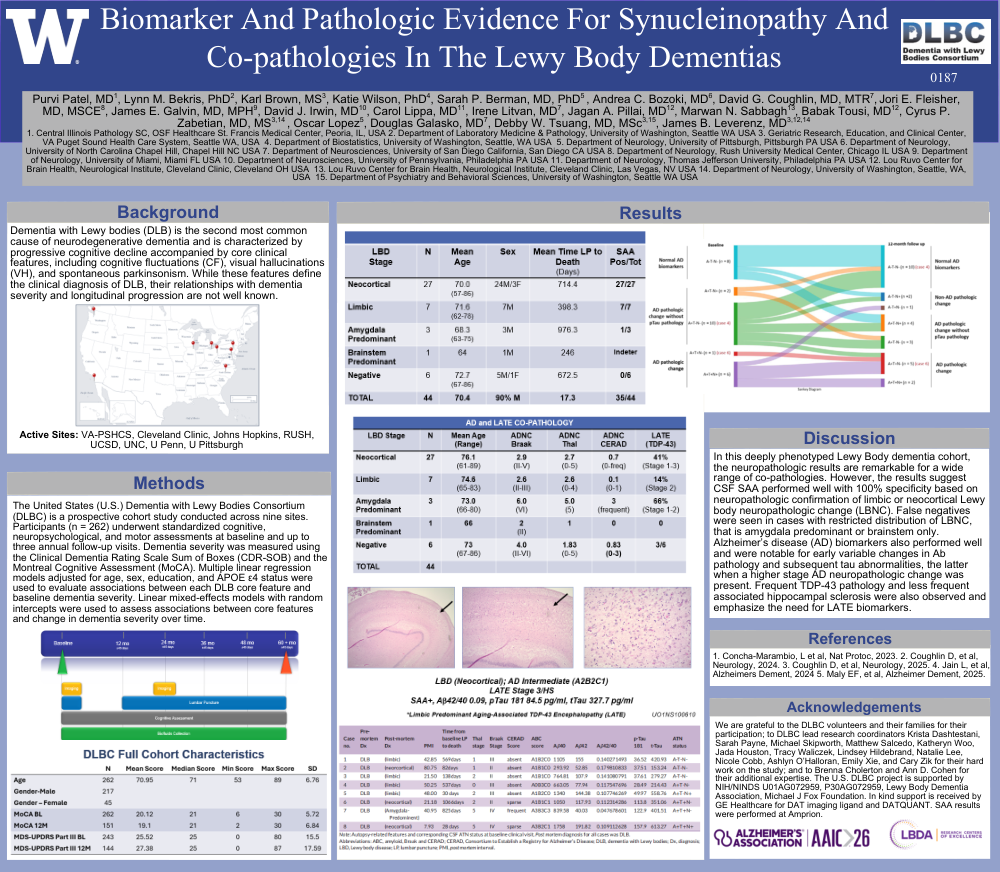
BACKGROUND: Dementia with Lewy bodies (DLB) is the second most common cause of neurodegenerative dementia and is characterized by progressive cognitive decline accompanied by core clinical features, including cognitive fluctuations (CF), visual hallucinations (VH), and spontaneous parkinsonism. While these features define the clinical diagnosis of DLB, their relationships with dementia severity and longitudinal progression are not well known.
Methods: The United States (U.S.) Dementia with Lewy Bodies Consortium (DLBC) is a prospective cohort study conducted across nine sites. Participants (n = 262) underwent standardized cognitive, neuropsychological, and motor assessments at baseline and up to three annual follow-up visits. Dementia severity was measured using the Clinical Dementia Rating Scale Sum of Boxes (CDR-SOB) and the Montreal Cognitive Assessment (MoCA).
DISCUSSION: In this deeply phenotyped Lewy Body dementia cohort, the neuropathologic results are remarkable for a wide range of co-pathologies. However, the results suggest CSF SAA performed well with 100% specificity based on neuropathologic confirmation of limbic or neocortical Lewy body neuropathologic change (LBNC). False negatives were seen in cases with restricted distribution of LBNC, that is amygdala predominant or brainstem only. Alzheimer’s disease (AD) biomarkers also performed well and were notable for early variable changes in Ab pathology and subsequent tau abnormalities, the latter when a higher stage AD neuropathologic change was present. Frequent TDP-43 pathology and less frequent associated hippocampal sclerosis were also observed and emphasize the need for LATE biomarkers.
Comments
Email is required but is not shown publicly.
Loading comments...