4,068 posters, 219 videos, 101 topics, 69 sessions, 14,365 authors, 6,128 institutions
ePostersLive by SciGen Technologies S.A. All rights reserved.
Alzheimer's Association International Conference 2026
July 12-15, 2026 | London, United Kingdom, and Online

5290
Targeting Neuroinflammation Relevant To Alzheimer’S Disease Using Phyllanthus Rotundifolius Leaves-derived Zinc Oxide Nanoparticles
Poster Presenter
Authors
Part of Topic
Targeting Neuroinflammation Relevant to Alzheimer’s Disease Using Phyllanthus rotundifolius-Derived Zinc Oxide Nanoparticles
Ikeru, Peace Nkiruka, Ifeoma Felicia Chukwuma, Victor Onukwube Apeh, Timothy Prince Chidike Ezeorba and Victor Nwadiogbu Ogugua
1Department of Biochemistry, Faculty of Biological Sciences, University of Nigeria, Enugu State, 410001, Nigeria:
2Department of Genetics and Biotechnology, Faculty of Biological Sciences, University of Nigeria, Enugu State, 410001, Nigeria.
3Federal University of Allied Health Sciences, Department of Applied Sciences, Enugu State, 01473, Nigeria.
Correspondence
Ifeoma Felicia Chukwuma, University of Nigeria, Nsukka, Nsukka, Enugu, Nigeria.
Email: chukwuma.ifeoma@unn.edu.ng
ABSTRACT
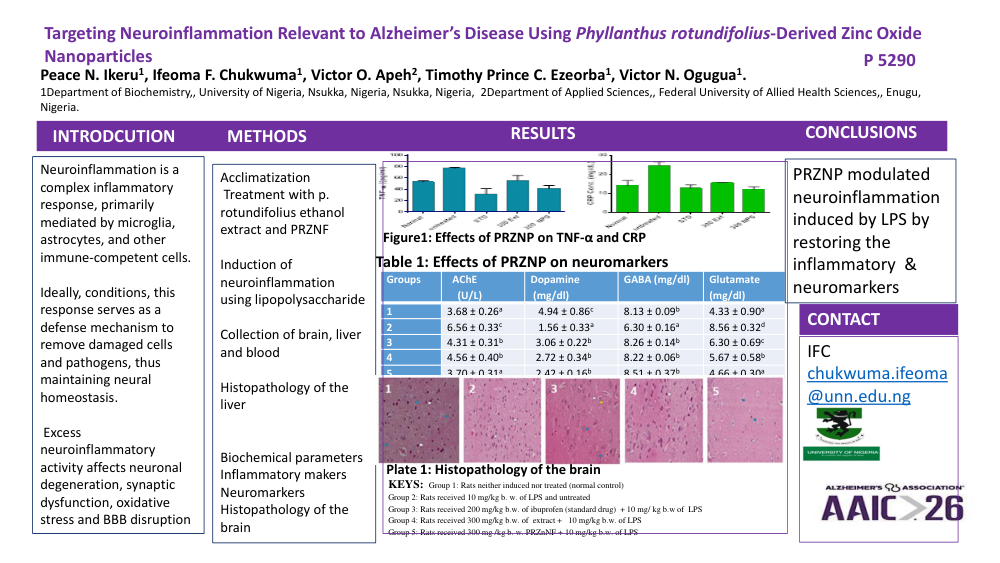
Background: Neuroinflammation is a core pathological mechanism in Alzheimer’s disease (AD), characterised by excessive pro-inflammatory cytokine release and sustained microglial activation. Phyllanthus rotundifolius is widely used in ethnomedicine to treat inflammation-related diseases. However, its role in modulating neuroinflammation relevant to AD has not been explored. This study investigated the protective effects of P. rotundifolius leaf extract and its zinc oxide nanoparticles (ZnO-NPs) on lipopolysaccharide (LPS)- induced neuroinflammation.
Methods: The green-synthesised ZnO-NPs were characterised using UV, FTIR, and SEM. Thirty male Wistar rats (140–165 g) were randomised into five groups (n = 6) with group1 serving as the normal control, group 2 (untreated), and groups 3-5 were pretreated with ibuprofen (200 mg/kg b.w.), P. rotundifolius ethanol extract (300 mg/kg b.w.), and ZnO-NPs (300 mg/kg b.w.), respectively, via the oral route for 7 days. On day 8, LPS (10 mg/kg, i.p.) was administered to groups 2-5. The brain tissues of all the rats were exercised 24 hours post-LPS induction to assess inflammatory and neuronal markers. Data were analysed using one-way ANOVA and Tukey’s post hoc test (p < 0.05).
Results: The ZnO-NPs exhibited a strong absorption band between 200 and 350 nm, contained reducing functional groups, and displayed sharp, intense diffraction peaks at 2θ values. LPS induction significantly (p < 0.05) increased levels of TNF-α (77.16 ±1.57 pg/ml), C-reactive protein (24.41 ± 3.03 ng/ml), glutamate (8.56 ± 0.32 mg/dL), and acetylcholine activity (6.56 ± 0.33 mg/dL) and elicited a significant decrease in the levels of dopamine (1.56 ± 0.34 IU/l) and GABA (6.31 ± 0.16 mg/dl), in the LPS model compared to the control group values of 52.95 ± 1.88 pg/mL, 13.91 ± 2.81 ng/mL, 4.33 ± 0.90 mg/dL, 3.68 ± 0.26 mg/dL, 4.95 ± 0.86 IU/l and 8.19 ± 0.09 mg/dL, respectively. The inflammatory, neurochemical changes, and brain histological integrity were preserved in the pretreated groups with ZnO-NPs, having an impact comparable to that of ibuprofen.
Conclusion: The ZnO-NPs was very effective in attenuating neuroinflammation and neurochemical imbalance, supporting its potential relevance for targeting inflammatory mechanisms implicated in AD. However, further studies are required to identify its phytochemicals mediating these effects.
Keywords: Alzheimer’s disease, lipopolysaccharide, Phyllanthus rotundifolius, neuroinflammation and neuroprotection.
Comments
Email is required but is not shown publicly.
Loading comments...