4,068 posters, 219 videos, 101 topics, 69 sessions, 14,365 authors, 6,128 institutions
ePostersLive by SciGen Technologies S.A. All rights reserved.
Alzheimer's Association International Conference 2026
July 12-15, 2026 | London, United Kingdom, and Online

5637
Elevated Temporal Tau Pet Signal Is Associated With Lower Cognitive Performance In Cognitively Unimpaired Older Adults
Poster Presenter
Authors
Kaycee Sink, Karra Harrington, Svenja Wacker, Paul Maruff, Kaycee Sink, A4 Research Group
Affiliations
, Cogstate
Part of Topic
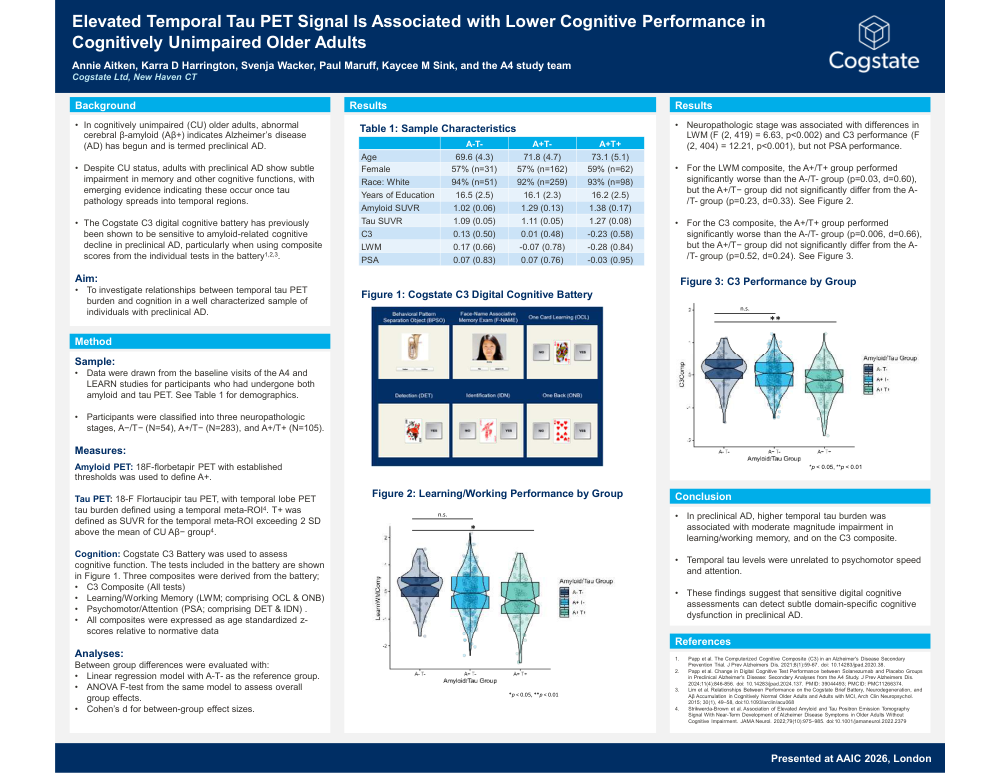
Background: In cognitively unimpaired (CU) older adults, abnormal cerebral β-amyloid (Aβ+) indicates Alzheimer’s disease (AD) has begun and is termed preclinical AD. Despite CU status, adults with preclinical AD show subtle impairment in memory and other cognitive functions, with emerging evidence indicating these occur once tau pathology spreads into temporal regions. In a preclinical AD population, this study investigated relationships between PET tau burden, aggregated across temporal regions of interest (ROIs), and cognition, measured with composite scores from the Computer Cognitive Composite (C3) battery. Methods: CU Participants were drawn from baseline visits of the A4 and LEARN studies. 18F‑florbetapir PET with established thresholds for amyloid positivity was used to define Aβ pathology. Temporal lobe PET tau burden was defined using a temporal meta-ROI (bilateral inferior, middle, and superior temporal cortex, temporal pole, transverse temporal cortex, entorhinal cortex, amygdala, parahippocampal gyrus, and fusiform gyrus), with positivity defined as uptake exceeding 2 SD above the mean of CU Aβ− group. Participants were classified into three neuropathologic groups, A−/T− (N=54), A+/T− (N=283), and A+/T+ (N=105). Cognitive outcomes were assessed using three composites from the C3; the C3 Composite (Cogstate Brief Battery, Face-Name Associative Memory and Behavioral Pattern Separation-Object) and the CBB learning/working memory (LWM) and psychomotor/attention (Psy/Att) composites. Composites were expressed as age-standardized scores using normative data. Group differences were examined using ANOVA with pairwise comparisons and Cohen’s D effect size. Results: Neuropathologic group was associated with differences in LWM and overall C3 performance (F≥6.60, p≤0.004, η2≥.03). The A−/T− group performed significantly better on the LWM composite than the A+/T+ group (p=0.01, d=0.60), but not the A+/T− group (p≥ 0.05, d≤ 0.32). The A−/T− group also performed significantly better on the C3 composite than the A+/T+ group (p=0.004, d=0.66) and the A+/T− group (p=0.02, d=0.45). There were no differences between groups on the Psy/Att composite. Conclusion: In preclinical AD, higher temporal tau burden was associated with moderate magnitude impairment in learning/working memory, and on the C3 composite. Temporal tau levels were unrelated to psychomotor speed and attention. These findings suggest that sensitive computerized cognitive assessments can detect subtle domain-specific cognitive dysfunction in preclinical AD.
Comments
Email is required but is not shown publicly.
Loading comments...