4,068 posters, 219 videos, 101 topics, 69 sessions, 14,365 authors, 6,128 institutions
ePostersLive by SciGen Technologies S.A. All rights reserved.
Alzheimer's Association International Conference 2026
July 12-15, 2026 | London, United Kingdom, and Online

2875
Photobiomodulation Influences Alzheimer’s Disease-Relevant Neurophysiology Beyond Amyloid
Poster Presenter
Part of Topic
Video
Photobiomodulation Influences Alzheimer’s Disease-Relevant Neurophysiology Beyond Amyloid
Background
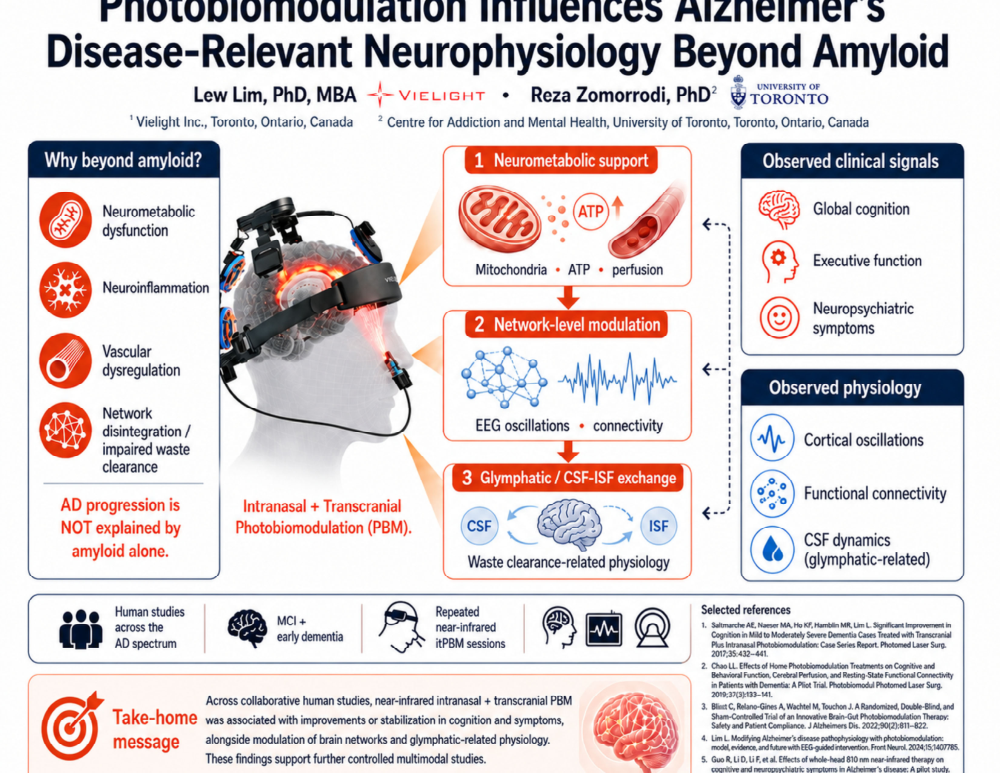
Alzheimer’s disease (AD) progression correlates incompletely with amyloid burden, while converging evidence implicates neurometabolic dysfunction, neuroinflammation, vascular dysregulation, impaired waste clearance, and large-scale network disintegration as key contributors to cognitive decline. Recently, the glymphatic system, which facilitates cerebrospinal fluid-interstitial fluid exchange and metabolic waste clearance, has emerged as a relevant but underexplored factor in AD pathophysiology. Intranasal combined with transcranial photobiomodulation (itPBM) has demonstrated neuromodulatory effects on mitochondrial function, cerebral perfusion, and neural network dynamics, suggesting potential relevance to these non-amyloid mechanisms. Together, these observations provide a rationale for investigating itPBM as a systems-level intervention targeting complementary pathways implicated in AD progression.
Methods
We summarize findings from collaborative human studies investigating near-infrared itPBM in individuals across the Alzheimer’s disease spectrum, including mild cognitive impairment (MCI) and early dementia. Outcomes included standardized cognitive and neuropsychiatric assessments, electroencephalographic (EEG) markers of network function, and fMRI for physiological measures related to cerebrospinal fluid dynamics. Treatment protocols were delivered over repeated sessions and adhered to established safety guidelines.
Results
Across cohorts, itPBM was associated with improvements or stabilization in global cognition, executive function, and neuropsychiatric symptoms. Neurophysiological analyses demonstrated modulation of large-scale brain network activity, including alterations in cortical oscillations power and functional connectivity patterns implicated in cognitive integration and network efficiency. In parallel, collaborative human data indicate that itPBM can influence physiological processes relevant to glymphatic function, consistent with enhanced cerebrospinal fluid-interstitial fluid exchange. These effects were observed without direct targeting of amyloid or tau pathology.
Conclusion
Collectively, these findings support the hypothesis that itPBM may influence Alzheimer’s disease-relevant neurophysiology through complementary pathways beyond amyloid, including neurometabolic support, network-level modulation, and physiological processes associated with waste clearance. While not disease-specific, glymphatic modulation represents a biologically plausible contribution mechanism by which itPBM may support brain function in MCI and early AD. These results warrant further controlled studies integrating multimodal biomarkers to clarify mechanistic links and clinical relevance.
Comments
Email is required but is not shown publicly.
Loading comments...