4,068 posters, 219 videos, 101 topics, 69 sessions, 14,365 authors, 6,128 institutions
ePostersLive by SciGen Technologies S.A. All rights reserved.
Alzheimer's Association International Conference 2026
July 12-15, 2026 | London, United Kingdom, and Online

9602
Evaluation Of Central Tau Pathology Following Intraperitoneal Administration Of P301S-derived Brain Homogenates
Poster Presenter
Part of Topic
Evaluation Of Central Tau Pathology Following Intraperitoneal Administration Of P301S-derived Brain Homogenates
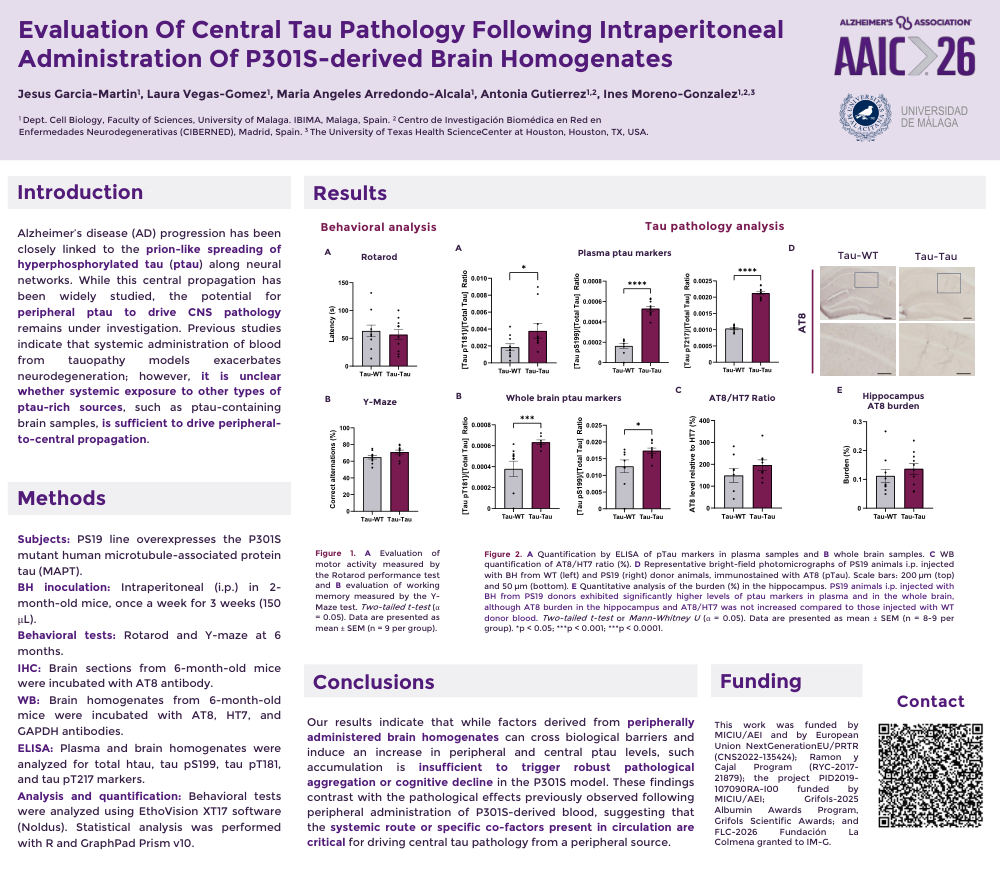
Background: Alzheimer’s disease (AD) progression has been closely linked to the prion-like spreading of hyperphosphorylated tau (ptau) along neural networks. While this central propagation has been widely studied, the potential for peripheral ptau to drive CNS pathology remains under investigation. Previous studies indicate that systemic administration of blood from tauopathy models exacerbates neurodegeneration; however, it is unclear whether systemic exposure to other types of ptau-rich sources, such as ptau-containing brain samples, is sufficient to drive peripheral-to-central propagation.
Methods: We examined the pathogenic potential of peripheral ptau by administering brain homogenates from aged, symptomatic P301S donors to young, pre-symptomatic P301S mice via intraperitoneal injection. Animals injected with wild-type brain homogenates served as controls. This approach allowed us to assess systemic dissemination without direct intracerebral inoculation. Ptau levels in plasma and brain homogenates were evaluated using ELISA. Additionally, Western blot and immunohistochemistry assays, alongside behavioral testing, were performed to determine whether the injected material is capable of seeding pathology and accelerate cognitive impairment.
Results: Biochemical quantification confirmed elevated levels of ptau markers in both plasma and brain homogenates of treated mice. However, no significant induction of pathological aggregates in the CNS compared to controls was observed. Consistent with these results, treated mice did not exhibit deficits in behavioral tests.
Conclusions: Our results indicate that while factors derived from peripherally administered brain homogenates can cross biological barriers and induce an increase in peripheral and central ptau levels, such accumulation is insufficient to trigger robust pathological aggregation or cognitive decline in the P301S model. These findings contrast with the pathological effects previously observed following peripheral administration of P301S-derived blood, suggesting that the systemic route or specific co-factors present in circulation are critical for driving central tau pathology from a peripheral source.
Comments
Email is required but is not shown publicly.
Loading comments...