4,068 posters, 219 videos, 101 topics, 69 sessions, 14,365 authors, 6,128 institutions
ePostersLive by SciGen Technologies S.A. All rights reserved.
Alzheimer's Association International Conference 2026
July 12-15, 2026 | London, United Kingdom, and Online

2671
Multi-class Detection And Quantification Of Neuropathological Features Using Yolov11 Deep Learning Architecture
Poster Presenter
Part of Topic
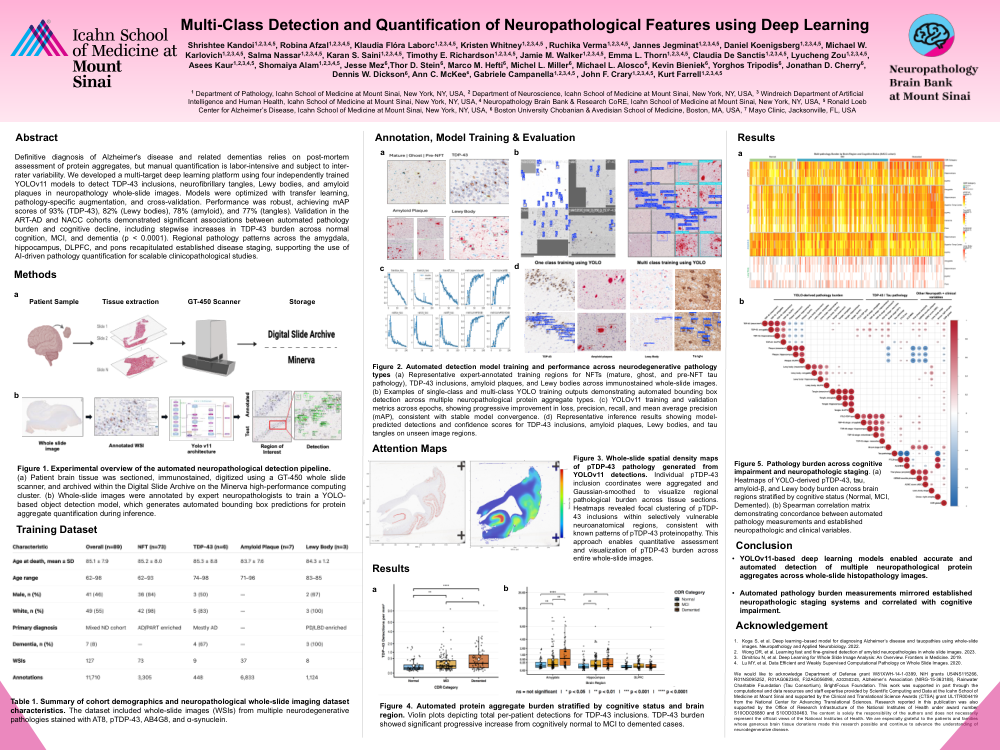
Background: Definitive diagnosis of Alzheimer's disease and related dementias requires post-mortem examination including characterization of various protein aggregates by immunohistochemistry. Manual quantification is labor-intensive, requires specialized expertise, and is subjective because of substantial inter-rater variability, limiting reproducibility and constraining large-scale clinicopathological studies. While deep learning on digital whole slide images offers promise for automated pathology quantification, existing approaches often lack the neuropathology-specific optimization and clinical validation needed for translation. To address this gap, we developed and validated a comprehensive proteinopathy detection platform that enables objective, reproducible quantification of protein aggregates at scale.
Methods: We developed four specialized YOLOv11-based object detectors, each fine-tuned independently for TDP-43 inclusions, tau-positive neurofibrillary tangles, Lewy bodies, and beta-amyloid plaques. Training datasets comprised 73 whole slide images (WSIs) across 73 patients for tangles (~3k labeled features), 9 WSIs from 6 patients for TDP-43 (~0.45k), 37 WSIs from 7 patients for amyloid plaques (~6.8k), and 4 WSIs from 3 patients for Lewy bodies (~1.1k). We employed transfer learning from pre-trained weights with pathology-specific data augmentation. Models were trained using k-fold cross-validation (k=5) to ensure robust performance and minimize overfitting. Final model performance was evaluated using precision, recall, F1-score, and mean average precision (mAP). Clinical validation was performed on the ART-AD cohort to correlate automated quantification with cognitive status.
Results: The classifiers achieved mAP scores of 93% (TDP-43), 77% (tangles), 82% (Lewy bodies), and 78% (amyloid), demonstrating robust performance across tissue preparations and staining intensities. NACC cohort validation revealed significant associations between automated pathology burden and cognitive decline across multiple protein aggregates. TDP-43 detections showed progressive increase from cognitively normal to mild cognitive impairment to dementia (p < 0.0001), with regional vulnerability patterns confirming that automated quantification captures clinically meaningful disease biology.
Conclusion: Our suite of four YOLOv11-based object detectors provides accurate, scalable detection of key protein aggregates in neurodegenerative diseases. This modular approach enables flexible, pathology-specific assessment, with potential applications in standardizing neuropathological evaluation and accelerating large-scale quantification of abnormal protein aggregates. Future work includes implementing an automated semi-supervised annotation expansion tool to systematically augment training data, which will improve model performance on rare pathological variants and enhance generalizability across diverse tissue preparations and staining protocols, ultimately establishing a robust framework for precision neuropathology in dementia research.
Comments
Email is required but is not shown publicly.
Loading comments...