4,068 posters, 219 videos, 101 topics, 69 sessions, 14,365 authors, 6,128 institutions
ePostersLive by SciGen Technologies S.A. All rights reserved.
Alzheimer's Association International Conference 2026
July 12-15, 2026 | London, United Kingdom, and Online

1727
Pathogen-driven Alzheimer's Disease? High-resolution Microbial Profiling Of Postmortem AD Brain Tissue
Poster Presenter
Authors
Arnav Bhattacharya, Claire Shepherd, Fatima El-Assaad, Karen Mather
Affiliations
Centre for Healthy Brain Ageing (CHeBA), Discipline of Psychiatry and Mental Health, School of Clinical Medicine, Faculty of Medicine and Health, UNSW Sydney, Neuroscience Research Australia (NeuRA), School of Biomedical Sciences, Faculty of Medicine and Health, UNSW Sydney, Microbiome Research Centre, School of Clinical Medicine, UNSW Medicine and Health, St George and Sutherland Clinical Campuses, UNSW Sydney
Part of Topic
Background
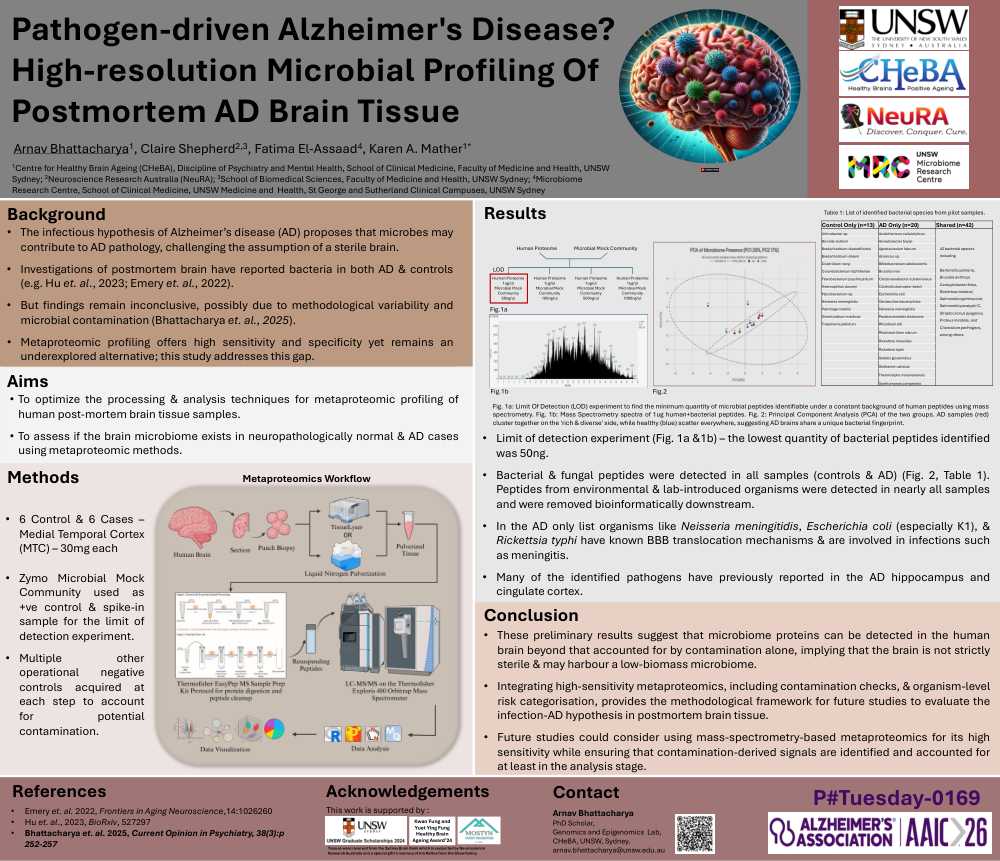
The infectious hypothesis of Alzheimer’s disease (AD) proposes that microbial pathogens may contribute to neuroinflammation and AD pathology, challenging the assumption of a sterile brain. Recent investigations of low-biomass postmortem brain tissues using 16S rRNA sequencing, qPCR, and metagenomics have reported bacterial signals in both AD and controls (e.g. Hu et. al., 2023; Emery et. al., 2022). However, findings remain inconsistent due to methodological variability and unresolved concerns about contamination. To date, high-sensitivity metaproteomic profiling has not been applied to this question, and this study aims to fill this critical gap.
Methods
Pathologically confirmed brain regions with variable neuropathological changes were profiled using high-sensitivity metaproteomics, supported by spike-in standards and limit-of-detection experiments to quantify assay sensitivity in low-biomass tissue. Standardised bioinformatic pipelines were used. Detected taxa were triaged using a categorical framework (known CNS pathogens; contaminants, beneficial/probiotic organisms; not-yet-categorised candidates) based on prior reports in the literature, enabling separation of relevant taxa from the background contamination signal.
Results
Bacterial and fungal proteins were detectable in all samples. As expected, signals were dominated by environmental and laboratory-introduced organisms (e.g. multiple Staphylococcus sp., Klebsiella sp., Salmonella sp., Bartonella sp.). At the same time, a smaller fraction comprised known neurotropic pathogens and candidate dementia-associated taxa, including meningitis agents, spirochetes, and biofilm-forming species (e.g. Treponema pallidum, Neisseria meningitidis, Haemophilus influenzae, Cryptococcus neoformans, multiple Rickettsia sp.). Importantly, many of these pathogens have been previously reported in the AD hippocampus and cingulate cortex.
Conclusions
These results suggest that microbiome proteins can be detected in the human brain, implying that the brain is not strictly sterile and may harbour a low-biomass microbiome. Integrating high-sensitivity metaproteomics, including contamination checks, and organism-level risk categorisation, provides the methodological framework for future studies to evaluate the infection-AD hypothesis in low-biomass postmortem brain tissue. Measures should be put in place to prioritise the identification of CNS-tropic and AD-linked organisms while ensuring that contamination-derived signals are identified and controlled for wherever possible.
References
Emery et. al. 2022, Frontiers in Aging Neuroscience,14:1026260
Hu et. al., 2023, BioRxiv, 527297
Comments
Email is required but is not shown publicly.
Loading comments...