4,068 posters, 219 videos, 101 topics, 69 sessions, 14,365 authors, 6,128 institutions
ePostersLive by SciGen Technologies S.A. All rights reserved.
Alzheimer's Association International Conference 2026
July 12-15, 2026 | London, United Kingdom, and Online

6750
Evaluating The Impact Of Early-life Seizures On Alzheimer’S Disease Progression In A 5xfad Mouse Model
Part of Topic
Title
Evaluating the Impact of Early-life Seizures on Alzheimer's Disease Progression in a 5xFAD Mouse Model
Authors
Nastaran Samimi¹², Matt Hudson¹, Nigel C. Jones¹²³
¹ Department of Neuroscience, School of Translational Medicine, Monash University, Melbourne, Australia
² Department of Neurology, Alfred Health, Australia
³ Department of Medicine (The Royal Melbourne Hospital), Melbourne Brain Centre, The University of Melbourne, Australia
Background
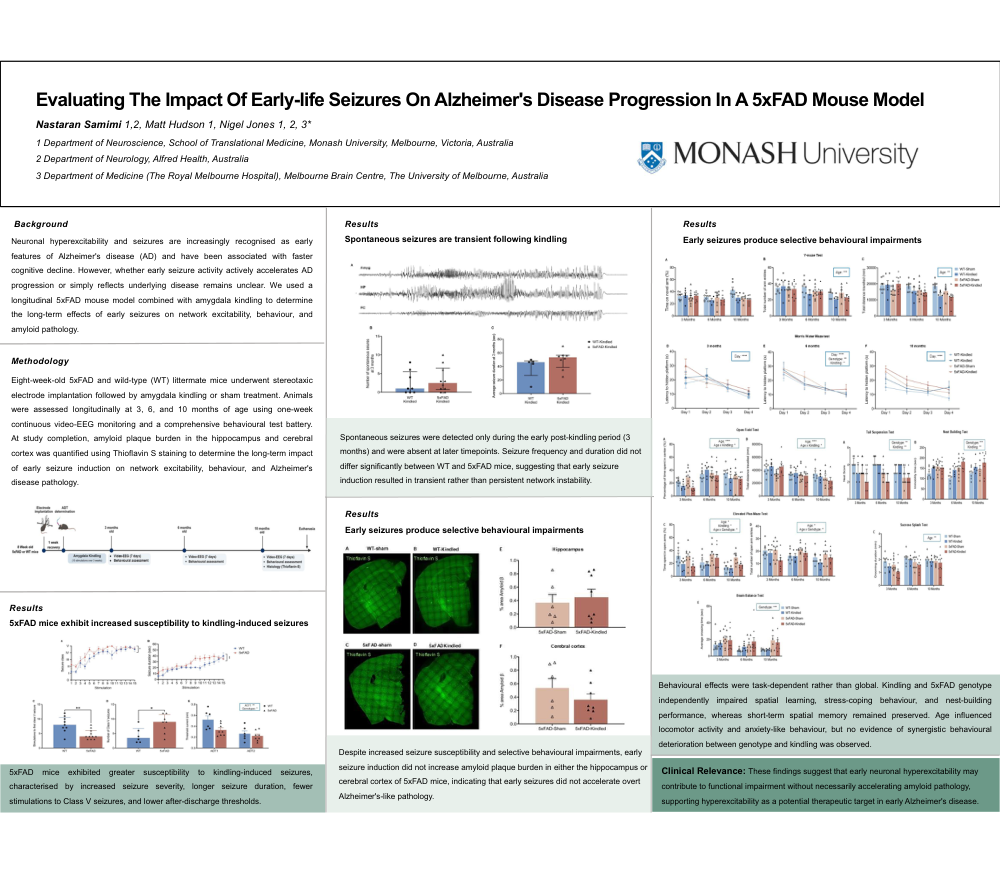
Neuronal hyperexcitability and seizures are increasingly recognised as early features of Alzheimer's disease (AD) and have been associated with faster cognitive decline. However, whether early seizure activity actively accelerates AD progression or simply reflects underlying disease remains unclear. We used a longitudinal 5xFAD mouse model combined with amygdala kindling to determine the long-term effects of early seizures on network excitability, behaviour, and amyloid pathology.
Methods
Eight-week-old 5xFAD and wild-type (WT) littermate mice underwent stereotaxic electrode implantation followed by amygdala kindling or sham treatment. Animals were assessed longitudinally at 3, 6, and 10 months of age using video-EEG monitoring and behavioural testing. Amyloid plaque burden was quantified using Thioflavin S staining.
Results
- 5xFAD mice exhibited greater susceptibility to kindling-induced seizures than WT mice.
- Spontaneous seizures occurred only during the early post-kindling period.
- Early seizures produced selective behavioural impairments without widespread cognitive decline.
- Kindling did not increase amyloid plaque burden in the hippocampus or cortex.
Conclusions
Early seizure induction increased network hyperexcitability and selectively affected behaviour without accelerating Alzheimer's-like pathology. These findings suggest that early network dysfunction may contribute to functional impairment independently of amyloid plaque progression.
Comments
Email is required but is not shown publicly.
Loading comments...