4,068 posters, 219 videos, 101 topics, 69 sessions, 14,365 authors, 6,128 institutions
ePostersLive by SciGen Technologies S.A. All rights reserved.
Alzheimer's Association International Conference 2026
July 12-15, 2026 | London, United Kingdom, and Online

1767
Sex-specific Effects Of Apoe e4 On The Clinical Impact Of Regional Tau Pathology In Alzheimer’s Disease.
Poster Presenter
Part of Topic
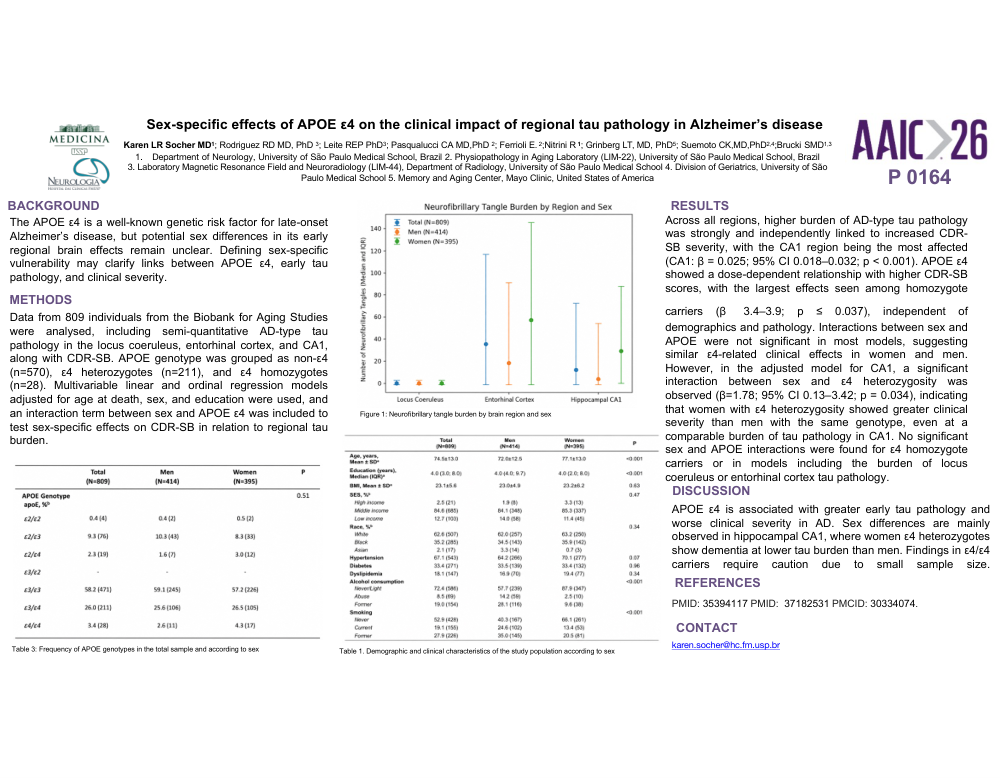
BACKGROUND:The APOE ε4 is a well-known genetic risk factor for late-onset Alzheimer’s disease, but potential sex differences in its early regional brain effects remain unclear. Defining sex-specific vulnerability may clarify links between APOE ε4, early tau pathology, and clinical severity.
METHODS:Data from 809 individuals from the Biobank for Aging Studies were analysed, including semi-quantitative AD-type tau pathology in the locus coeruleus, entorhinal cortex, and CA1, along with CDR-SB. APOE genotype was grouped as non-ε4 (n=570), ε4 heterozygotes (n=211), and ε4 homozygotes (n=28). Multivariable linear and ordinal regression models adjusted for age at death, sex, and education were used, and an interaction term between sex and APOE ε4 was included to test sex-specific effects on CDR-SB in relation to regional tau burden.
RESULTS:Across all regions, higher burden of AD-type tau pathology was strongly and independently linked to increased CDR-SB severity, with the CA1 region being the most affected (CA1: β = 0.025; 95% CI 0.018–0.032; p < 0.001). APOE ε4 showed a dose-dependent relationship with higher CDR-SB scores, with the largest effects seen among homozygote carriers (β 3.4–3.9; p ≤ 0.037), independent of demographics and pathology. Interactions between sex and APOE were not significant in most models, suggesting similar ε4-related clinical effects in women and men. However, in the adjusted model for CA1, a significant interaction between sex and ε4 heterozygosity was observed (β=1.78; 95% CI 0.13–3.42; p = 0.034), indicating that women with ε4 heterozygosity showed greater clinical severity than men with the same genotype, even at a comparable burden of tau pathology in CA1. No significant sex and APOE interactions were found for ε4 homozygote carriers or in models including the burden of locus coeruleus or entorhinal cortex tau pathology.
DISCUSSION: APOE ε4 is associated with greater early tau pathology and worse clinical severity in AD. Sex differences are mainly observed in hippocampal CA1, where women ε4 heterozygotes show dementia at lower tau burden than men. Findings in ε4/ε4 carriers require caution due to small sample size.
Comments
Email is required but is not shown publicly.
Loading comments...