Loading...

4,068 posters, 219 videos, 101 topics, 69 sessions, 14,365 authors, 6,128 institutions

ePostersLive by SciGen Technologies S.A. All rights reserved.

Alzheimer's Association International Conference 2026

July 12-15, 2026 | London, United Kingdom, and Online

Alzheimer's Association International Conference 2026 banner

3789

Relationship Of HbA1c With Biomarkers Of Alzheimer’s Disease
Poster Presenter

Sierra Alban

Part of Topic

•Increased risk of Alzheimer’s disease (AD) has been linked to metabolic comorbidities, including type 2 diabetes (T2DM).
•This relationship is primarily mediated by metabolic or vascular factors, rather than neuropathological changes. T
•The relationship between hemoglobin A1c (HbA1c) as a marker for T2DM and biomarkers of AD is not well understood.
•We hypothesize that subjects with higher HbA1c will have increased amyloid-β and tau burden and increased white matter hyperintensities (WMH) as a marker for cerebrovascular disease.
•Data were obtained from ADNI.
•Observational cohort of 1,266 participants.
•Subjects included in this study included cognitively unimpaired, mild cognitive impairment, and Alzheimer’s dementia,
•Subjects were further categorized by baseline HbA1c as non-diabetic (<5.7%), pre-diabetic (5.7-6.4%), or diabetic (≥6.5%).
•Outcomes included plasma amyloid-β (Aβ42, Aβ40, and Aβ42/40 ratio) and phosphorylated tau biomarkers (p-tau) across multiple assay platforms, amyloid and tau PET measures, cerebral white matter and meta-temporal volumetric measures, and WMH volume.
•Associations were evaluated using multivariable linear regression adjusted for follow-up time and demographic and clinical covariates.

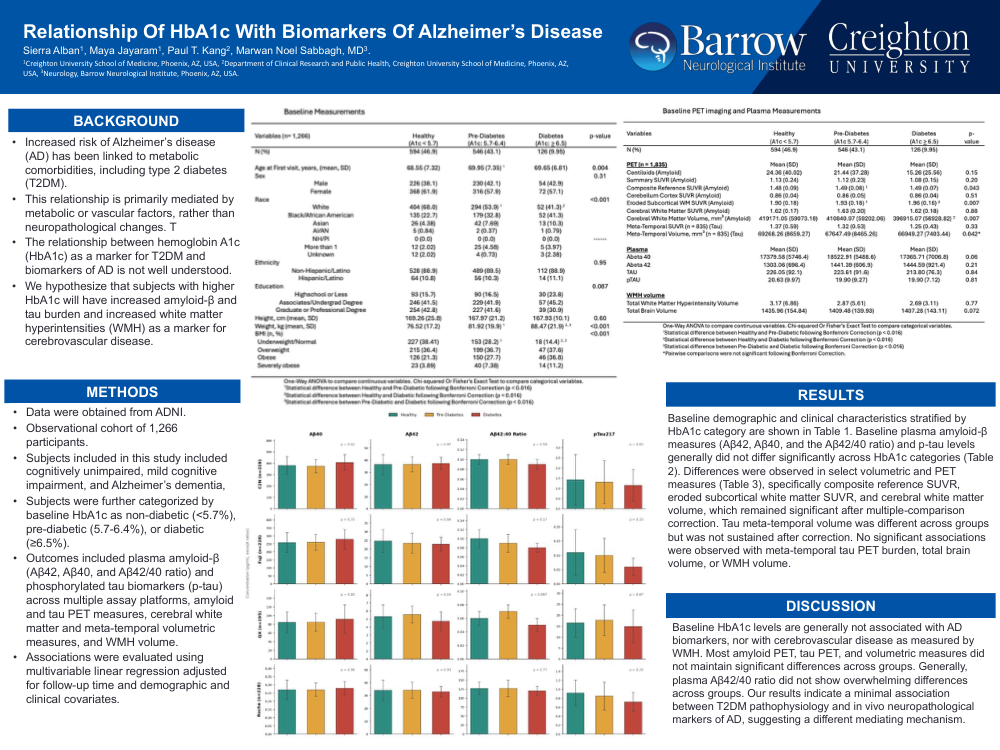
Baseline demographic and clinical characteristics stratified by HbA1c category are shown in Table 1. Baseline plasma amyloid-β measures (Aβ42, Aβ40, and the Aβ42/40 ratio) and p-tau levels generally did not differ significantly across HbA1c categories (Table 2). Differences were observed in select volumetric and PET measures (Table 3), specifically composite reference SUVR, eroded subcortical white matter SUVR, and cerebral white matter volume, which remained significant after multiple-comparison correction. Tau meta-temporal volume was different across groups but was not sustained after correction. No significant associations were observed with meta-temporal tau PET burden, total brain volume, or WMH volume.

Baseline HbA1c levels are generally not associated with AD biomarkers, nor with cerebrovascular disease as measured by WMH. Most amyloid PET, tau PET, and volumetric measures did not maintain significant differences across groups. Generally, plasma Aβ42/40 ratio did not show overwhelming differences across groups. Our results indicate a minimal association between T2DM pathophysiology and in vivo neuropathological markers of AD, suggesting a different mediating mechanism.


Comments

Email is required but is not shown publicly.

Loading comments...

aaic2026 banner
Copyright © 2015-2026, ePostersLive® SciGen is a registered trademark of SciGen Technologies S.A. Patent pending.

This website and third-party tools we use rely on cookies for the best user experience. By selecting "I agree", you agree to cookie usage as described in our Privacy Policy.