4,068 posters, 219 videos, 101 topics, 69 sessions, 14,365 authors, 6,128 institutions
ePostersLive by SciGen Technologies S.A. All rights reserved.
Alzheimer's Association International Conference 2026
July 12-15, 2026 | London, United Kingdom, and Online

2732
Targeting Alzheimer’s Disease Microglia With A Radioisotope Linked To The V-domain of RAGE
Poster Presenter
Authors
Affiliations
Part of Topic
Video
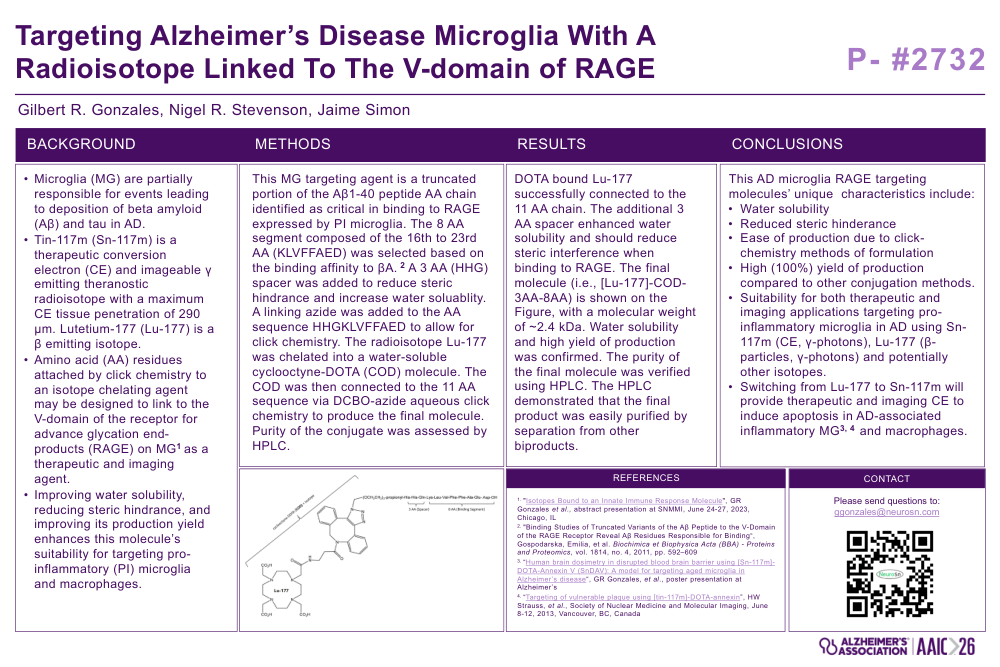
Targeting Alzheimer’s Disease Microglia With A Radioisotope Linked To The V-domain Of RAGE
Author Block: Gilbert R. Gonzales, Nigel R. Stevenson, Jaime Simon.
Abstract:
Background: Subsets of reactive microglia are at least partially responsible for events leading to deposition of amyloid beta (Aβ) and tau in AD. Sn-117m is a conversion electron (CE) emitting theranostic radioisotope with a maximum tissue penetration of 290 µm thereby limiting its therapeutic effect to targeted sites. Imageable gamma photons are emitted by Sn-117m and Lu-177. Amino acid (AA) residues were previously described attached to a Sn-117m and to a Lu-177 chelating agent designed to link to the V-domain of the RAGE receptor on microglia (SNMMI abstract - 2023), in order to induce apoptosis in AD-associated inflammatory microglia.
Methods: The targeting agent centers on a truncated portion of the Aβ peptide AA chain identified as critical in binding to RAGE receptors expressed by pro-inflammatory microglia. The 8 AA segment between the 16th and 23rd AA (KLVFFAED) was selected based on the binding affinity, with a spacer of 3 additional AA (HHG) to reduce steric hindrance. A linking azide was added resulting in the water-soluble AA sequence HHGKLVFFAED. The radioisotope Lu-177 was chelated into a water-soluble cyclooctyne-DOTA (COD) molecule. The COD was then connected to the AA sequence via DCBO-Azide aqueous click chemistry to produce the final molecule. The high yield and purity of the final molecule was verified using HPLC.
Results: DOTA bound Lu-177 successfully connected to the targeting AA chain. An additional 3 AA spacer enhanced water solubility and should reduce steric interference when binding to RAGE. The final molecule (i.e., [Lu-177]-COD-3AA-8AA) is shown on the Figure, with a molecular weight of ~2.4 kDa. Purity of the conjugate was assessed by HPLC which demonstrated that they were easily separable from other biproducts and were conjugated in high yields. Switching to Sn-117m from Lu-177 will provide therapeutic CE.
Conclusion: This AD microglia RAGE targeting molecules’ characteristics includes (1) water solubility, (2) reduced steric hinderance, and (3) ease and high yield of production due to click-chemistry methods of formulation. This molecule is well suited for both therapeutic and imaging applications targeting pro-inflammatory microglia in Alzheimer’s disease, using Sn-117m (conversion electrons, γ-photons) and Lu-177 (β-particles, γ-photons)
Comments
Email is required but is not shown publicly.
Loading comments...