4,068 posters, 219 videos, 101 topics, 69 sessions, 14,365 authors, 6,128 institutions
ePostersLive by SciGen Technologies S.A. All rights reserved.
Alzheimer's Association International Conference 2026
July 12-15, 2026 | London, United Kingdom, and Online

2420
Gene-by-diet Effects In A Novel, Humanized Late-onset Alzheimer’s Disease Mouse Model Expressing ApoEe4, Amyloid-beta, And Tau.
Poster Presenter
Authors
Kevin P. Kotredes, Ravi S. Pandey, Sean-Paul G. Williams, Mike Sasner, Adrian L. Oblak, Stacey J. Sukoff-Rizzo, Gregory W. Carter, Nicholas T. Seyfried, Paul R. Territo, Gareth R. Howell, Bruce T. Lamb
Affiliations
Emory University, The Jackson Laboratory, The University of Pittsburgh School of Medicine, Stark Neurosciences Research Institute
Part of Topic
Background
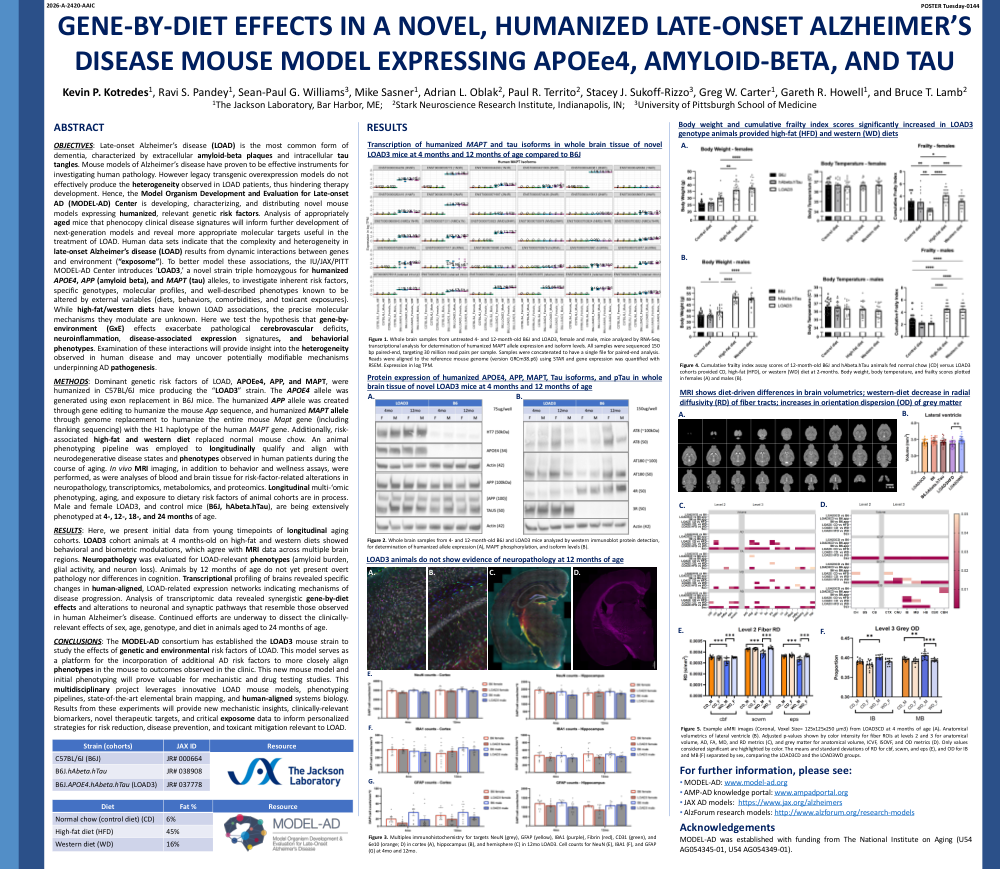
Late-onset Alzheimer’s disease (LOAD) is the most common form of dementia, characterized by extracellular amyloid-beta plaques and intracellular tau tangles. Mouse models of Alzheimer’s disease have proven to be effective instruments for investigating human pathology. However legacy transgenic overexpression models do not effectively produce the heterogeneity observed in LOAD patients, thus hindering therapy development. Hence, the Model Organism Development and Evaluation for Late-onset AD (MODEL-AD) Center is developing, characterizing, and distributing novel mouse models expressing humanized, relevant genetic risk factors. Analysis of appropriately aged mice that phenocopy clinical disease signatures will inform further development of next-generation models and reveal more appropriate molecular targets useful in the treatment of LOAD.
Methods
Dominant genetic risk factors of LOAD, APOE4, APP, and MAPT, were humanized in C57BL/6J mice producing the “LOAD3” strain. Additionally, risk-associated high-fat and western diet replaced normal mouse chow. An animal phenotyping pipeline was employed to longitudinally qualify and align with neurodegenerative disease states and phenotypes observed in human patients during the course of aging. In vivo MRI imaging, in addition to behavior and wellness assays, were performed, as were analyses of blood and brain tissue for risk-factor-related alterations in neuropathology, transcriptomics, metabolomics, and proteomics.
Results
LOAD3 cohort animals at 4 months-old on high-fat and western diets showed behavioral and biometric modulations, which agree with MRI data across multiple brain regions. Animals by 12 months of age do not yet present overt pathology nor differences in cognition. Analysis of transcriptomic data revealed synergistic gene-by-diet effects and alterations to neuronal and synaptic pathways that resemble those observed in human Alzheimer’s disease. Continued efforts are underway to dissect the clinically-relevant effects of sex, age, genotype, and diet in animals aged to 24 months of age.
Conclusion
The MODEL-AD consortium has established the LOAD3 mouse strain to study the effects of genetic and environmental risk factors of LOAD. This model serves as a platform for the incorporation of additional AD risk factors to more closely align phenotypes in the mouse to outcomes observed in the clinic. This new mouse model and initial phenotyping will prove valuable for mechanistic and drug testing studies.
Comments
Email is required but is not shown publicly.
Loading comments...