4,068 posters, 219 videos, 101 topics, 69 sessions, 14,365 authors, 6,128 institutions
ePostersLive by SciGen Technologies S.A. All rights reserved.
Alzheimer's Association International Conference 2026
July 12-15, 2026 | London, United Kingdom, and Online

9813
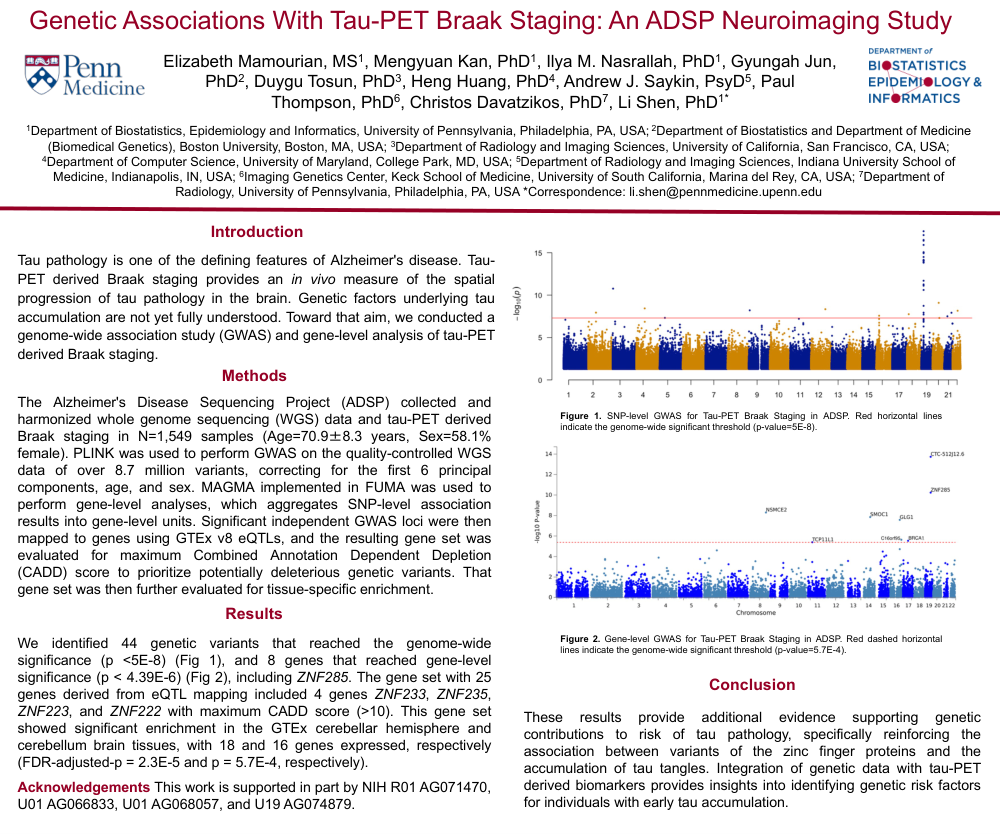
Genetic Associations With Tau-PET Braak Staging: An ADSP Neuroimaging Study
Poster Presenter
Authors
Elizabeth Mamourian, Mengyuan Kai, Ilya Nasrallah, Gyungah Jun, Duygu Tosun, Heng Huang, Andrew Saykin, Paul Thompson, Christos Davatzikos, Li Shen
Affiliations
University of Maryland, University of California, San Francisco, Boston University, University of Pennsylvania, Indiana University, University of South California
Part of Topic
Background: Alzheimer’s disease (AD) shows substantial variability in amyloid depositionpatterns across individuals. Treating individuals solely based on clinical diagnosis (AD, mildcognitive impairment, or cognitively normal) as a single phenotype may dilute genetic signalsand limit discovery of subtype-specific mechanisms. Data-driven subtyping offers biologicallyinformed phenotypes for genetic studies. Subtype and Stage Inference (SuStaIn) is aprogression-based modeling framework that can identify distinct disease subtypes and stagefrom imaging biomarkers. The Alzheimer’s Disease Neuroimaging Initiative (ADNI), withharmonized amyloid imaging and genome-wide genotyping data, provides an ideal dataset toperform GWAS of imaging-derived amyloid subtypes.Methods: Amyloid PET scans were processed using standardized pipelines, and regional amyloidburden was quantified as standardized uptake value ratios (SUVRs) across predefined corticalregions of interest (ROIs). Higher-level regional measures—including subcortical, frontal,cingulate, parietal, temporal, occipital, and sensorimotor cortices—were derived by averagingSUVRs across ROIs within each anatomical region. These high-level regional features were thenused as inputs to event-based SuStaIn modeling, enabling identification of two disease subtypesand probabilistic assignment of each individual based on their posterior subtype and stageprobabilities. Genotyped data from three ADNI phases were downloaded and merged. Qualitycontrol retained variants with call rate >0.98, sample call rate >0.95, HWE p-value>1e-6, andminor allele frequency ≥0.01. Individuals were excluded for sex discordance or up-to-third-degree relatedness. Genotype imputation was performed using the Michigan Imputation Server.Functional annotation was performed using ANNOVAR. GWAS comparing the two imaging-derived subtypes was performed using logistic regression in PLINK2, adjusting for age, sex, andthe first ten principal components. Genetic loci were determined with index variants (p-value<1e-6) and additional nominally associated variants (p-value<1e-4) in linkagedisequilibrium (r2≥0.02) within 250kb using PLINK clump function.Results: 1,072 individuals with genotype data and SuStaIn subtypes available (Subtype-0:N=937; Subtype-1: N=135) and 8,416,387 common autosomal variants were included in GWAS.No variants reached genome-wide significance; however, two genetic loci on chromosome 12and 20 within/near two protein-coding genes showed suggestive significance (p-value<1e-6)(Figure 1).Conclusion: We identified amyloid imaging-derived SuStaIn subtypes independent of diagnosticcategories, and subtype-related genetic variants may support further prediction of ADprogression.
Comments
Email is required but is not shown publicly.
Loading comments...