4,068 posters, 219 videos, 101 topics, 69 sessions, 14,365 authors, 6,128 institutions
ePostersLive by SciGen Technologies S.A. All rights reserved.
Alzheimer's Association International Conference 2026
July 12-15, 2026 | London, United Kingdom, and Online

599
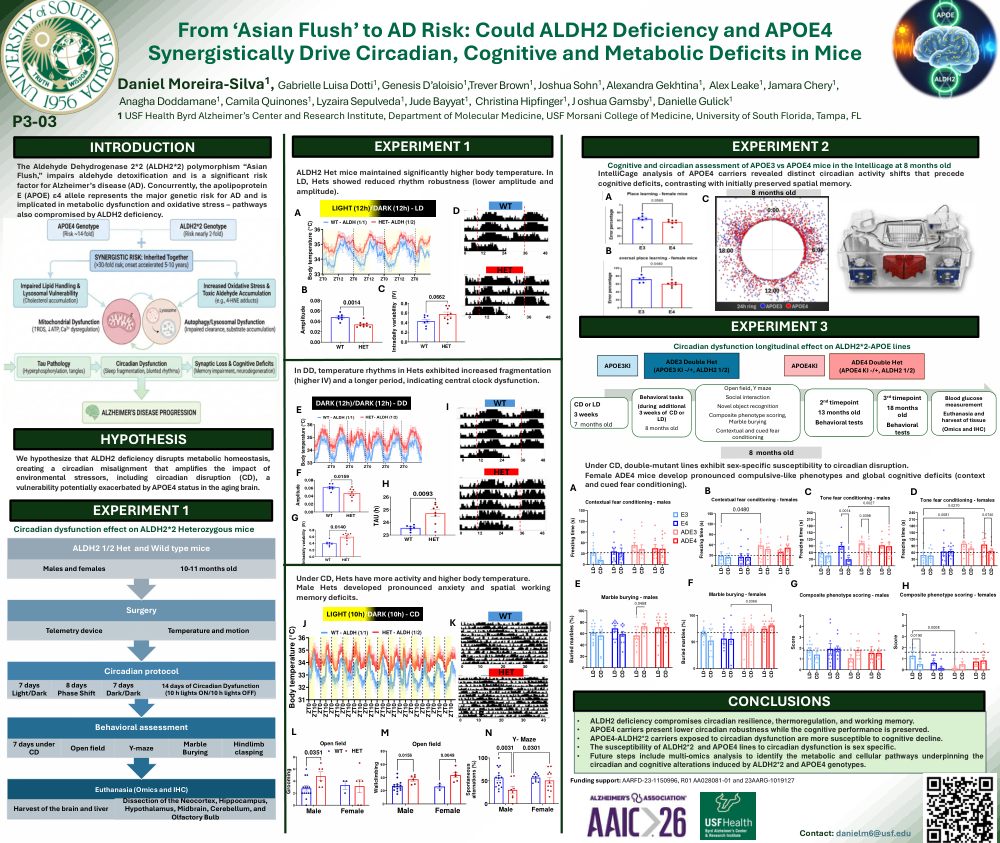
From ‘Asian Flush’ To AD Risk: Could ALDH2 Deficiency And APOE4 Synergistically Drive Circadian, Cognitive And Metabolic Deficits In Mice?
Poster Presenter
Authors
Daniel Moreira-Silva, Gabrielle Luisa Dotti, Genesis D’aloisio, Trever Brown, Joshua Sohn, Alexandra Gekhtina, Alex Leake, Jamara Chery, Anagha Doddamane, Camila Quinones, Lyzaira Sepulveda, Jude Bayyat, Christina Hipfinger, Joshua Gamsby, Danielle Gulick
Affiliations
USF Health Byrd Alzheimer’s Center and Research Institute, Department of Molecular Medicine, USF Morsani College of Medicine, University of South Florida, Tampa, FL, USF Health Byrd Alzheimer’s Center and Research Institute, Department of Molecular Medicine, USF Morsani College of Medicine, University of South Florida, Tampa, FLUSF Health Byrd Alzheimer’s Center and Research Institute, Department of Molecular Medicine, USF Morsani College of Medicine, University of South Florida, Tampa, FL
Part of Topic
The Aldehyde Dehydrogenase 2*2 (ALDH2*2) polymorphism “Asian Flush,” impairs aldehyde detoxification and is a significant risk factor for Alzheimer’s disease (AD). Concurrently, the apolipoprotein E (APOE) ε4 allele represents the major genetic risk for AD and is implicated in metabolic dysfunction and oxidative stress – pathways also compromised by ALDH2 deficiency.
We hypothesize that ALDH2 deficiency disrupts metabolic homeostasis, creating a circadian misalignment that amplifies the impact of environmental stressors, including circadian disruption (CD), a vulnerability potentially exacerbated by APOE4 status in the aging brain.
ALDH2 Het mice maintained significantly higher body temperature. In LD, Hets showed reduced rhythm robustness (lower amplitude and amplitude).
In DD, temperature rhythms in Hets exhibited increased fragmentation (higher IV) and a longer period, indicating central clock dysfunction.
Under CD, Hets have more activity and higher body temperature.
Male Hets developed pronounced anxiety and spatial working memory deficits.
IntelliCage analysis of APOE4 carriers revealed distinct circadian activity shifts that precede cognitive deficits, contrasting with initially preserved spatial memory.
Under CD, double-mutant lines exhibit sex-specific susceptibility to circadian disruption.
Female ADE4 mice develop pronounced compulsive-like phenotypes and global cognitive deficits (context and cued fear conditioning).
•ALDH2 deficiency compromises circadian resilience, thermoregulation, and working memory.
Future steps include multi-omics analysis to identify the metabolic and cellular pathways underpinning the circadian and cognitive alterations induced by ALDH2*2 and APOE4 genotypes
Funding support: AARFD-23-1150996, R01 AA028081-01 and 23AARG-1019127
Contact: danielm6@usf.edu
Comments
Email is required but is not shown publicly.
Loading comments...