4,068 posters, 219 videos, 101 topics, 69 sessions, 14,365 authors, 6,128 institutions
ePostersLive by SciGen Technologies S.A. All rights reserved.
Alzheimer's Association International Conference 2026
July 12-15, 2026 | London, United Kingdom, and Online

788
Adherence-dependent Effects Of A Self-monitoring Activity Programme On Dementia Incidence: A Randomised Controlled Trial
Poster Presenter
Authors
Hiroyuki Shimada, Masanori Morikawa, Takehiko Doi, Osamu Katayama, Sho Nakakubo, Kenji Harada, Sangyoon Lee, Seongryu Bae, Keitaro Makino, Ippei Chiba, Naoto Takayanagi, Yukari Yamashiro, Motoki Sudo, Hidenori Arai
Affiliations
National Center for Geriatrics and Gerontology, Department of Preventive Gerontology, Center for Gerontology and Social Science, Research Institute, National Center for Geriatrics and Gerontology, Research Team of Digital Health, Center for Gerontology and Social Science, Research Institute, National Center for Geriatrics and Gerontology, Department of Research, Obu Center for Dementia Care Research and Practice, Department of Health Sciences, The Graduate School of Dong-A University, Tohoku Medical Megabank Organization, Tohoku University, Tokyo Research Laboratories, Kao Corporation
Part of Topic
Adherence-dependent effects of a self-monitoring activity programme on dementia incidence: A randomised controlled trial
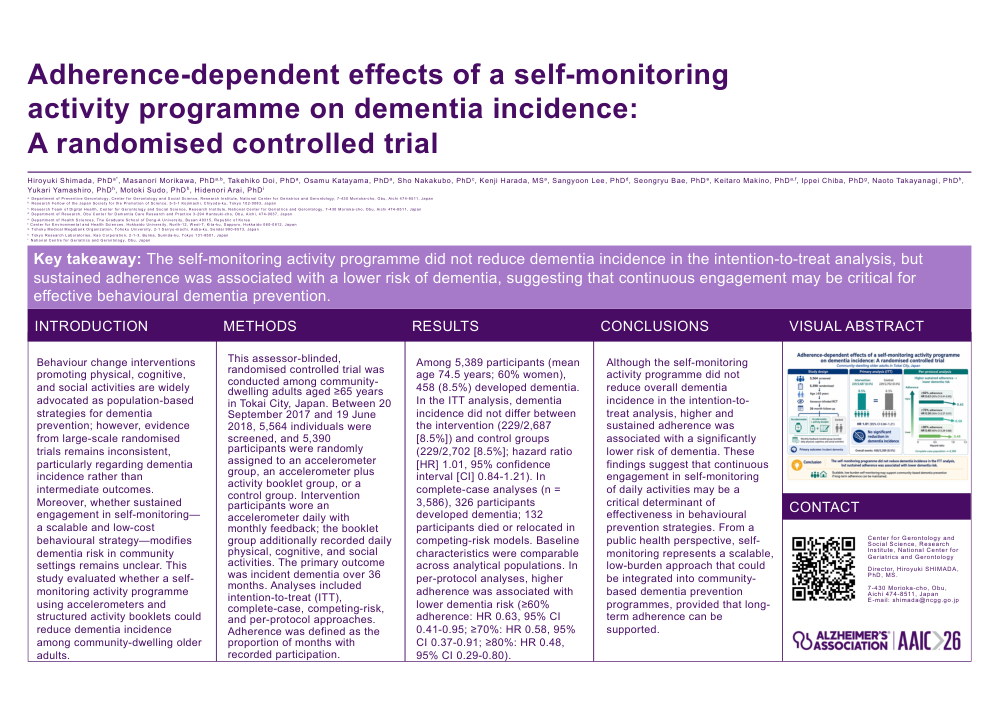
Background: Behaviour change interventions promoting physical, cognitive, and social activities are widely advocated as population-based strategies for dementia prevention; however, evidence from large-scale randomised trials remains inconsistent, particularly regarding dementia incidence rather than intermediate outcomes. Moreover, whether sustained engagement in self-monitoring—a scalable and low-cost behavioural strategy—modifies dementia risk in community settings remains unclear. This study evaluated whether a self-monitoring activity programme using accelerometers and structured activity booklets could reduce dementia incidence among community-dwelling older adults.
Methods: This assessor-blinded, randomised controlled trial was conducted among community-dwelling adults aged ≥65 years in Tokai City, Japan. Between 20 September 2017 and 19 June 2018, 5,564 individuals were screened, and 5,390 participants were randomly assigned to an accelerometer group, an accelerometer plus activity booklet group, or a control group. Intervention participants wore an accelerometer daily with monthly feedback; the booklet group additionally recorded daily physical, cognitive, and social activities. The primary outcome was incident dementia over 36 months. Analyses included intention-to-treat (ITT), complete-case, competing-risk, and per-protocol approaches. Adherence was defined as the proportion of months with recorded participation.
Results: Among 5,389 participants (mean age 74.5 years; 60% women), 458 (8.5%) developed dementia. In the ITT analysis, dementia incidence did not differ between the intervention (229/2,687 [8.5%]) and control groups (229/2,702 [8.5%]; hazard ratio [HR] 1.01, 95% confidence interval [CI] 0.84-1.21). In complete-case analyses (n = 3,586), 326 participants developed dementia; 132 participants died or relocated in competing-risk models. Baseline characteristics were comparable across analytical populations. In per-protocol analyses, higher adherence was associated with lower dementia risk (≥60% adherence: HR 0.63, 95% CI 0.41-0.95; ≥70%: HR 0.58, 95% CI 0.37-0.91; ≥80%: HR 0.48, 95% CI 0.29-0.80).
Conclusion: Although the self-monitoring activity programme did not reduce overall dementia incidence in the intention-to-treat analysis, higher and sustained adherence was associated with a significantly lower risk of dementia. These findings suggest that continuous engagement in self-monitoring of daily activities may be a critical determinant of effectiveness in behavioural prevention strategies. From a public health perspective, self-monitoring represents a scalable, low-burden approach that could be integrated into community-based dementia prevention programmes, provided that long-term adherence can be supported.
Comments
Email is required but is not shown publicly.
Loading comments...