4,068 posters, 219 videos, 101 topics, 69 sessions, 14,365 authors, 6,128 institutions
ePostersLive by SciGen Technologies S.A. All rights reserved.
Alzheimer's Association International Conference 2026
July 12-15, 2026 | London, United Kingdom, and Online

1008
Gene-environment Interactions In Dementia And Alzheimer's Disease: A Systematic Review Of Genome-wide Association Studies
Poster Presenter
Authors
Part of Topic
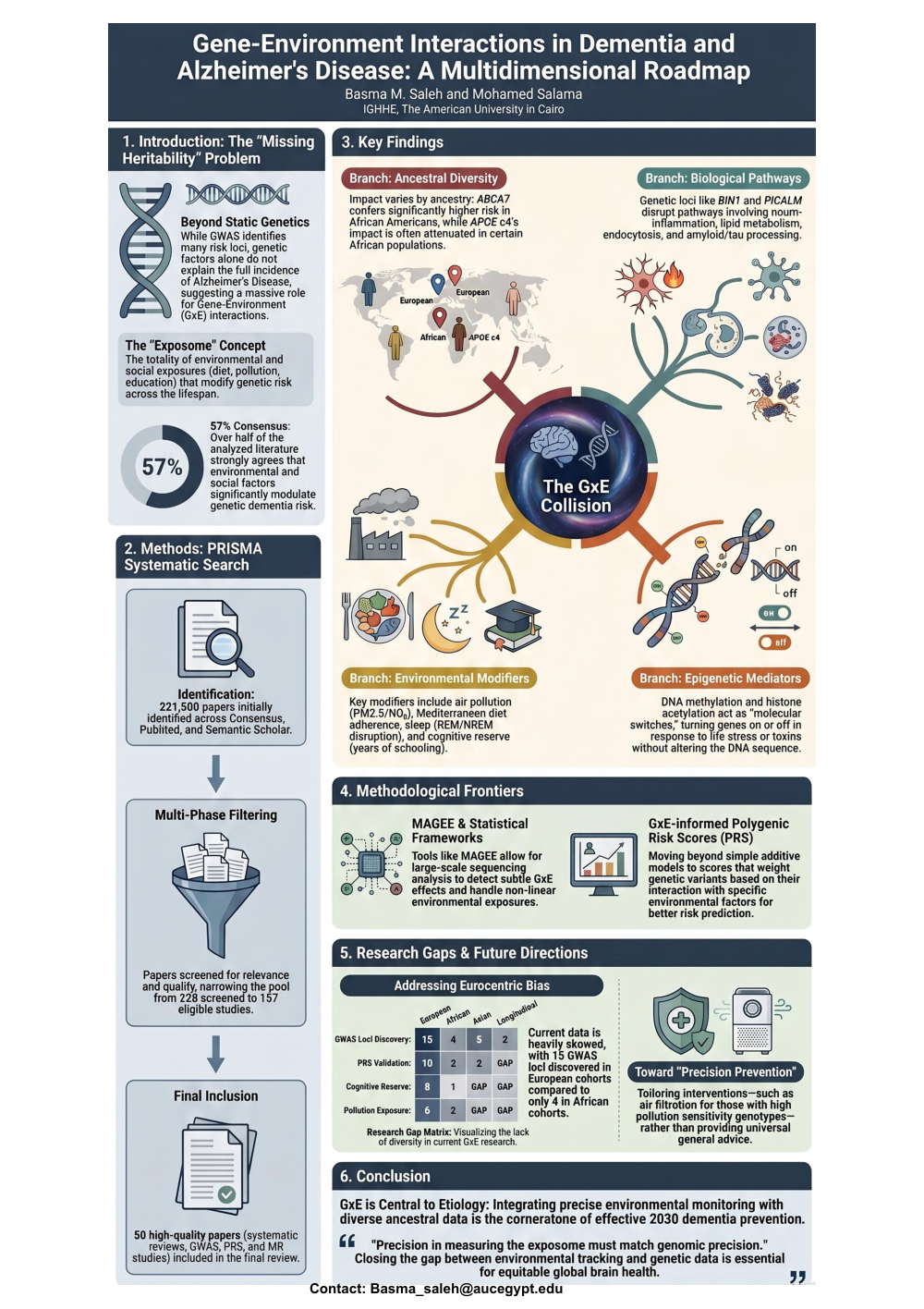
Gene-Environment Interactions in Dementia and Alzheimer's Disease: A Multidimensional Roadmap
Authors: Basma M. Saleh and Mohamed Salama Institution: IGHHE, The American University in Cairo
1. Introduction: The "Missing Heritability" Problem
-
Beyond Static Genetics: GWAS identifies many risk loci, but genetics alone do not explain Alzheimer’s incidence → strong role for Gene-Environment interactions.
-
Exposome Concept: Totality of environmental and social exposures (diet, pollution, education) modifies genetic risk across lifespan.
-
Consensus: 57% of analyzed literature agrees environmental/social factors significantly modulate dementia risk.
2. Methods: PRISMA Systematic Search
-
Identification: 221,500 papers initially screened across Consensus, Publited, Semantic Scholar.
-
Filtering: Narrowed to 228 screened → 157 eligible studies.
-
Final Inclusion: 50 high-quality papers (systematic reviews, GWAS, PRS, MR studies).
3. Key Findings
Ancestral Diversity
-
ABCA7 → higher risk in African Americans.
-
APOE c4 → attenuated impact in some African populations.
Biological Pathways
-
Loci: BIN1, PICALM.
-
Pathways disrupted: neuroinflammation, lipid metabolism, endocytosis, amyloid/tau processing.
Environmental Modifiers
-
Air pollution (PM2.5/NOx).
-
Mediterranean diet adherence.
-
Sleep disruption (REM/NREM).
-
Cognitive reserve (years of schooling).
Epigenetic Mediators
-
DNA methylation & histone acetylation act as molecular switches.
-
Genes turned on/off in response to stress or toxins without DNA sequence change.
4. Methodological Frontiers
-
MAGEE & Statistical Frameworks: Detect subtle GxE effects, handle non-linear exposures.
-
GxE-informed Polygenic Risk Scores (PRS): Move beyond additive models → weight variants by environmental interactions for better prediction.
5. Research Gaps & Future Directions
-
Eurocentric Bias:
-
GWAS loci: 15 in European cohorts vs 4 in African cohorts.
-
PRS validation: 10 European vs 2 African cohorts.
-
-
Toward Precision Prevention:
-
Tailored interventions (e.g., air filtration for pollution-sensitive genotypes).
-
Move beyond universal advice.
-
-
Research Gap Matrix: Visualizes lack of diversity in GxE research.
6. Conclusion
-
Central Role of GxE: Integrating environmental monitoring + diverse ancestral data is cornerstone of dementia prevention by 2030.
-
Precision Needed: “Precision in measuring the exposome must match genomic precision.”
-
Equity Goal: Closing gap between environmental tracking and genetic data is essential for global brain health.
Contact: Basma_saleh@aucegypt.edu
Comments
Email is required but is not shown publicly.
Loading comments...