4,068 posters, 219 videos, 101 topics, 69 sessions, 14,365 authors, 6,128 institutions
ePostersLive by SciGen Technologies S.A. All rights reserved.
Alzheimer's Association International Conference 2026
July 12-15, 2026 | London, United Kingdom, and Online

9361
Real-world Experience Of A Multi-domain Intervention To Lower Dementia Risk In Chiapas, Mexico: Preliminary Results
Poster Presenter
Authors
Juan Francisco Flores-Vázquez, Nancy Lysvet Flores-Vastillo, Evalinda Barrón-Velázquez, Jovan Zahid Guadarrama-Corrugedo, Rosa Maria Salinas-Contreras, Sury Antonio López-Cancino, Ana Luisa Sosa-Ortiz
Affiliations
Instituto Nacional de Geriatría, Mexico City, Mexico, IMSS-Bienestar, Mexico City, Mexico, Instituto Nacional de Neurología, Mexico City, Mexico
Part of Topic
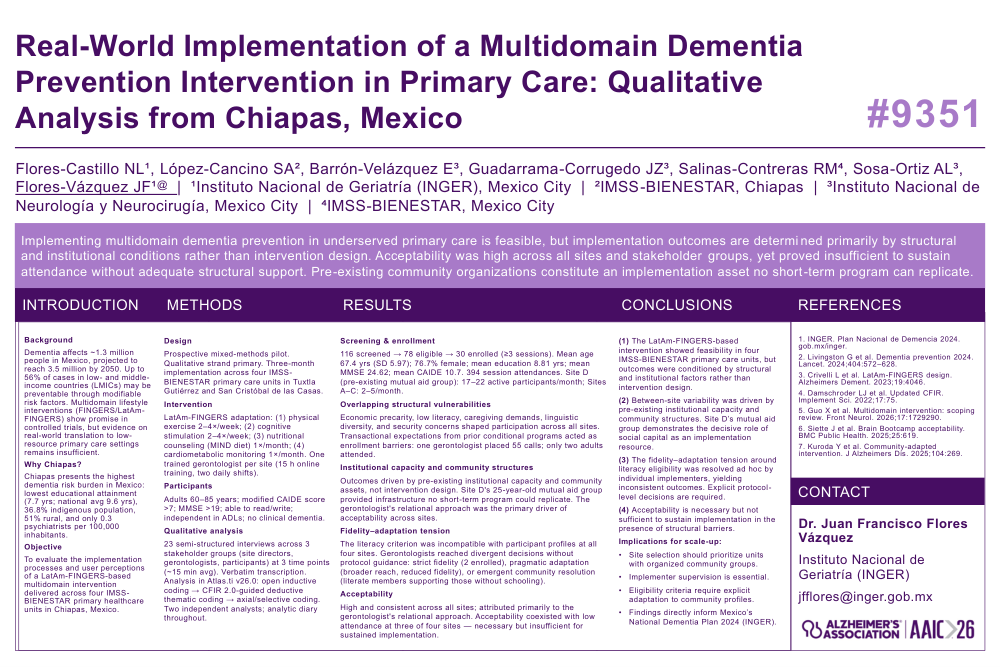
Real-World Implementation of a Multidomain Dementia Prevention Intervention in Primary Care: Qualitative Analysis from Chiapas, Mexico
Flores-Castillo NL¹, Antonio López-Cancino S², Barrón-Velázquez E³, Guadarrama-Corrugedo JZ³, Salinas-Contreras RM⁴, Sosa-Ortiz AL³, Flores-Vázquez JF¹@ | ¹Instituto Nacional de Geriatría (INGER), Mexico City | ²IMSS-BIENESTAR, Chiapas | ³Instituto Nacional de Neurología y Neurocirugía, Mexico City | ⁴IMSS-BIENESTAR, Mexico City
Implementing multidomain dementia prevention in underserved primary care is feasible, but implementation outcomes are determined primarily by structural and institutional conditions rather than intervention design. Acceptability was high across all sites and stakeholder groups, yet proved insufficient to sustain attendance without adequate structural support. Pre-existing community organizations constitute an implementation asset no short-term program can replicate.
Background
Dementia affects ~1.3 million people in Mexico, projected to reach 3.5 million by 2050. Up to 56% of cases in low- and middle-income countries (LMICs) may be preventable through modifiable risk factors. Multidomain lifestyle interventions (FINGERS/LatAm-FINGERS) show promise in controlled trials, but evidence on real-world translation to low-resource primary care settings remains insufficient.
Why Chiapas?
Chiapas presents the highest dementia risk burden in Mexico: lowest educational attainment (7.7 yrs; national avg 9.6 yrs), 36.8% indigenous population, 51% rural, and only 0.3 psychiatrists per 100,000 inhabitants.
Objective
To evaluate the implementation processes and user perceptions of a LatAm-FINGERS-based multidomain intervention delivered across four IMSS-BIENESTAR primary healthcare units in Chiapas, Mexico.
Design
Prospective mixed-methods pilot. Qualitative strand primary. Three-month implementation across four IMSS-BIENESTAR primary care units in Tuxtla Gutiérrez and San Cristóbal de las Casas.
Intervention
LatAm-FINGERS adaptation: (1) physical exercise 2–4×/week; (2) cognitive stimulation 2–4×/week; (3) nutritional counseling (MIND diet) 1×/month; (4) cardiometabolic monitoring 1×/month. One trained gerontologist per site (15 h online training, two daily shifts).
Participants
Adults 60–85 years; modified CAIDE score >7; MMSE >19; able to read/write; independent in ADLs; no clinical dementia.
Qualitative analysis
23 semi-structured interviews across 3 stakeholder groups (site directors, gerontologists, participants) at 3 time points (~15 min avg). Verbatim transcription. Analysis in Atlas.ti v26.0: open inductive coding → CFIR 2.0-guided deductive thematic coding → axial/selective coding. Two independent analysts; analytic diary throughout.
Screening & enrollment
116 screened → 78 eligible → 30 enrolled (≥3 sessions). Mean age 67.4 yrs (SD 5.97); 76.7% female; mean education 8.81 yrs; mean MMSE 24.62; mean CAIDE 10.7. 394 session attendances. Site D (pre-existing mutual aid group): 17–22 active participants/month; Sites A–C: 2–5/month.
Overlapping structural vulnerabilities
Economic precarity, low literacy, caregiving demands, linguistic diversity, and security concerns shaped participation across all sites. Transactional expectations from prior conditional programs acted as enrollment barriers: one gerontologist placed 55 calls; only two adults attended.
Institutional capacity and community structures
Outcomes driven by pre-existing institutional capacity and community assets, not intervention design. Site D's 25-year-old mutual aid group provided infrastructure no short-term program could replicate. The gerontologist's relational approach was the primary driver of acceptability across sites.
Fidelity–adaptation tension
The literacy criterion was incompatible with participant profiles at all four sites. Gerontologists reached divergent decisions without protocol guidance: strict fidelity (2 enrolled), pragmatic adaptation (broader reach, reduced fidelity), or emergent community resolution (literate members supporting those without schooling).
Acceptability
High and consistent across all sites; attributed primarily to the gerontologist's relational approach. Acceptability coexisted with low attendance at three of four sites — necessary but insufficient for sustained implementation
Concusions
(1) The LatAm-FINGERS-based intervention showed feasibility in four IMSS-BIENESTAR primary care units, but outcomes were conditioned by structural and institutional factors rather than intervention design.
(2) Between-site variability was driven by pre-existing institutional capacity and community structures. Site D’s mutual aid group demonstrates the decisive role of social capital as an implementation resource.
(3) The fidelity–adaptation tension around literacy eligibility was resolved ad hoc by individual implementers, yielding inconsistent outcomes. Explicit protocol-level decisions are required.
(4) Acceptability is necessary but not sufficient to sustain implementation in the presence of structural barriers.
Implications for scale-up:
References
1. INGER. Plan Nacional de Demencia 2024. gob.mx/inger.
2. Livingston G et al. Dementia prevention 2024. Lancet. 2024;404:572–628.
3. Crivelli L et al. LatAm-FINGERS design. Alzheimers Dement. 2023;19:4046.
4. Damschroder LJ et al. Updated CFIR. Implement Sci. 2022;17:75.
5. Guo X et al. Multidomain intervention: scoping review. Front Neurol. 2026;17:1729290.
6. Siette J et al. Brain Bootcamp acceptability. BMC Public Health. 2025;25:619.
7. Kuroda Y et al. Community-adapted intervention. J Alzheimers Dis. 2025;104:269
Contact
Dr. Juan Francisco Flores Vázquez
Instituto Nacional de Geriatría (INGER)
jfflores@inger.gob.mx
Comments
Email is required but is not shown publicly.
Loading comments...