4,068 posters, 219 videos, 101 topics, 69 sessions, 14,365 authors, 6,128 institutions
ePostersLive by SciGen Technologies S.A. All rights reserved.
Alzheimer's Association International Conference 2026
July 12-15, 2026 | London, United Kingdom, and Online

9329
Rare Genetic Variants Related To C9orf72 Promoter Methylation In FTD/ALS Families
Poster Presenter
Authors
Nadia Dehghani, Sevinch Rakhmonova, EunRan Suh, Anil R. Wadhwani, Hao Xu, Laynie Dratch, Allison Snyder, Lauren Massimo, David J. Irwin, Wanding Zhou, Vivianna M. Van Deerlin, Edward B. Lee, Corey T. McMillan
Affiliations
University of Pennsylvania, Philadelphia, PA, USA, University of Pennsylvania, Philadelphia, PA, USA; Children’s Hospital of Philadelphia, Philadelphia, PA, USA
Part of Topic
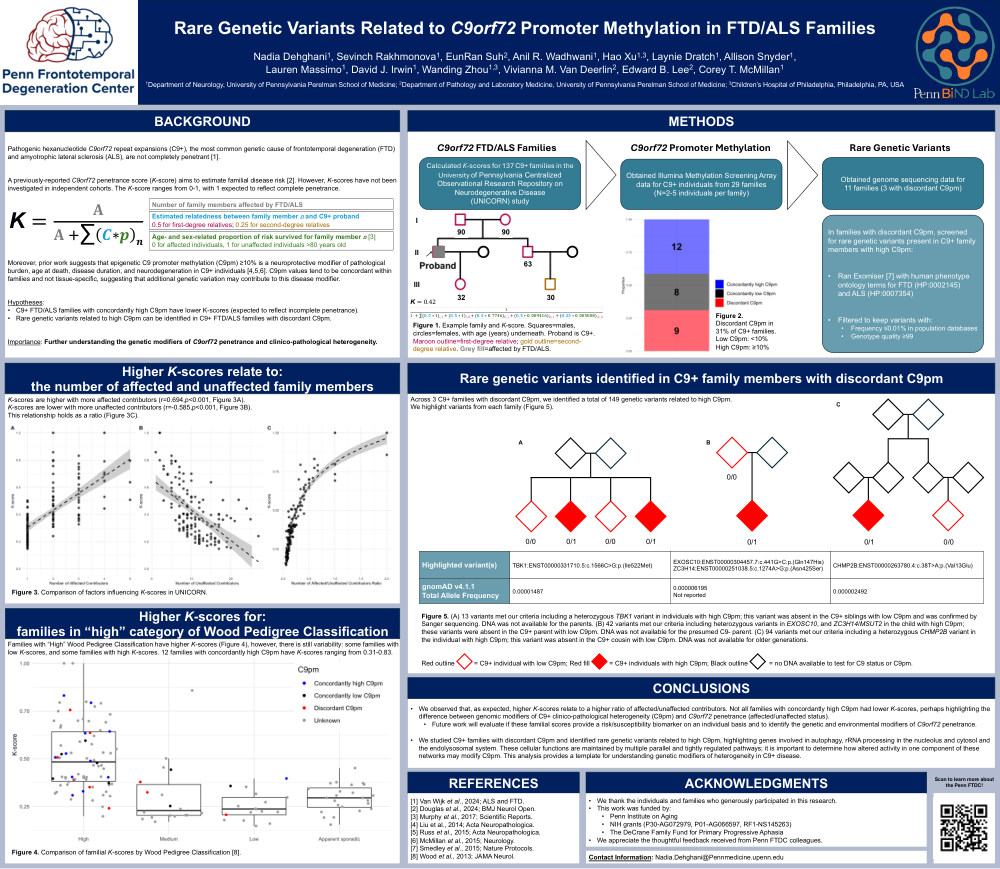
Background: The most common genetic cause of frontotemporal degeneration (FTD) and amyotrophic lateral sclerosis (ALS) is a hexanucleotide repeat expansion in C9orf72 (C9). Prior work suggests that epigenetic C9 promoter methylation (C9pm) over 10% is a neuroprotective modifier of pathological burden, age at death, disease duration, and neurodegeneration [1,2,3]. C9pm values tend to be concordant within families, suggesting that additional genetic variation may contribute to this disease modifier. In this work, we studied C9+ family members to identify rare genetic variants related to high C9pm.
Methods: Genome sequencing and Illumina Methylation Screening Array data were obtained for C9+ individuals from 11 families in the Penn FTD Center (N=2-5 individuals per family). We identified 5 families with C9pm <10%, and 3 family with C9pm ≥10% in all individuals tested. We ran Exomiser software in the remaining 3 families with discordant C9pm to identify rare genetic variants related to high C9pm. We further filtered to keep genetic variants with a frequency ≤0.01% in population databases, and genotype quality ≥99.
Results: Across the 3 families with discordant C9pm, we identified a total of 149 genetic variants related to high C9pm. Candidate genetic variants were identified in genes involved in autophagy and the endolysosomal system. Considering that these cellular functions are maintained by multiple parallel and tightly regulated pathways, future work is required to determine how altered activity in one component of these networks may modify C9pm.
Conclusion: We studied 3 C9+ families with discordant C9pm and prioritized candidate genetic variants related to high C9pm. This analysis identified rare genetic variants in biologically plausible pathways and provides a template for understanding genetic modifiers of heterogeneity in C9+ disease that we will extend to a larger cohort.
[1] Liu et al., 2014; Acta Neuropathologica. [2] Russ et al., 2015; Acta Neuropathologica. [3] McMillan et al., 2015; Neurology.
Comments
Email is required but is not shown publicly.
Loading comments...