4,068 posters, 219 videos, 101 topics, 69 sessions, 14,365 authors, 6,128 institutions
ePostersLive by SciGen Technologies S.A. All rights reserved.
Alzheimer's Association International Conference 2026
July 12-15, 2026 | London, United Kingdom, and Online

6142
Proteomic Signatures Of APOE4 Resilience Reveal Causal Pathways That Delay Alzheimer’S Disease Onset
Poster Presenter
Authors
Part of Topic
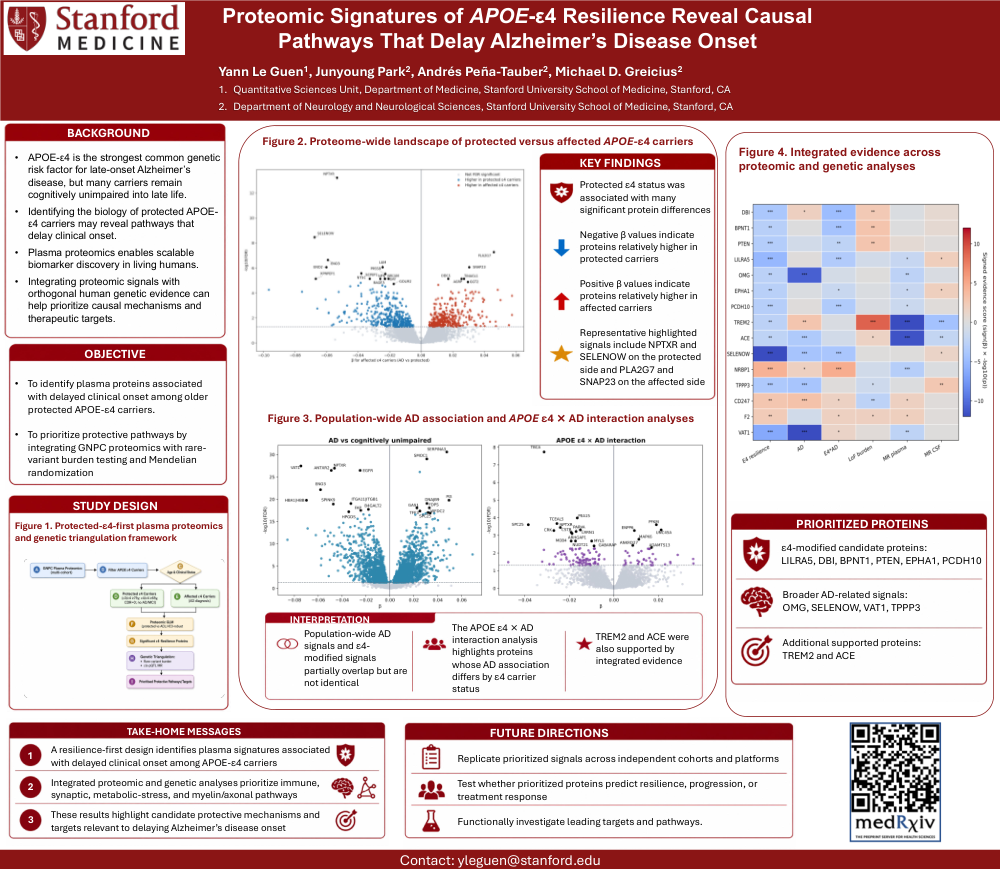
Introduction: APOE-ε4 is the strongest common genetic risk factor for Alzheimer's disease (AD), yet many carriers remain cognitively unimpaired into late life. We tested whether a protected-ε4-first proteomic approach could identify plasma proteins associated with delayed clinical onset among ε4 carriers.
Methods: We analyzed harmonized plasma proteomics from the Global Neurodegeneration Proteomics Consortium. Protected ε4 carriers (ε3/ε4 aged ≥75 years; ε4/ε4 aged ≥65 years; CDR=0; n=456) were compared with ε4 carriers with AD (n=1,096). Protein-wise linear models adjusted for age, sex, ε4 dosage, and plasma proteomic principal components. Top signals were integrated with high-confidence loss-of-function burden testing and plasma/CSF Mendelian randomization.
Results: ε4 protected was associated with 721 protein levels. Integrated analyses prioritized proteins linked to ε4-modified disease biology, including LILRA5, DBI, BPNT1, PTEN, EPHA1, and PCDH10, and proteins aligned with broader AD-related change, including OMG, SELENOW, VAT1, and TPPP3. TREM2 and ACE were also identified, providing internal biological validation of the approach.
Discussion: A protected-ε4-first plasma proteomic strategy highlights immune, synaptic, metabolic-stress, and myelin/axonal pathways that may delay AD onset and helps prioritize candidate ε4-specific modifiers for prevention-focused therapeutics.
Comments
Email is required but is not shown publicly.
Loading comments...