4,068 posters, 219 videos, 101 topics, 69 sessions, 14,365 authors, 6,128 institutions
ePostersLive by SciGen Technologies S.A. All rights reserved.
Alzheimer's Association International Conference 2026
July 12-15, 2026 | London, United Kingdom, and Online

4432
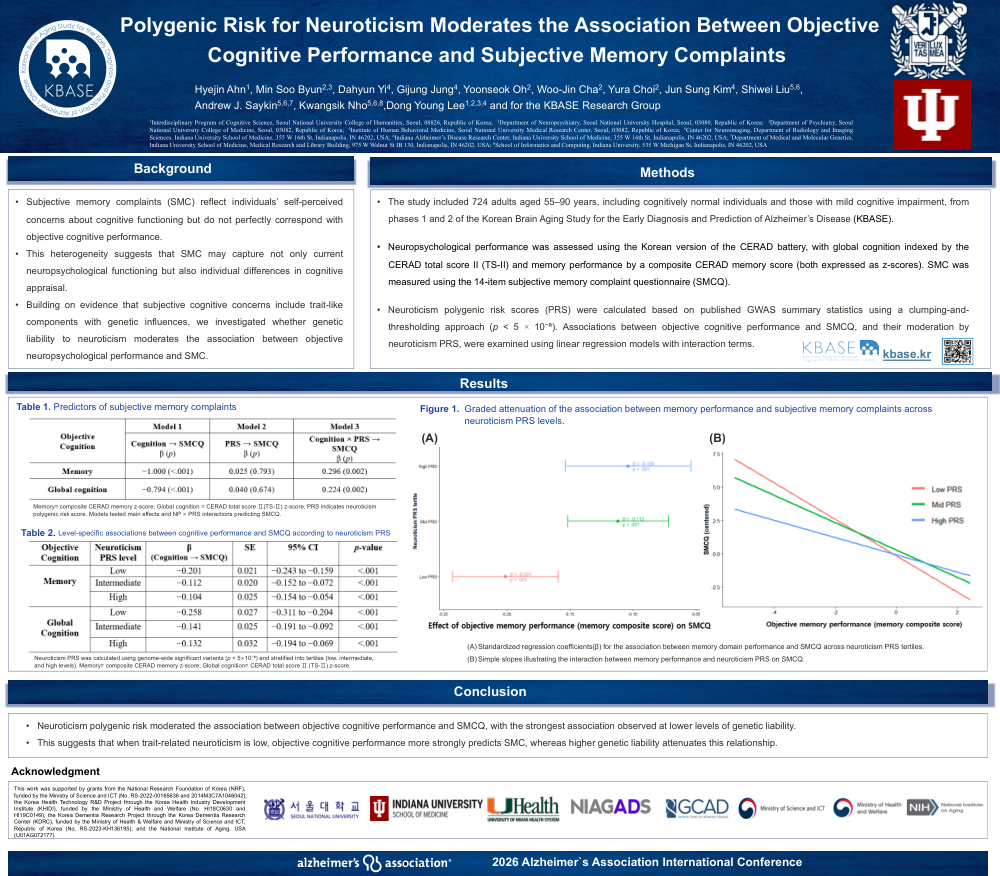
Polygenic Risk For Neuroticism Modulates The Association Between Objective Cognitive Performance And Subjective Memory Complaints
Poster Presenter
Authors
Hyejin Ahn, Min Soo Byun, Dahyun Yi, Gijung Jung, Yoonseok Oh, Woo-Jin Cha, Yura Choi, Jun Sung Kim, Shiwei Liu, Andrew J. Saykin, Kwangsik Nho, Dong Young Lee
Affiliations
Institute of Human Behavioral Medicine, Seoul National University Medical Research Center, Seoul, 03082, Republic of Korea, Department of Neuropsychiatry, Seoul National University Hospital, Seoul, 03080, Republic of Korea, Interdisciplinary Program of Cognitive Science, Seoul National University College of Humanities, Seoul, 08826, Department of Neuropsychiatry, Seoul National University Hospital, Seoul, 03080, Republic of Korea; Department of Psychiatry, Seoul National University College of Medicine, Seoul, 03082, Republic of Korea, Department of Neuropsychiatry, Seoul National University Hospital, Seoul, 03080, Republic of Korea; 3Department of Psychiatry, Seoul National University College of Medicine, Seoul, 03082, Republic of Korea, Center for Neuroimaging, Department of Radiology and Imaging Sciences, Indiana University School of Medicine, 355 W 16th St, Indianapolis, IN 46202, USA; Indiana Alzheimer’s Disease Research Center, Indiana University School of Medicine, Center for Neuroimaging, Department of Radiology and Imaging Sciences, Indiana University School of Medicine, 355 W 16th St, Indianapolis, IN 46202, USA; Indiana Alzheimer’s Disease Research Center, Indiana University School of Medicine, 355 W 16th St, Indianapolis, IN 46202, USA; Department of Medical and Molecular Genetics, Indiana University School of Medicine, Medical Research and Library Building, 975 W Walnut St IB 130, Indianapolis, IN 46202, USA, Center for Neuroimaging, Department of Radiology and Imaging Sciences, Indiana University School of Medicine, 355 W 16th St, Indianapolis, IN 46202, USA; Indiana Alzheimer’s Disease Research Center, Indiana University School of Medicine, 355 W 16th St, Indianapolis, IN 46202, USA; School of Informatics and Computing, Indiana University, 535 W Michigan St, Indianapolis, IN 46202, USA, Interdisciplinary Program of Cognitive Science, Seoul National University College of Humanities, Seoul, 08826, Republic of Korea; Department of Neuropsychiatry, Seoul National University Hospital, Seoul, 03080, Republic of Korea; Department of Psychiatry, Seoul National University College of Medicine, Seoul, 03082, Republic of Korea; Institute of Human Behavioral Medicine, Seoul National University Medical Research Center, Seoul, 03082, Republic of Korea
Part of Topic
Abstract
Background:
Subjective memory complaints (SMC) reflect individuals’ self-perceived concerns about cognitive functioning but do not perfectly correspond with objective cognitive performance. This heterogeneity suggests that SMC may capture not only current neuropsychological functioning but also individual differences in cognitive appraisal. Building on evidence that subjective cognitive concerns include trait-like components with genetic influences, we investigated whether genetic liability to neuroticism moderates the association between objective neuropsychological performance and SMC.
Methods:
The study included 724 adults aged 55–90 years, including cognitively normal individuals and those with mild cognitive impairment, from phases 1 and 2 of the Korean Brain Aging Study for the Early Diagnosis and Prediction of Alzheimer’s Disease (KBASE). Neuropsychological performance was assessed using the Korean version of the CERAD battery, with global cognition indexed by the CERAD total score (TS) (z-score) (Han et al., 2014) and memory performance by a composite CERAD memory score (z-score). SMC was measured using the 14-item subjective memory complaint questionnaire (SMCQ) (Youn et al., 2009). Neuroticism polygenic risk scores (PRS) were calculated based on published GWAS summary statistics using a clumping-and-thresholding approach (p < 5 × 10⁻⁸). Associations between objective cognitive performance and SMCQ, and their moderation by neuroticism PRS, were examined using linear regression models with interaction terms.
Results:
Objective cognitive measures were significantly associated with SMCQ, indicating that poorer memory and global cognitive performance were related to higher SMCQ scores. Neuroticism PRS showed no main effect on SMCQ, whereas significant interactions between cognitive performance and neuroticism PRS were observed for memory, with a comparable pattern for global cognition (Table 1). In level-specific analyses, associations between memory performance and SMCQ were significant across all neuroticism PRS levels, but the magnitude of the association was strongest at lower PRS levels and progressively attenuated with increasing PRS (Table 2; Figure 1). A similar graded attenuation pattern was observed for global cognition.
Conclusion:
Neuroticism polygenic risk moderated the association between objective cognitive performance and SMCQ, with the strongest association observed at lower levels of genetic liability. This suggests that when trait-related neuroticism is low, objective cognitive performance more strongly predicts SMC, whereas higher genetic liability attenuates this relationship.
Comments
Email is required but is not shown publicly.
Loading comments...