4,068 posters, 219 videos, 101 topics, 69 sessions, 14,365 authors, 6,128 institutions
ePostersLive by SciGen Technologies S.A. All rights reserved.
Alzheimer's Association International Conference 2026
July 12-15, 2026 | London, United Kingdom, and Online

9709
RNA Processing Dysregulation In Huntington's Disease
Poster Presenter
Authors
Affiliations
Part of Topic
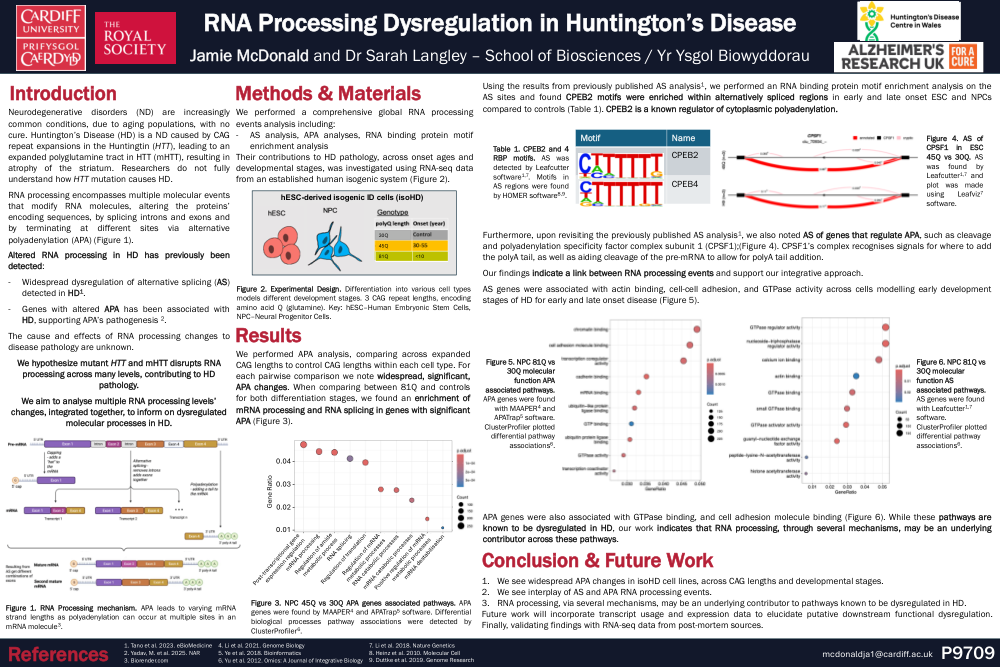
Neurodegenerative disorders (ND) are increasingly common conditions, due to aging populations, with no cure. Huntington’s Disease (HD) is a ND caused by CAG repeat expansions in the Huntingtin (HTT), leading to an expanded polyglutamine tract in HTT (mHTT), resulting in atrophy of the striatum. Researchers do not fully understand how HTT mutation causes HD.
RNA processing encompasses multiple molecular events that modify RNA molecules, altering the proteins’ encoding sequences, by splicing introns and exons and by terminating at different sites via alternative polyadenylation (APA) (Figure 1).
Altered RNA processing in HD has previously been detected:
The cause and effects of RNA processing changes to disease pathology are unknown.
We hypothesize mutant HTT and mHTT disrupts RNA processing across many levels, contributing to HD pathology.
We aim to analyse multiple RNA processing levels’ changes, integrated together, to inform on dysregulated molecular processes in HD.
We performed a comprehensive global RNA processing events analysis including:
Their contributions to HD pathology, across onset ages and developmental stages, was investigated using RNA-seq data from an established human isogenic system (Figure 2).
We performed APA analysis, comparing across expanded CAG lengths to control CAG lengths within each cell type. For each pairwise comparison we note widespread, significant, APA changes. When comparing between 81Q and controls for both differentiation stages, we found an enrichment of mRNA processing and RNA splicing in genes with significant APA (Figure 3).
Using the results from previously published AS analysis1, we performed an RNA binding protein motif enrichment analysis on the AS sites and found CPEB2 motifs were enriched within alternatively spliced regions in early and late onset ESC and NPCs compared to controls (Table 1). CPEB2 is a known regulator of cytoplasmic polyadenylation.
Furthermore, upon revisiting the previously published AS analysis1, we also noted AS of genes that regulate APA, such as cleavage and polyadenylation specificity factor complex subunit 1 (CPSF1);(Figure 4). CPSF1’s complex recognises signals for where to add the polyA tail, as well as aiding cleavage of the pre-mRNA to allow for polyA tail addition.
Our findings indicate a link between RNA processing events and support our integrative approach.
AS genes were associated with actin binding, cell-cell adhesion, and GTPase activity across cells modelling early development stages of HD for early and late onset disease (Figure 5).
APA genes were also associated with GTPase binding, and cell adhesion molecule binding (Figure 6). While these pathways are known to be dysregulated in HD, our work indicates that RNA processing, through several mechanisms, may be an underlying contributor across these pathways.
Future work will incorporate transcript usage and expression data to elucidate putative downstream functional dysregulation. Finally, validating findings with RNA-seq data from post-mortem sources.
Comments
Email is required but is not shown publicly.
Loading comments...