4,068 posters, 219 videos, 101 topics, 69 sessions, 14,365 authors, 6,128 institutions
ePostersLive by SciGen Technologies S.A. All rights reserved.
Alzheimer's Association International Conference 2026
July 12-15, 2026 | London, United Kingdom, and Online

9486
Evaluation Of Interactions Between Subcortical Brain Volume Polygenic Scores, Age And Apoe Genotype On Alzheimer Disease
Poster Presenter
Authors
Affiliations
Part of Topic
Background: Subcortical brain structures play important roles in neurodegenerative processes, including Alzheimer’s disease (AD). However, the associations between subcortical brain volumes and AD risk are uncertain and may influenced by age and APOE genotype. Polygenic scores (PGSs) for subcortical structures capture the genetic predisposition to structural variation and provide approach to investigate genetic factors related to AD. We aim to investigate the interactions between subcortical volume PGSs, age and APOE genotype on AD risk.
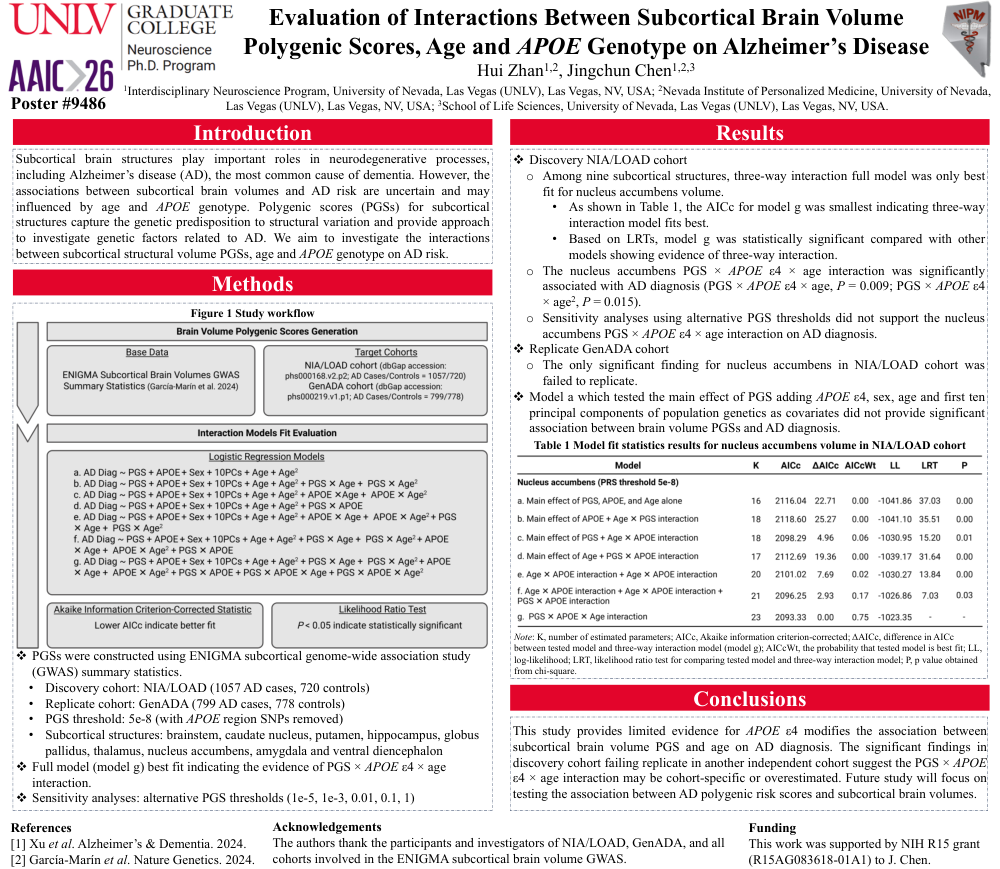
Method: PGSs were constructed in NIA/LOAD cohort (dbGap accession: phs000168.v2.p2; 1057 cases and 720 controls) using ENIGMA subcortical genome-wide association study summary statistics. SNPs of genome-wide significance (P < 5e-8) were included, with APOE region excluded. Logistic regression model evaluated the associations between PGSs for nine subcortical structures (brainstem, caudate nucleus, putamen, hippocampus, globus pallidus, thalamus, nucleus accumbens, amygdala and ventral diencephalon) and AD diagnosis, adjusting for sex and first ten principal components. A set of models containing pairwise interactions and three-way interaction of PGS, APOE ε4, age, and age2 were evaluated with Akaike information criterion-corrected (AICc) statistic and likelihood ratio test (LRT). Significant findings were validated in GenADA cohort (dbGap accession: phs000219.v1.p1; 799 cases and 778 controls).
Result: Among nine subcortical structures, three-way interaction (PGS × APOE ε4 × age) model was only best fit for nucleus accumbens volume in NIA/LOAD cohort (Table 1). The interaction showed statistical significance (PGS × APOE ε4 × age, P=0.009; PGS × APOE ε4 × age2, P=0.015). Sensitivity analyses using alternative PGS thresholds did not support the interaction. It also failed to replicate in GenADA cohort.
Conclusion: This study provides limited evidence for interactions between subcortical volume PGS, age, and APOE genotype on AD. The significant findings in discovery cohort failing replicate in another independent cohort suggest the PGS × APOEε4 × age interaction may be cohort-specific or overestimated. Future study will focus on testing the association between AD polygenic risk scores and subcortical brain volumes.
Comments
Email is required but is not shown publicly.
Loading comments...