Loading...

4,068 posters, 219 videos, 101 topics, 69 sessions, 14,365 authors, 6,128 institutions

ePostersLive by SciGen Technologies S.A. All rights reserved.

Alzheimer's Association International Conference 2026

July 12-15, 2026 | London, United Kingdom, and Online

Alzheimer's Association International Conference 2026 banner

5647

Early Detection Of Alzheimer’S Disease: Investigator And Community Perspectives On Research, Recruitment, And Translational Barriers
Part of Topic

Early Detection Of Alzheimer’s Disease: Investigator And Community Perspectives On Research, Recruitment, And Translational Barriers

Shishuka malhotra, MD, FAPA

INTRODUCTION

•Early Alzheimer’s detection supports earlier intervention and management of symptoms.
•Advances in care planning, research, and decision-making require timely and informed access.
•Despite advances, many remain undiagnosed after severe neurodegeneration.
•This poster examines early detection and research recruitment from investigator and community perspectives.
 
METHODS 

This work synthesizes findings from:

•Observational insights from investigator oversight of Alzheimer’s clinical research and recruitment activities.
•Community outreach and engagement efforts.
 
RESULTS
 
•Early-stage Alzheimer’s trial recruitment is hindered by limited awareness, stigma, female underrepresentation (awareness below 65%), and couples living together (Okamura et al., 2024).
•Early diagnosis improves affordability, access, and clinical outcomes.
•Our outreach and education coordinator had success in fighting against stigma and fear of testing by targeting caregivers who had at least one person in their family who had experienced dementia. These individuals were more likely to continue testing, especially when provided with free testing every 6 months, which supports early detection.
 
INVESTIGATOR & COMMUNITY PERSPECTIVES
1. Awareness of Early Detection
2. Access to Diagnostic Tools
3. Inclusive Recruitment Strategies
4. Timely Enrollment in Clinical Research
5. Better Outcomes and Earlier Intervention
 
BARRIERS TO EARLY DETECTION & RESEARCH RECRUITMENT
•Limited awareness
•Stigma
•Female underrepresentation (awareness below 65%)
•Couples living together are resistant to diagnosis
•Access and affordability challenges
•Delayed diagnosis reduces time for planning and intervention
 
SOLUTIONS & OPPORTUNITIES
üExpand community education and awareness
üReduce stigma through targeted outreach
üAddress gender and diversity gaps
üSupport caregivers and couples
üImprove affordability and access
üFoster trust and transparency
üEnable earlier intervention, care planning,
and research participation
 
KEY FINDINGS
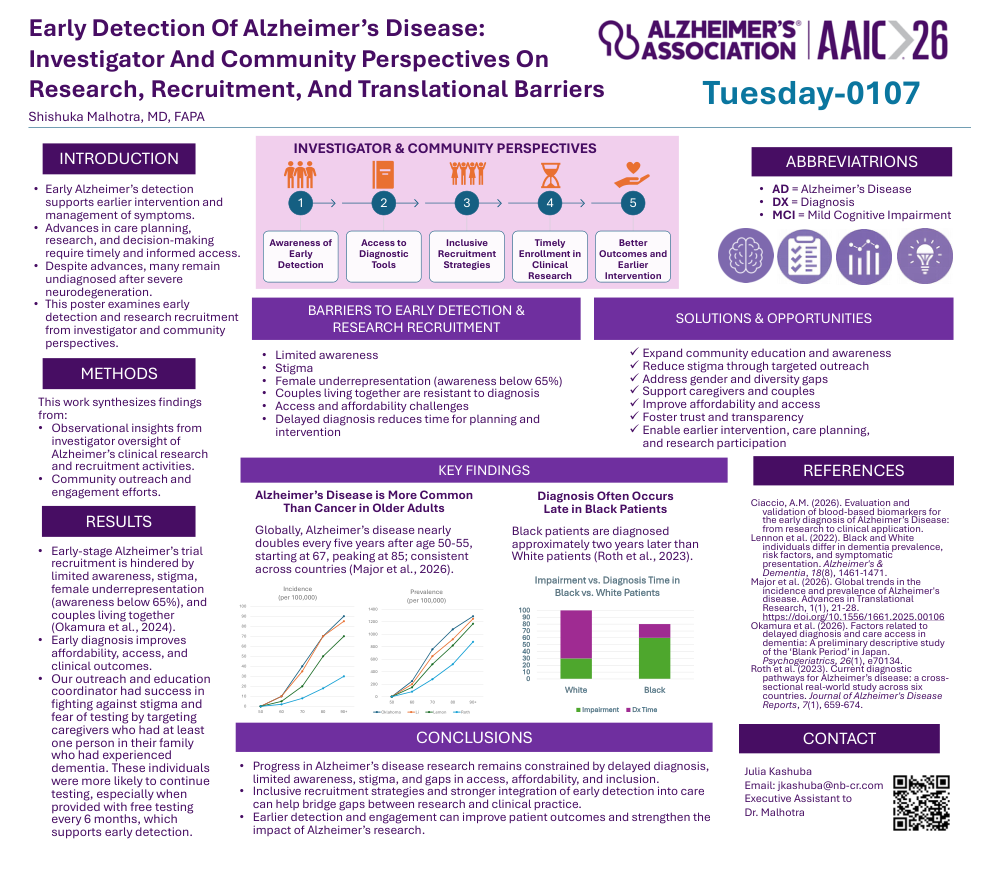
Alzheimer's Disease is More Common Than Cancer in Older Adults

Globally, Alzheimer’s disease nearly doubles every five years after age 50-55, starting at 67, peaking at 85; consistent across countries (Major et al., 2026).

Diagnosis Often Occurs Late in Black Patients

Black patients are diagnosed approximately two years later than White patients (Roth et al., 2023).

CONCLUSIONS

•Progress in Alzheimer’s disease research remains constrained by delayed diagnosis, limited awareness, stigma, and gaps in access, affordability, and inclusion.
•Inclusive recruitment strategies and stronger integration of early detection into care can help bridge gaps between research and clinical practice.
•Earlier detection and engagement can improve patient outcomes and strengthen the impact of Alzheimer’s research.
 
ABBREVIATIONS
•AD = Alzheimer’s Disease
•DX = Diagnosis
•MCI = Mild Cognitive Impairment
 
REFERENCES

Ciaccio, A.M. (2026). Evaluation and validation of blood-based biomarkers for the early diagnosis of Alzheimer’s Disease: from research to clinical application.

Lennon et al. (2022). Black and White individuals differ in dementia prevalence, risk factors, and symptomatic presentation. Alzheimer's & Dementia, 18(8), 1461-1471.

Major et al. (2026). Global trends in the incidence and prevalence of Alzheimer's disease. Advances in Translational Research, 1(1), 21-28. https://doi.org/10.1556/1661.2025.00106

Okamura et al. (2026). Factors related to delayed diagnosis and care access in dementia: A preliminary descriptive study of the ‘Blank Period’ in Japan. Psychogeriatrics, 26(1), e70134.

Roth et al. (2023). Current diagnostic pathways for Alzheimer’s disease: a cross-sectional real-world study across six countries. Journal of Alzheimer's Disease Reports, 7(1), 659-674.


CONTACT

Julia Kashuba

Email: jkashuba@nb-cr.com

Executive Assistant to Dr. Malhotra

Comments

Email is required but is not shown publicly.

Loading comments...

aaic2026 banner
Copyright © 2015-2026, ePostersLive® SciGen is a registered trademark of SciGen Technologies S.A. Patent pending.

This website and third-party tools we use rely on cookies for the best user experience. By selecting "I agree", you agree to cookie usage as described in our Privacy Policy.