4,068 posters, 219 videos, 101 topics, 69 sessions, 14,365 authors, 6,128 institutions
ePostersLive by SciGen Technologies S.A. All rights reserved.
Alzheimer's Association International Conference 2026
July 12-15, 2026 | London, United Kingdom, and Online

4625
Comorbidity Polypharmacy Score and Health Related Outcomes Associated with Cognitive and Functional Decline Among Older Adults
Part of Topic
TITLE
Comorbidity-Polypharmacy Score (CPS) and Health-Related Outcomes Associated with Cognitive and Functional Decline in Older Adults: A Two-Hospital Validation Study
AUTHORS
E. Bou Raad¹'², H. Mowafi³, S. Hajj² ¹Yale School of Public Health, New Haven, CT, USA; ²American University of Beirut Medical Center, Beirut, Lebanon; ³[affiliation]
KEY TAKEAWAY
A higher CPS at admission was independently associated with functional impairment and correlated strongly with established burden indices, supporting CPS as a simple bedside tool to flag high-burden older adults for medication reconciliation and deprescribing.
INTRODUCTION
Aging populations carry a greater burden of chronic conditions requiring long-term, multi-drug treatment, which raises the risk of inappropriate polypharmacy. Inappropriate polypharmacy is associated with adverse outcomes linked to cognitive and functional decline in older adults. The Comorbidity-Polypharmacy Score (CPS), defined as the sum of comorbid conditions and routine medications, offers an easy, bedside measure of combined disease and drug burden, but it requires further validation across older-adult populations.
Objective: To validate CPS and assess its association with health-related outcomes (functional impairment, hospital length of stay, readmission, in-hospital death) and with established indices (the Charlson Comorbidity Index and the GerontoNet ADR Risk Score) in hospitalized adults aged 65 years or older.
METHODS
- Design: retrospective medical chart review.
- Setting: two university hospitals in Lebanon; admissions 2020 to 2025.
- Population: inpatients aged 65 years or older. Current analytic sample N = 625; data collection is ongoing toward at least 1,000 charts.
- Exposure: CPS at admission, analyzed continuously and stratified as Low, Moderate, and High.
- Covariates: age, sex, Charlson Comorbidity Index (CCI), GerontoNet ADR Risk Score.
- Outcomes: functional impairment, hospital length of stay, readmission, in-hospital death.
- Analysis: descriptive statistics by CPS stratum (ANOVA, Kruskal-Wallis, chi-square); Spearman correlations for convergent validity; multivariable regression for adjusted associations. Reporting follows STROBE.
RESULTS
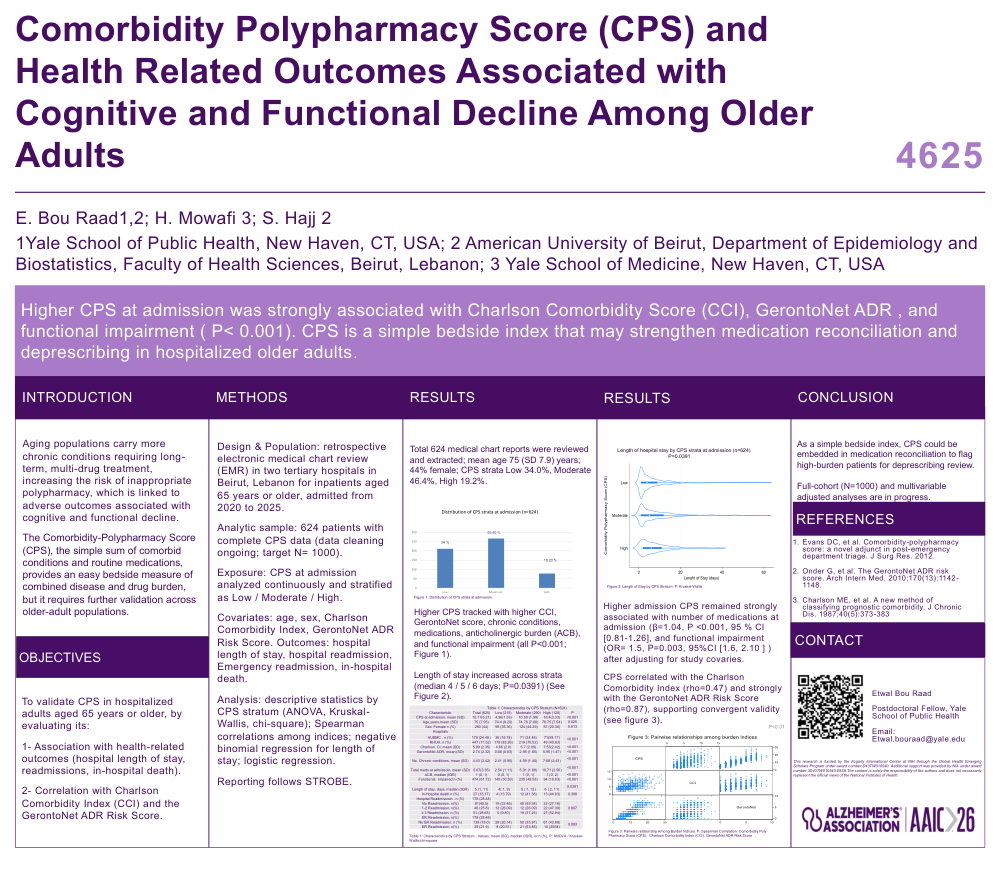
- A total of 625 hospitalized older adults were analyzed; mean age 75 years (SD 7.9), 44% female.
- CPS strata: Low 34.0%, Moderate 46.4%, High 19.0%.
- Known-groups validity: higher CPS was associated with greater comorbidity, more medications, higher anticholinergic burden, and functional impairment across strata (all P < 0.001).
- Convergent validity: CPS correlated with the Charlson Comorbidity Index (rho = 0.47) and strongly with the GerontoNet ADR Risk Score (rho = 0.87); all P < 0.001.
- Adjusted associations: a higher CPS at admission was significantly associated with functional impairment after adjustment for study covariates [aOR = 1.5, 95% CI 1.6, 2.10 to 0.003]. CPS was not significantly associated with hospital length of stay in the adjusted model.
CONCLUSIONS
In hospitalized older adults, a higher admission CPS was independently associated with functional impairment and correlated with established comorbidity and adverse-drug-reaction risk indices, supporting its construct and convergent validity. As a simple bedside index of combined disease and drug burden, CPS could be embedded in medication reconciliation to identify high-burden patients for deprescribing review. Analyses are ongoing toward a full sample of at least 1,000 charts, with multivariable adjusted and predictive analyses to follow.
REFERENCES
- Evans DC, et al. Comorbidity-polypharmacy score: a novel adjunct in post-emergency department triage. J Surg Res. 2012.
- Onder G, et al. Development and validation of a score to assess risk of adverse drug reactions among in-hospital patients 65 years or older: the GerontoNet ADR risk score. Arch Intern Med. 2010;170(13):1142-1148.
- Charlson ME, et al. A new method of classifying prognostic comorbidity in longitudinal studies. J Chronic Dis. 1987;40(5):373-383.
CONTACT
Etwal Bou Raad, Postdoctoral Fellow, Yale School of Public Health. Email: Etwal.bouraad@yale.edu
Comments
Email is required but is not shown publicly.
Loading comments...