4,068 posters, 219 videos, 101 topics, 69 sessions, 14,365 authors, 6,128 institutions
ePostersLive by SciGen Technologies S.A. All rights reserved.
Alzheimer's Association International Conference 2026
July 12-15, 2026 | London, United Kingdom, and Online

9214
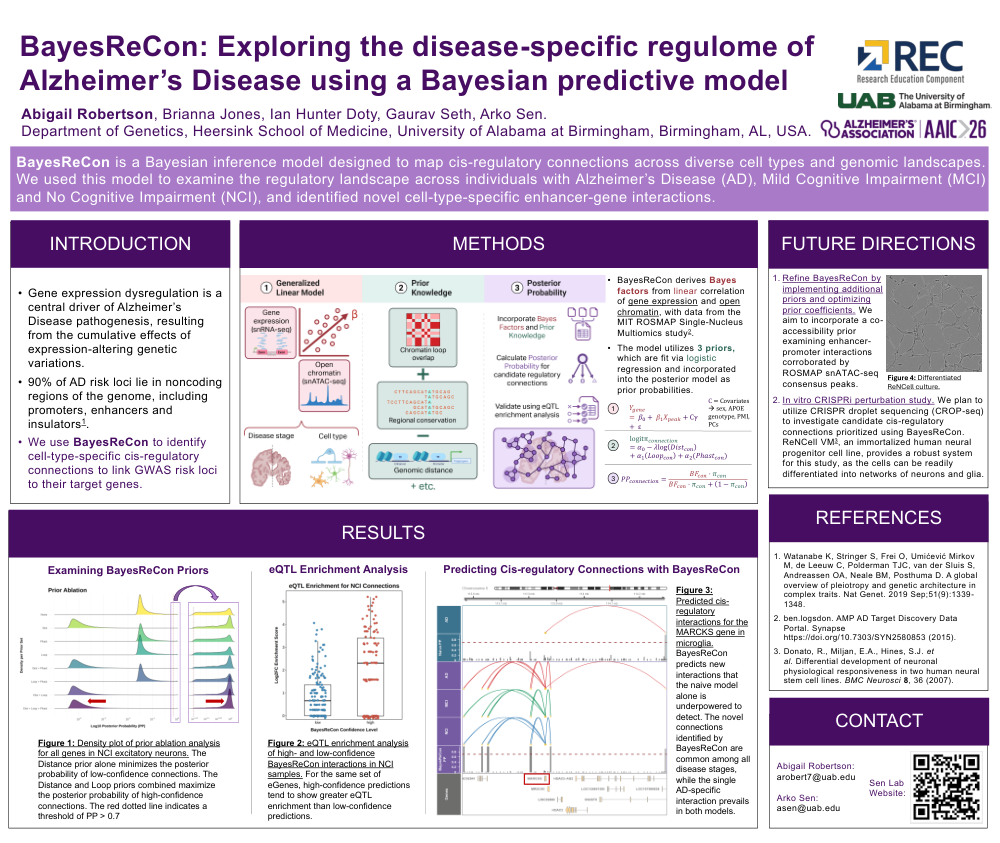
Exploring The Disease-specific Regulome Of Alzheimer’S Disease
Poster Presenter
Authors
Abigail Robertson, Brianna Jones, Ian Doty, Gaurav Seth, Arko Sen
Affiliations
Part of Topic
Video
Background: Genome-wide association studies (GWAS) have identified dozens of Alzheimer’s disease (AD) risk loci, the majority of which reside in non-coding regions of the genome. These findings implicate gene regulation as a central driver of AD pathogenesis; however, the mechanisms by which non-coding variants alter gene expression, cell-type-specific pathways, and downstream disease phenotypes remain poorly understood. Additionally, GWAS alone are underpowered to detect rare or context-specific regulatory effects and typically do not identify causal variants or their target genes. These limitations represent a major barrier to translating genetic discoveries into mechanistic insight and therapeutic strategies.
Methods: To overcome these limitations, we will analyze single-nucleus ATAC-seq and RNA-seq datasets from ROSMAP patients showing AD, mild cognitive impairment, and no cognitive impairment, identifying regulatory region-gene pairs that are cell-type- and disease-state-specific. To prioritize pathological relevance, we will evaluate their association with clinical outcomes—amyloid-β plaque burden, neurofibrillary tangle accumulation, and cognition scores—using a multivariate regression model. We will then map non-coding variants to prioritized regions and predict allele-specific effects on chromatin accessibility, histone marks, transcription factor binding, and gene regulation using sequence-to-chromatin deep learning models such as Basenji. Finally, we will validate top non-coding variants by introducing alternate alleles into their native genomic loci using prime editing in APP-mutant hNPC-derived 3D cultures to determine allele-specific effects.
Results: We have executed this pipeline for GWAS risk genes using a small, preliminary set of single-cell multiomic data. For the CASP7 gene, we identified 12 regulatory regions present across 6 cell types, most prevalently in astrocytes. Of the 22 variants found in these regulatory regions, 6 significantly altered chromatin accessibility and all 22 disrupted TF binding, particularly within the AD-implicated FOX and POU families.
Conclusion: These results will provide key insights into the role non-coding regulatory elements play in AD progression. Our candidate regulatory region-gene pairs will establish a critical foundation for future study, through which we plan to map known GWAS risk loci and rare non-coding variants to understand their allele-specific impact on tau, Aβ, and neuroinflammatory pathologies.
Comments
Email is required but is not shown publicly.
Loading comments...