4,068 posters, 219 videos, 101 topics, 69 sessions, 14,365 authors, 6,128 institutions
ePostersLive by SciGen Technologies S.A. All rights reserved.
Alzheimer's Association International Conference 2026
July 12-15, 2026 | London, United Kingdom, and Online

548
Investigation Of Clinical Spectrum And Neuropsychological Profiles In Dementia Patients With Trem2 Mutations
Poster Presenter
Authors
Part of Topic
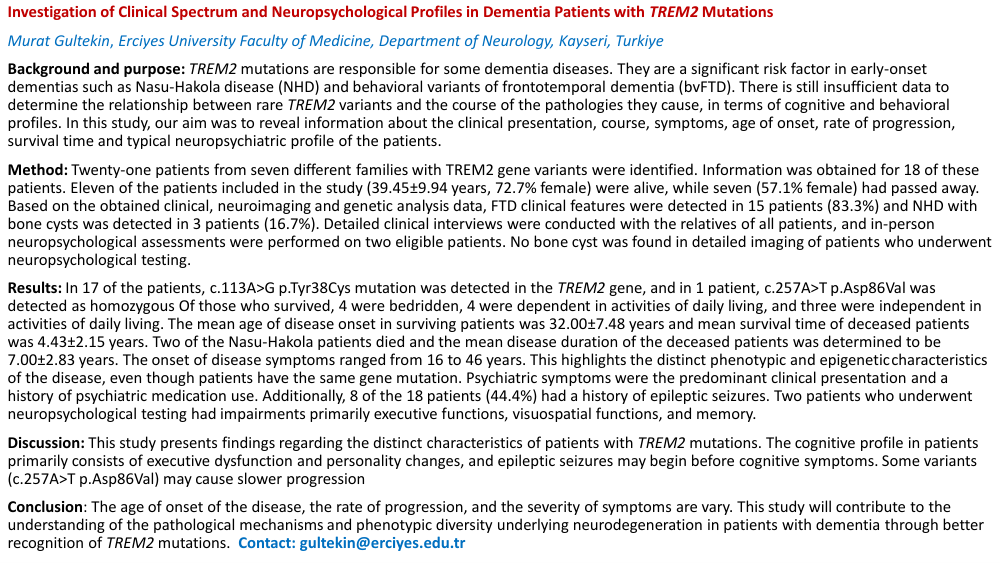
Investigation of Clinical Spectrum and Neuropsychological Profiles in Dementia Patients with TREM2 Mutations
Murat Gultekin, Erciyes University Faculty of Medicine, Department of Neurology, Kayseri, Turkiye
Background and purpose: TREM2 mutations are responsible for some dementia diseases. They are a significant risk factor in early-onset dementias such as Nasu-Hakola disease (NHD) and behavioral variants of frontotemporal dementia (bvFTD). There is still insufficient data to determine the relationship between rare TREM2 variants and the course of the pathologies they cause, in terms of cognitive and behavioral profiles. In this study, our aim was to reveal information about the clinical presentation, course, symptoms, age of onset, rate of progression, survival time and typical neuropsychiatric profile of the patients.
Method: Twenty-one patients from seven different families with TREM2 gene variants were identified. Information was obtained for 18 of these patients. Eleven of the patients included in the study (39.45±9.94 years, 72.7% female) were alive, while seven (57.1% female) had passed away. Based on the obtained clinical, neuroimaging and genetic analysis data, FTD clinical features were detected in 15 patients (83.3%) and NHD with bone cysts was detected in 3 patients (16.7%). Detailed clinical interviews were conducted with the relatives of all patients, and in-person neuropsychological assessments were performed on two eligible patients. No bone cyst was found in detailed imaging of patients who underwent neuropsychological testing.
Results: In 17 of the patients, c.113A>G p.Tyr38Cys mutation was detected in the TREM2 gene, and in 1 patient, c.257A>T p.Asp86Val was detected as homozygous Of those who survived, 4 were bedridden, 4 were dependent in activities of daily living, and three were independent in activities of daily living. The mean age of disease onset in surviving patients was 32.00±7.48 years and mean survival time of deceased patients was 4.43±2.15 years. Two of the Nasu-Hakola patients died and the mean disease duration of the deceased patients was determined to be 7.00±2.83 years. The onset of disease symptoms ranged from 16 to 46 years. This highlights the distinct phenotypic and epigenetic characteristics of the disease, even though patients have the same gene mutation. Psychiatric symptoms were the predominant clinical presentation and a history of psychiatric medication use. Additionally, 8 of the 18 patients (44.4%) had a history of epileptic seizures. Two patients who underwent neuropsychological testing had impairments primarily executive functions, visuospatial functions, and memory.
Discussion: This study presents findings regarding the distinct characteristics of patients with TREM2 mutations. The cognitive profile in patients primarily consists of executive dysfunction and personality changes, and epileptic seizures may begin before cognitive symptoms. Some variants (c.257A>T p.Asp86Val) may cause slower progression
Conclusion: The age of onset of the disease, the rate of progression, and the severity of symptoms are vary. This study will contribute to the understanding of the pathological mechanisms and phenotypic diversity underlying neurodegeneration in patients with dementia through better recognition of TREM2 mutations. Contact: gultekin@erciyes.edu.tr
Comments
Email is required but is not shown publicly.
Loading comments...