4,068 posters, 219 videos, 101 topics, 69 sessions, 14,365 authors, 6,128 institutions
ePostersLive by SciGen Technologies S.A. All rights reserved.
Alzheimer's Association International Conference 2026
July 12-15, 2026 | London, United Kingdom, and Online

1517
ADAM10 Genotype Reveals Sex-Dependent Vulnerability to Depressive Symptoms in Aging
Poster Presenter
Authors
Marcia Cominetti, Ari Alex Ramos, Lucas Nogueira de Carvalho Pelegrini, Maria Clara Ribeiro Zucato, Pedro Henrique Moreira Victoriano, Vanessa Alexandre-Silva, Marina Mantellatto Grigoli, Sabrina Peviani, Patrícia Regina Manzine, Cristiane Cominetti
Affiliations
University of Barcelona, Federal University of São Carlos, Federal University of Goiás
Part of Topic
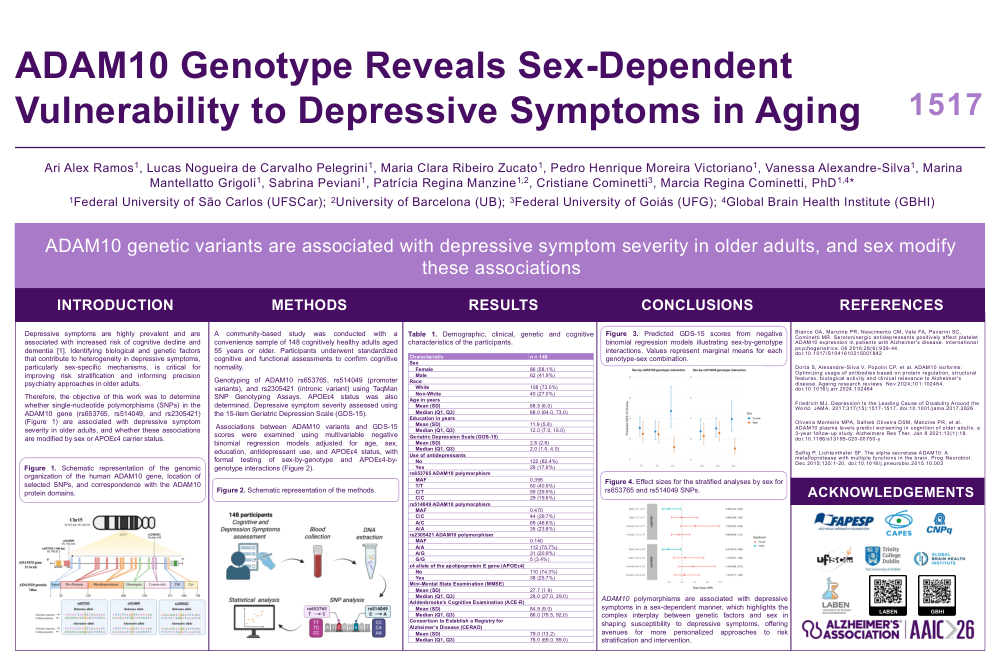
Background: Depressive symptoms are highly prevalent and are associated with increased risk of cognitive decline and dementia. Identifying biological and genetic factors that contribute to heterogeneity in depressive symptoms, particularly sex-specific mechanisms, is critical for improving risk stratification and informing precision psychiatry approaches in older adults. This study aimed to determine whether single-nucleotide polymorphisms (SNPs) in the ADAM10 gene (rs653765, rs514049, and rs2305421) are associated with depressive symptom severity in older adults and whether these associations are modified by sex or APOEε4 carriership.
Methods: This cross-sectional study was conducted between 2023 and 2025, with data analysis performed in 2025. Community-based study conducted in São Carlos, Brazil. A convenience sample of 148 cognitively healthy adults aged 55 years or older was included. Participants underwent standardized cognitive and functional assessments to confirm cognitive normality. Individuals with major psychiatric disorders (eg, bipolar disorder, schizophrenia), substance use disorder, neurologic conditions contributing to dementia, or uncorrected sensory deficits were excluded. Genotyping of ADAM10 rs653765, rs514049 (promoter variants), and rs2305421 (intronic variant) was performed using TaqMan SNP Genotyping Assays. APOEε4 status was also determined. Depressive symptom severity was assessed using the 15-item Geriatric Depression Scale (GDS-15). Associations between ADAM10 variants and GDS-15 scores were examined using multivariable negative binomial regression models adjusted for age, sex, education, antidepressant use, and APOEε4 status, with formal testing of sex-by-genotype and APOEε4-by-genotype interactions.
Results: Significant sex-by-genotype interactions were observed for rs653765 (P = .005) and rs514049 (P = .011). Among men, carriers of the rs653765 CC genotype exhibited a 52% lower rate of depressive symptoms compared with TT carriers (rate ratio [RR], 0.48; 95% CI, 0.24-0.94), and carriers of the rs514049 AA genotype showed a 53% lower rate compared with CC carriers (RR, 0.47; 95% CI, 0.23-0.96). These associations were not observed in women. No significant sex-dependent associations were identified for rs2305421.
Conclusion: ADAM10 promoter variants are associated with depressive symptom severity in older adults in a sex-specific manner. These findings highlight the importance of incorporating sex-stratified analyses into psychiatric genetic studies and suggest ADAM10-related pathways as potential targets for personalized approaches to late-life depression.
Comments
Email is required but is not shown publicly.
Loading comments...