4,068 posters, 219 videos, 101 topics, 69 sessions, 14,365 authors, 6,128 institutions
ePostersLive by SciGen Technologies S.A. All rights reserved.
Alzheimer's Association International Conference 2026
July 12-15, 2026 | London, United Kingdom, and Online

8799
Variants Of Uncertain Significance In Frontotemporal Dementia: The Need For An Integrated Translational Approach
Part of Topic
Variants of Uncertain Significance in Frontotemporal Dementia: The Need for an Integrated Translational Approach
Magrath-Guimet N; Massazza V; Itzcovich T; Avedaño D; Ardohain C; Morello-Garcia F; Bagnati P; Allegri RF; Surace E. Fleni (Frontotemporal Dementia Clinic; Dept. of Cognitive Neurology, Neuropsychology & Neuropsychiatry; Laboratory of Neurodegenerative Diseases, Dept. of Neuropathology & Molecular Biology), Buenos Aires, Argentina; INEU-Fleni/CONICET; Global Brain Health Institute (GBHI), UCSF, USA; Universidad de la Costa (CUC), Colombia.
TAKE-HOME MESSAGE: VUS in FTD are not incidental findings: a Translational Medicine Committee converts genetic uncertainty into prioritized, resource-efficient research — and clearer answers for families.
BACKGROUND
The increasing use of next-generation sequencing has led to a growing identification of variants of uncertain significance (VUS) in frontotemporal dementia (FTD). While pathogenic mutations are well characterized, the clinical relevance and optimal management of VUS remain poorly defined, particularly in real-world cohorts and underrepresented populations. This uncertainty represents a major challenge for diagnosis, genetic counseling, and research prioritization.
METHODS
Descriptive analysis of FTD patients evaluated at a tertiary cognitive neurology center (Fleni, Buenos Aires, Argentina) carrying at least one variant classified as VUS (n=18), compared with carriers of pathogenic variants (n=14) and sporadic FTD (n=12). Genetic work-up included C9orf72 testing and whole-exome sequencing (WES); variants were screened with in-silico classifiers (Franklin, VarSome) and adjudicated by the Fleni Translational Medicine Committee. Demographic, clinical and family-history data were systematically collected, and clinical diagnoses established according to current consensus criteria. Comparisons were exploratory (Kruskal–Wallis, Fisher/chi-square).
RESULTS
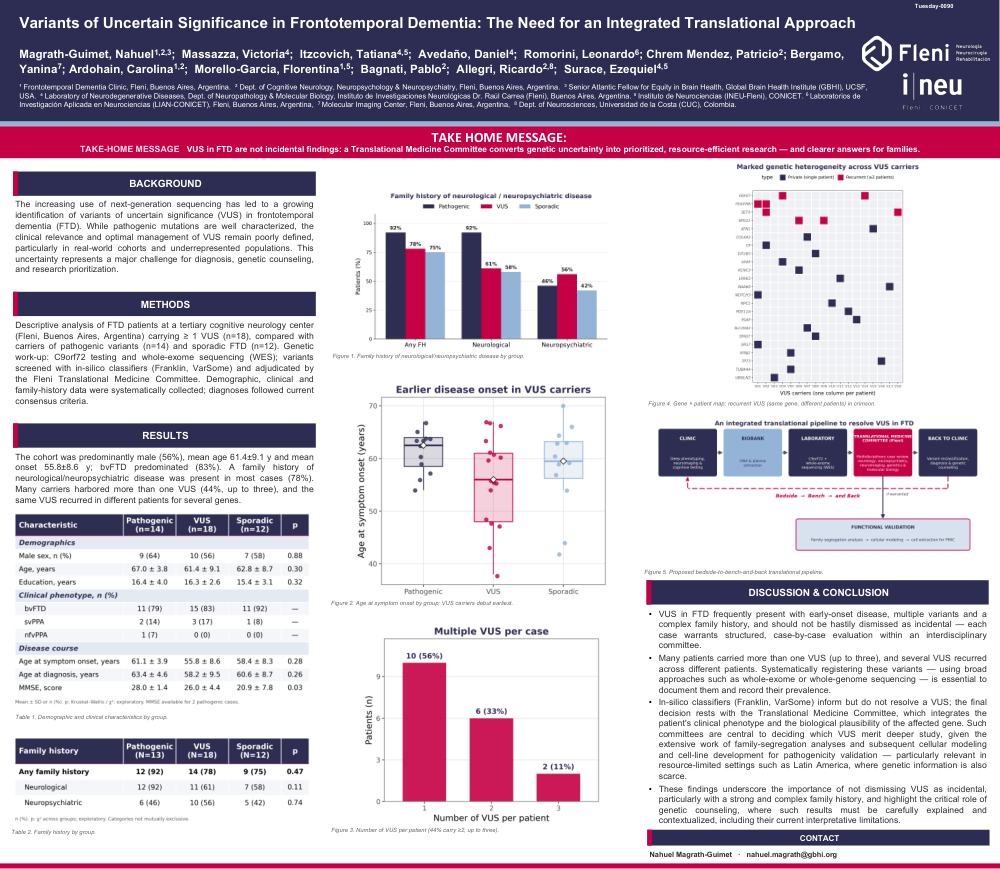
The cohort was predominantly male (56%), with a mean age of 61.4 ± 9.1 years and a mean age at symptom onset of 55.8 ± 8.6 years; bvFTD was the most frequent presentation (83%), followed by svPPA (17%). VUS carriers showed the earliest symptom onset of the three groups (median 56 vs 62 years in pathogenic and 60 in sporadic cases; Figure 2). A family history of neurological or neuropsychiatric disease was present in most cases (78%), spanning both neurological and neuropsychiatric domains, without significant differences from pathogenic-variant carriers (Figure 1, Table 2). Marked genetic heterogeneity was observed: 23 distinct genes were involved, 44% of carriers harbored more than one VUS (up to three; Figure 3), and the same VUS recurred across different patients for several genes (FBX07, PDGFRB, SETX, SPG11; Figure 4).
DISCUSSION & CONCLUSION
VUS in FTD frequently present with early-onset disease, multiple variants and a complex family history, and should not be hastily dismissed as incidental — each case warrants structured, case-by-case evaluation within an interdisciplinary committee. Many patients carried more than one VUS (up to three), and several VUS recurred across different patients. Systematically registering these variants — using broad approaches such as whole-exome or whole-genome sequencing — is essential to document them and build a record of their prevalence. In-silico classifiers (Franklin, VarSome) inform but do not resolve a VUS; the final decision rests with the Translational Medicine Committee, which integrates the patient's clinical phenotype and the biological plausibility of the affected gene. Such committees are central to deciding which VUS merit deeper study, given the extensive work of family-segregation analyses and subsequent cellular modeling and cell-line development for pathogenicity validation — particularly relevant in resource-limited settings such as Latin America, where genetic information is also scarce. These findings underscore the importance of not dismissing VUS as incidental, particularly in the context of a strong and complex family history, and highlight the critical role of genetic counseling, where such results must be carefully explained and contextualized, including their current interpretative limitations. Resolving VUS requires an integrated, bedside-to-bench-and-back pipeline anchored in a multidisciplinary committee, systematic phenotyping and biobanking, segregation analysis, and functional validation (Figure 5).
Contact: Nahuel Magrath-Guimet · nahuel.magrath@gbhi.org
Comments
Email is required but is not shown publicly.
Loading comments...