4,068 posters, 219 videos, 101 topics, 69 sessions, 14,365 authors, 6,128 institutions
ePostersLive by SciGen Technologies S.A. All rights reserved.
Alzheimer's Association International Conference 2026
July 12-15, 2026 | London, United Kingdom, and Online

9581
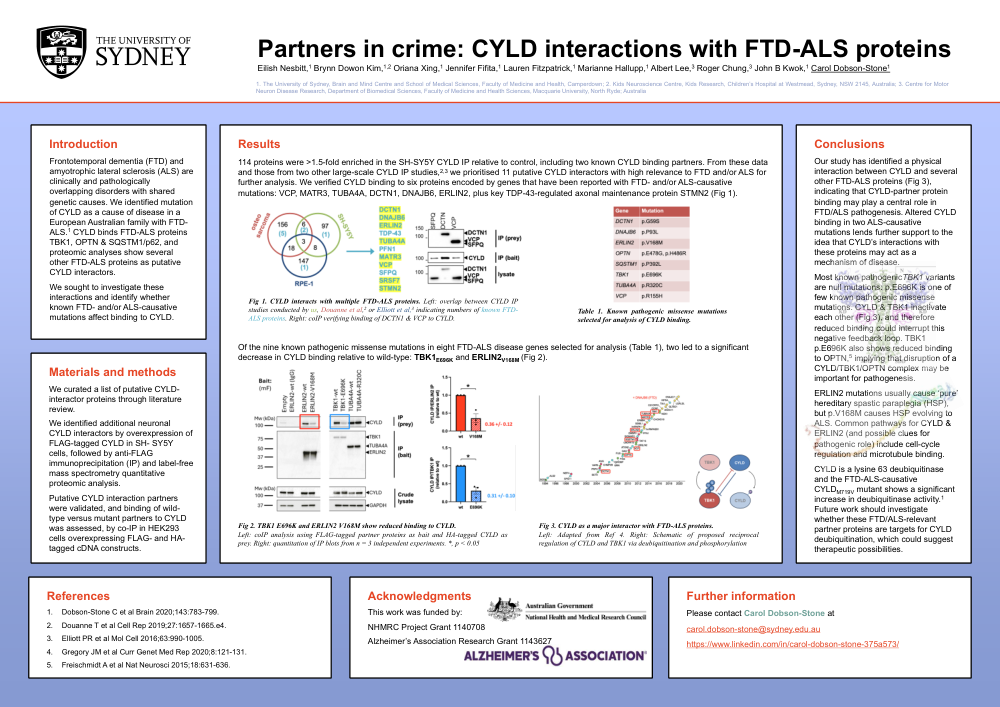
Partners In Crime: CYLD Interactions With FTD-ALS Proteins
Poster Presenter
Authors
Eilish Nesbitt, Brynn Dowon Kim, Oriana Xing, Jennifer Fifita, Lauren Fitzpatrick, Marianne Hallupp, Albert Lee, Roger Chung, John Kwok, Carol Dobson-Stone
Affiliations
The University of Sydney, Brain and Mind Centre and School of Medical Sciences, Faculty of Medicine and Health, Sydney, Australia, The University of Sydney, Brain and Mind Centre and School of Medical Sciences, Faculty of Medicine and Health, Sydney, Australia; Kids Neuroscience Centre, Kids Research, Children’s Hospital at Westmead, Sydney, Australia, Centre for Motor Neuron Disease Research, Department of Biomedical Sciences, Faculty of Medicine and Health Sciences, Macquarie University, Sydney, Australia
Part of Topic
Introduction
Frontotemporal dementia (FTD) and amyotrophic lateral sclerosis (ALS) are clinically and pathologically overlapping disorders with shared genetic causes. We identified mutation of CYLD as a cause of disease in a European Australian family with FTD- ALS.1 CYLD binds FTD-ALS proteins TBK1, OPTN & SQSTM1/p62, and proteomic analyses show several other FTD-ALS proteins as putative CYLD interactors. We sought to investigate these interactions and identify whether known FTD- and/or ALS-causative mutations affect binding to CYLD.
Materials and methods
We curated a list of putative CYLD- interactor proteins through literature review. We identified additional neuronal CYLD interactors by overexpression of FLAG-tagged CYLD in SH- SY5Y cells, followed by anti-FLAG immunoprecipitation (IP) and label-free mass spectrometry quantitative proteomic analysis. Putative CYLD interaction partners were validated, and binding of wild- type versus mutant partners to CYLD was assessed, by co-IP in HEK293 cells overexpressing FLAG- and HA- tagged cDNA constructs.
Results
114 proteins were >1.5-fold enriched in the SH-SY5Y CYLD IP relative to control, including two known CYLD binding partners. From these data and those from two other large-scale CYLD IP studies,2,3 we prioritised 11 putative CYLD interactors with high relevance to FTD and/or ALS for further analysis. We verified CYLD binding to six proteins encoded by genes that have been reported with FTD- and/or ALS-causative mutations: VCP, MATR3, TUBA4A, DCTN1, DNAJB6, ERLIN2, plus key TDP-43-regulated axonal maintenance protein STMN2 (Fig 1). Of the nine known pathogenic missense mutations in eight FTD-ALS disease genes selected for analysis (Table 1), two led to a significant decrease in CYLD binding relative to wild-type: TBK1E696K and ERLIN2V168M (Fig 2).
Conclusions
Our study has identified a physical interaction between CYLD and several other FTD-ALS proteins (Fig 3), indicating that CYLD-partner protein binding may play a central role in FTD/ALS pathogenesis. Altered CYLD binding in two ALS-causative mutations lends further support to the idea that CYLD’s interactions with these proteins may act as a mechanism of disease. Most known pathogenicTBK1 variants are null mutations: p.E696K is one of few known pathogenic missense mutations. CYLD & TBK1 inactivate each other (Fig 3), and therefore reduced binding could interrupt this negative feedback loop. TBK1 p.E696K also shows reduced binding to OPTN,5 implying that disruption of a CYLD/TBK1/OPTN complex may be important for pathogenesis. ERLIN2 mutations usually cause ‘pure’ hereditary spastic paraplegia (HSP), but p.V168M causes HSP evolving to ALS. Common pathways for CYLD & ERLIN2 (and possible clues for pathogenic role) include cell-cycle regulation and microtubule binding. CYLD is a lysine 63 deubiquitinase and the FTD-ALS-causative CYLDM719V mutant shows a significant increase in deubiquitinase activity.1 Future work should investigate whether these FTD/ALS-relevant partner proteins are targets for CYLD deubiquitination, which could suggest therapeutic possibilities.
Comments
Email is required but is not shown publicly.
Loading comments...