4,068 posters, 219 videos, 101 topics, 69 sessions, 14,365 authors, 6,128 institutions
ePostersLive by SciGen Technologies S.A. All rights reserved.
Alzheimer's Association International Conference 2026
July 12-15, 2026 | London, United Kingdom, and Online

6118
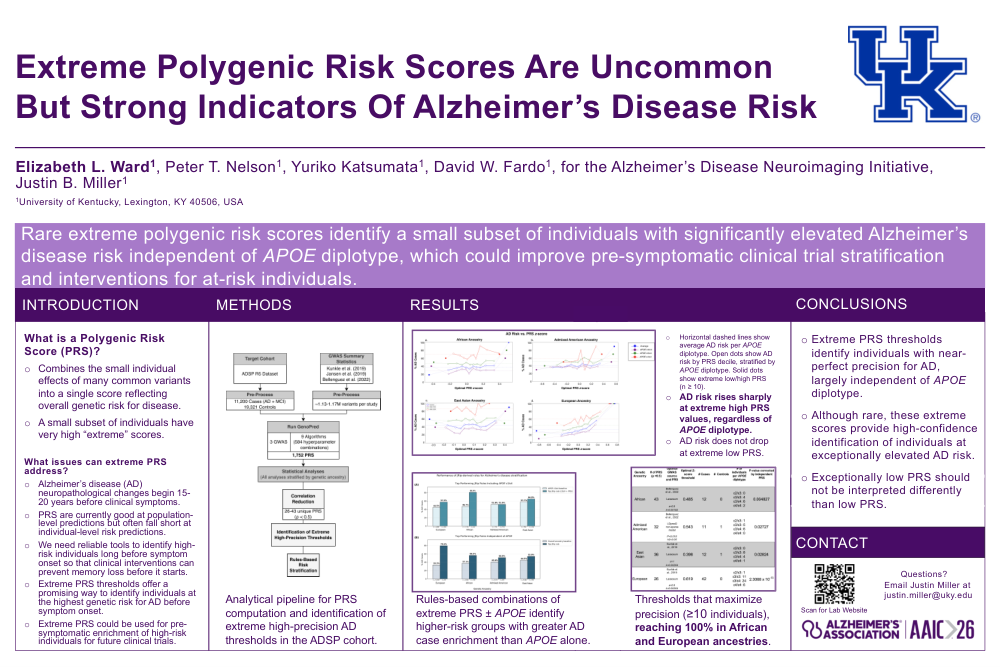
Extreme Polygenic Risk Scores Are Uncommon But Strong Indicators Of Alzheimer’s Disease Risk
Poster Presenter
Part of Topic
Background. Polygenic risk scores (PRS) combine the common genetic variant effects identified through genome-wide association studies (GWAS) to predict Alzheimer’s disease (AD) risk beyond APOE diplotyping alone. PRS generally have a modest impact on AD risk prediction when assessed across a large population. Here, we explored the frequency and confidence of AD diagnosis in individuals at the highest genetic risk for AD in various populations using extreme PRS (i.e., rare conformations of common genetic variants that result in exceptionally high PRS for a specific genetic ancestry).
Methods. Using the standardized GenoPred pipeline, 1,752 PRS algorithms and hyperparameter were evaluated across three commonly used GWAS summary statistics from Kunkle et al., 2019, Jansen et al., 2019, and Bellenguez et al., 2022. Starting with 11,200 autopsy or clinically defined AD cases and 19,321 controls (age ≥65) from the ADSP release 5, individuals were stratified by genetic ancestry (>95% probability), and HapMap3-restricted PRS were standardized to the 1000 Genomes and Human Genome Diversity Project populations. Populations with >1,000 cases and controls in the ADSP were included in downstream analyses: 3,393 African (1,260 cases; 2,133 controls), 3,212 Admixed American (1,304 cases; 1,908 controls), 2,289 East Asian (1,018 cases; 1,271 controls), and 13,232 European (4,392 cases; 8,840 controls). Thresholds maximizing PRS precision were identified, and chi-squared p-values were adjusted by the number of PRS with moderately-low correlation (Spearman’s ρ<0.5).
Results. Extreme PRS were found across APOE diplotypes and could confidently indicate AD diagnosis for 42 European cases (0 controls) and 12 African cases (0 controls). There was no significant difference in age between AD cases with extreme PRS and other AD cases, although Europeans with extreme PRS tended to be about two years younger at AD diagnosis than other AD cases (P=0.1174). Extreme PRS significantly denote AD risk in each population (African Padj=0.004827; Admixed American Padj=0.02727; East Asian Padj=0.02824; European Padj=2.3068x10⁻¹³).
Conclusions. Extreme PRS transcend APOE diplotypes and indicate exceptionally high risk for AD. AD genetic risk models may consider using extreme PRS as independent risk factors similar to rare variants with large effects.
Comments
Email is required but is not shown publicly.
Loading comments...