4,068 posters, 219 videos, 101 topics, 69 sessions, 14,365 authors, 6,128 institutions
ePostersLive by SciGen Technologies S.A. All rights reserved.
Alzheimer's Association International Conference 2026
July 12-15, 2026 | London, United Kingdom, and Online

10636
Changes In Loneliness Among Family Caregivers Of People Living With Dementia: A One-year Longitudinal Study Of Predictive Factors
Poster Presenter
Part of Topic
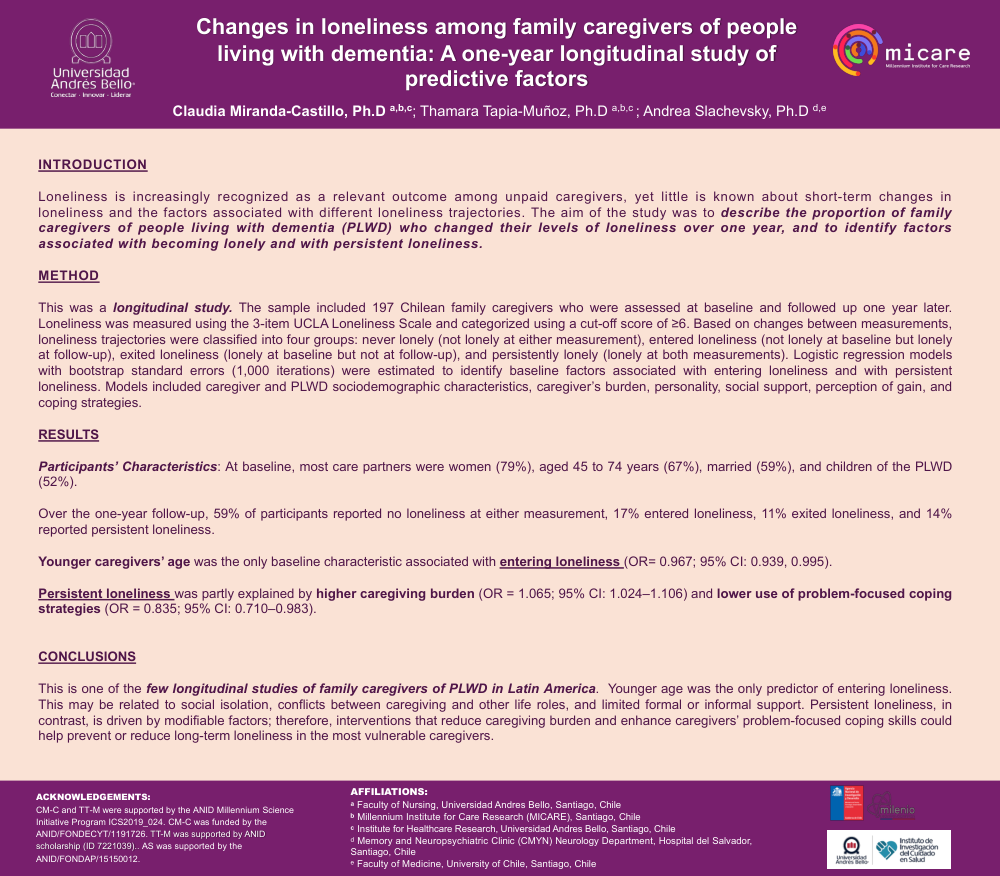
Title: Changes in loneliness among family caregivers of people living with dementia: A one-year longitudinal study of predictive factors.
Background: Loneliness is increasingly recognised as a relevant outcome among unpaid caregivers, yet little is known about short-term changes in loneliness and the factors associated with different loneliness trajectories.The aim of the study was to describe the proportion of family caregivers of people living with dementia (PLWD) who changed their levels of loneliness over one year, and to identify factors associated with becoming lonely and with persistent loneliness.
Method: The sample included 197 Chilean family caregivers who were assessed at baseline and followed up one year later. Loneliness was measured using the 3-item UCLA Loneliness Scale and categorised using a cut-off score of ≥6. Based on changes between measurements, loneliness trajectories were classified into four groups: never lonely (not lonely at either measurement), entered loneliness (not lonely at baseline but lonely at follow-up), exited loneliness (lonely at baseline but not at follow-up), and persistently lonely (lonely at both measurements). Logistic regression models with bootstrap standard errors (1,000 iterations) were estimated to identify baseline factors associated with entering loneliness and with persistent loneliness. Models included caregiver and PLWD sociodemographic characteristics, caregiver’s burden, personality, social support, perception of gain, and coping strategies.
Results: At baseline, most care partners were women (79%), aged 45 to 74 years (67%), married (59%), and children of the PLWD (52%). Over the one-year follow-up, 59% of participants reported no loneliness at either measurement, 17% entered loneliness, 11% exited loneliness, and 14% reported persistent loneliness. Caregivers’ age was the only baseline characteristic associated with entering loneliness (OR= 0.967; 95% CI: 0.939, 0.995). Persistent loneliness was partly explained by higher caregiving burden (OR = 1.065; 95% CI: 1.024–1.106) and lower use of problem-focused coping strategies (OR = 0.835; 95% CI: 0.710–0.983).
Conclusion: Younger age was the only predictor of entering loneliness. This may be related to social isolation, conflicts between caregiving and other life roles, and limited formal or informal support. Persistent loneliness, in contrast, is driven by modifiable factors; therefore, interventions that reduce caregiving burden and enhance caregivers’ problem-focused coping skills could help prevent or reduce long-term loneliness in the most vulnerable caregivers.
Comments
Email is required but is not shown publicly.
Loading comments...