4,068 posters, 219 videos, 101 topics, 69 sessions, 14,365 authors, 6,128 institutions
ePostersLive by SciGen Technologies S.A. All rights reserved.
Alzheimer's Association International Conference 2026
July 12-15, 2026 | London, United Kingdom, and Online

10340
Network- And Pathway-informed Precision Drug Combinations For APOE- And Endocrine-specific Alzheimer’s Risk
Poster Presenter
Authors
Part of Topic
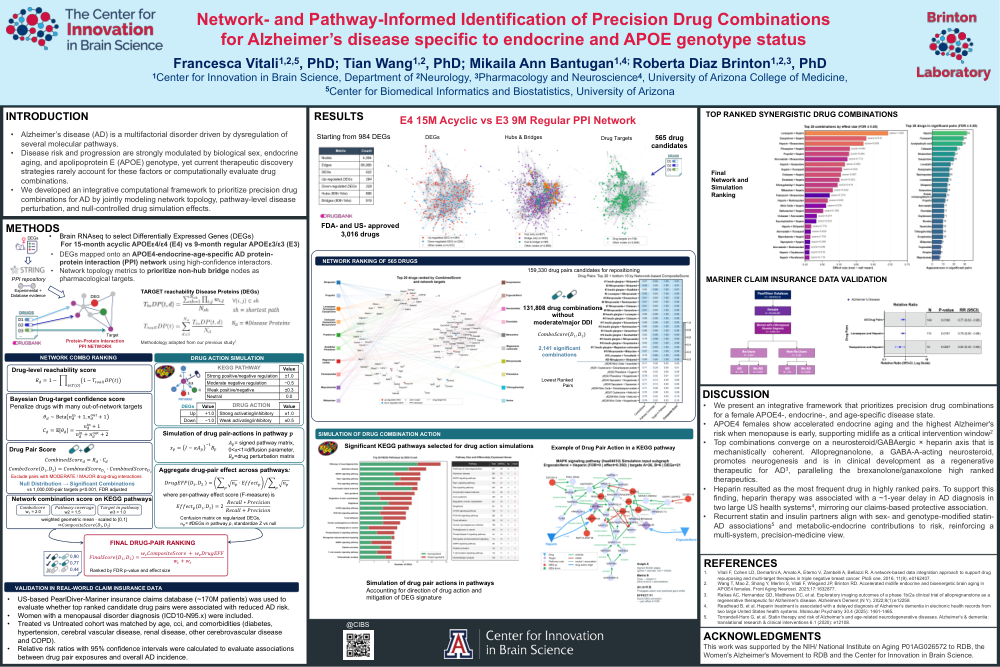
Network- and Pathway-Informed Identification of Precision Drug Combinations for Alzheimer’s disease specific to endocrine and APOE genotype status
Francesca Vitali, PhD1,3,4; Tian Wang1,3, PhD; Roberta Diaz Brinton, PhD1,2,3
1Center for Innovation in Brain Science, University of Arizona Health Sciences, Tucson, AZ; 2Department of Pharmacology, University of Arizona College of Medicine Tucson; 3Department of Neurology, University of Arizona College of Medicine Tucson;4Center for Biomedical Informatics and Biostatistics, University of Arizona, Tucson, AZ
Introduction
Alzheimer’s disease (AD) is a multifactorial disorder driven by dysregulation of several molecular pathways. Disease risk and progression are strongly modulated by biological sex, endocrine aging, and apolipoprotein E (APOE) genotype, yet current therapeutic discovery strategies rarely account for these factors or computationally evaluate drug combinations. We developed an integrative computational framework to prioritize precision drug combinations for AD by jointly modeling network topology, pathway-level disease perturbation, and null-controlled drug simulation effects.
Methods
Transcriptomic signatures were derived from brain RNAseq data comparing 15-month acyclic APOEε4/ε4 (E4) vs 9-month regular APOEε3/ε3 (E3) female mouse models, identifying Differentially Expressed Genes (DEGs, p-value < 0.01). DEGs were mapped onto an APOE4-endocrine-age-specific AD protein-protein network using high-confidence interactors from STRING. Network topology metrics were computed to prioritize non-hub bridge nodes as pharmacological targets. Drug-target relationships were curated from DrugBank to include FDA-approved drugs with blood-brain barrier permeability. Drug pairs were generated, filtered for adverse drug-drug interactions, and scored using a network-based synergy metric integrating target reachability while penalizing off-network targeting. Statistical significance was assessed using null distribution, and significant drug pairs (FDR<0.01) were advanced for simulation. KEGG pathway enrichment and pathway-level simulations incorporating gene-gene and drug-gene interactions were used to quantify reversal of DEG dysregulation. Simulation scores were integrated with network synergy scores for final ranking.
Results
Differential expression analysis identified 984 and enabled construction of an APOE4-specific AD network comprising 4,594 proteins and 66,066 interactions. Drug integration yielded 565 therapeutic candidates and 131,808 drug pairs. Null model analysis identified 1,639 significant pairs (FDR < 0.01). KEGG enrichment analysis identified 44 disease-relevant pathways including pathways related to neurodegeneration, AD, and immune regulation. Final ranking of drug pairs highlighted recurrent drugs such as lorazepam, heparin, brexanolone, and statins, which have been previously associated with reduced AD risk or slower cognitive decline in experimental and real-world retrospective studies.
Conclusions
We present a network- and pathway-informed framework for identifying AD precision drug combinations tailored to APOE genotype and endocrine aging. By integrating network topology with pathway-level drug action simulations, this approach identified biologically meaningful combination of therapeutic candidates. Identified drug combinations provide a rational, data-driven foundation for experimental validation and translational development of therapies for APOE4-associated AD.
#Alzheimer's disease, #APOE, #drug repurposing, #sex differences, #network pharmacology
Comments
Email is required but is not shown publicly.
Loading comments...