4,068 posters, 219 videos, 101 topics, 69 sessions, 14,365 authors, 6,128 institutions
ePostersLive by SciGen Technologies S.A. All rights reserved.
Alzheimer's Association International Conference 2026
July 12-15, 2026 | London, United Kingdom, and Online

3871
Current and future strategies to manage CAA and ARIA
Poster Presenter
Authors
Part of Topic
Current and Future Strategies to Manage CAA
and ARIA
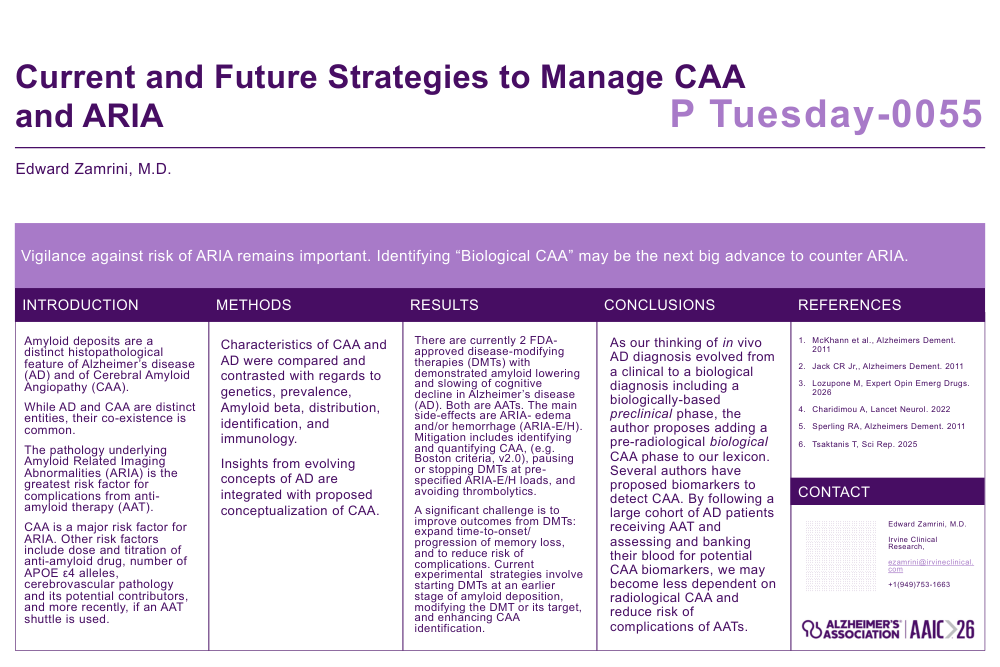
Vigilance against risk of ARIA remains important. Identifying “Biological CAA” may be the next big advance to counter ARIA.
Edward Zamrini, M.D.
P Tuesday-0055
INTRODUCTION METHODS RESULTS CONCLUSIONS REFERENCES
CONTACT
Amyloid deposits are a
distinct histopathological
feature of Alzheimer’s disease
(AD) and of Cerebral Amyloid
Angiopathy (CAA).
While AD and CAA are distinct
entities, their co-existence is
common.
The pathology underlying
Amyloid Related Imaging
Abnormalities (ARIA) is the
greatest risk factor for
complications from anti-
amyloid therapy (AAT).
CAA is a major risk factor for
ARIA. Other risk factors
include dose and titration of
anti-amyloid drug, number of
APOE ε4 alleles,
cerebrovascular pathology
and its potential contributors,
and more recently, if an AAT
shuttle is used.
Characteristics of CAA and
AD were compared and
contrasted with regards to
genetics, prevalence,
Amyloid beta, distribution,
identification, and
immunology.
Insights from evolving
concepts of AD are
integrated with proposed
conceptualization of CAA.
There are currently 2 FDA-
approved disease-modifying
therapies (DMTs) with
demonstrated amyloid lowering
and slowing of cognitive
decline in Alzheimer’s disease
(AD). Both are AATs. The main
side-effects are ARIA- edema
and/or hemorrhage (ARIA-E/H).
Mitigation includes identifying
and quantifying CAA, (e.g.
Boston criteria, v2.0), pausing
or stopping DMTs at pre-
specified ARIA-E/H loads, and
avoiding thrombolytics.
A significant challenge is to
improve outcomes from DMTs:
expand time-to-onset/
progression of memory loss,
and to reduce risk of
complications. Current
experimental strategies involve
starting DMTs at an earlier
stage of amyloid deposition,
modifying the DMT or its target,
and enhancing CAA
identification.
As our thinking of in vivo
AD diagnosis evolved from
a clinical to a biological
diagnosis including a
biologically-based
preclinical phase, the
author proposes adding a
pre-radiological biological
CAA phase to our lexicon.
Several authors have
proposed biomarkers to
detect CAA. By following a
large cohort of AD patients
receiving AAT and
assessing and banking
their blood for potential
CAA biomarkers, we may
become less dependent on
radiological CAA and
reduce risk of
complications of AATs.
1. McKhann et al., Alzheimers Dement.
2011
2. Jack CR Jr,, Alzheimers Dement. 2011
3. Lozupone M, Expert Opin Emerg Drugs.
2026
4. Charidimou A, Lancet Neurol. 2022
5. Sperling RA, Alzheimers Dement. 2011
6. Tsaktanis T, Sci Rep. 2025
Edward Zamrini, M.D.
Irvine Clinical
Research,
ezamrini@irvineclinical.
com
+1(949)753-1663
Comments
Email is required but is not shown publicly.
Loading comments...