4,068 posters, 219 videos, 101 topics, 69 sessions, 14,365 authors, 6,128 institutions
ePostersLive by SciGen Technologies S.A. All rights reserved.
Alzheimer's Association International Conference 2026
July 12-15, 2026 | London, United Kingdom, and Online

7008
Activity And Clinical Progress Of Pmn310 Designed To Selectively Target Toxic aί Oligomers For Greater Potency In Alzheimer’s Disease
Poster Presenter
Authors
Part of Topic
Title: Activity and clinical progress of PMN310 designed to selectively target toxic Aß oligomers for greater potency in Alzheimer’s disease
Authors:
Johanne Kaplan1, Ebrima Gibbs2, Beibei Zhao1, Juliane Coutts2, Oliver Bannach3, Marlene Pils3, Fabian Rehn3, Larry Altstiel1, Neil Cashman1,2
1ProMIS Neurosciences, Cambridge, MA, 2University of British Columbia, Vancouver, BC, Canada, 3attyloid, GmbH, Dusseldorf, Germany
Background:
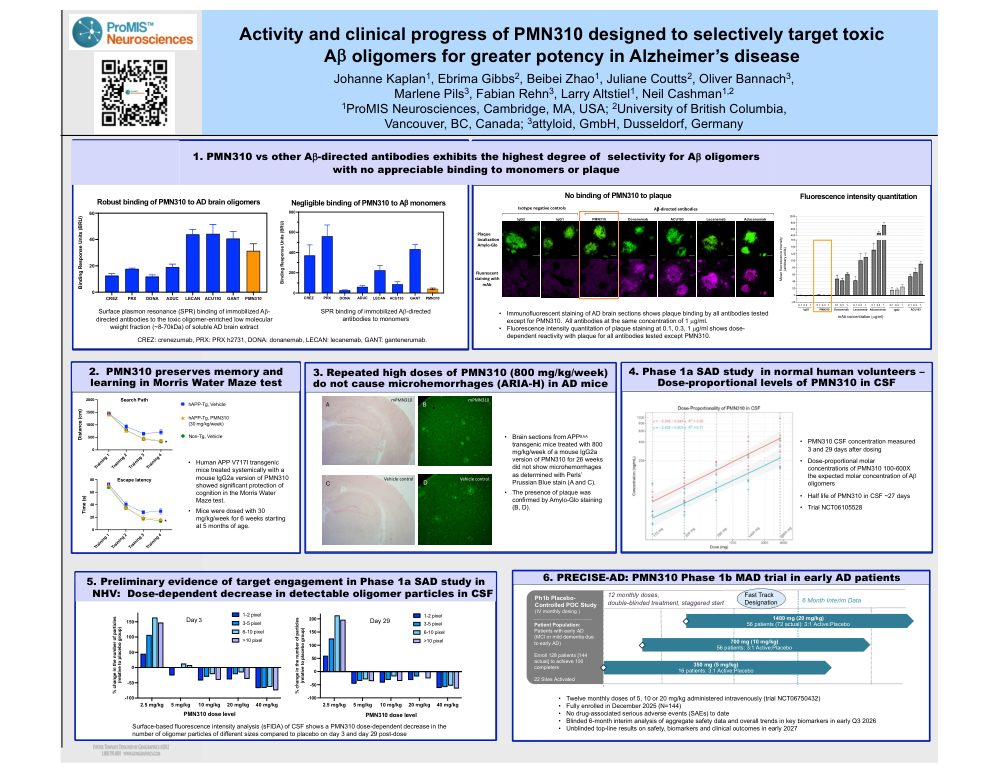
Advances in the understanding of Alzheimer’s disease (AD) suggest that pathogenesis is not directly related to plaque burden, but rather to soluble toxic amyloid-beta oligomers (AßO). Off-target binding to monomers and/or plaque can reduce the effective dose, and plaque binding is associated with dose-limiting brain edema (ARIA-E) and microhemorrhages (ARIA-H). These findings suggest that antibodies capable of selectively neutralizing toxic AßO may achieve improved efficacy and safety. PMN310 was designed to achieve this goal.
Methods:
The binding selectivity of PMN310 and other Aß-directed antibodies was characterized by surface plasmon resonance (SPR) and staining of AD brain tissue. The protective activity and safety of PMN310 were tested preclinically in transgenic mouse models of AD. A single ascending dose (SAD) Phase 1a trial was conducted in healthy volunteers (N=40) and a multiple ascending dose (MAD) Phase 1b trial is ongoing in patients with early AD (N=144 at enrollment completion).
Results:
Unlike other Aß-directed antibodies, PMN310 showed strong binding to AßO with no interaction with monomers by SPR and no detectable reactivity with plaque and vascular deposits in AD brain sections. Systemic administration of PMN310 to AD mice preserved memory and learning in the water maze task. In safety assessments, administration of 800 mg/kg/week for 26 weeks did not show signs of adverse toxicity or bleeding in the brain (no ARIA-H). PMN310 was well-tolerated in the Phase 1a SAD trial. CSF concentrations were linearly dose-dependent reaching 100-600X the estimated molar concentration of AßO with a half-life of ~27 days. Analysis of CSF by surface-based fluorescence intensity distribution analysis (sFIDA) showed target engagement with a dose-dependent interaction of PMN310 with AßO. The Phase 1b MAD trial is ongoing at dose levels of 5, 10 and 20 mg/kg/month administered intravenously for 12 months. To date (over 60 AD patients treated for 6 months or more), the safety profile is in line with expectations with no drug-related serious adverse events.
Conclusion:
PMN310 is differentiated from other Aß-directed antibodies by its strict selectivity for AßO. Ongoing clinical testing may provide the basis for a true test of the “oligomer hypothesis” without confounding reactivity with other Aß species.
Comments
Email is required but is not shown publicly.
Loading comments...