4,068 posters, 219 videos, 101 topics, 69 sessions, 14,365 authors, 6,128 institutions
ePostersLive by SciGen Technologies S.A. All rights reserved.
Alzheimer's Association International Conference 2026
July 12-15, 2026 | London, United Kingdom, and Online

4905
Ultra-high-frequency Visual Stimulation As Potential Treatment For Alzheimer’s Disease
Poster Presenter
Authors
Julian Keil, Maria Buthut, Ravit Hadar, Jana Fass, Liam Doherty, Jakob Litsch, Fabian Queisner, Markus Müschenich, Surjo Soekadar
Affiliations
Clinical Neurotechnology Lab, Department of Psychiatry and Neurosciences, Charité Campus Mitte (CCM), Charité – Universitätsmedizin Berlin, Berlin, Germany, Nuuron GmbH, Berlin, Germany, Medical School Berlin, Berlin, Germany, Potsdam Embodied Cognition Group, Department of Cognitive Science, University of Potsdam, Potsdam, Germany
Part of Topic
Video
Ultra-high-frequency visual stimulation as potential treatment for Alzheimer’s Disease
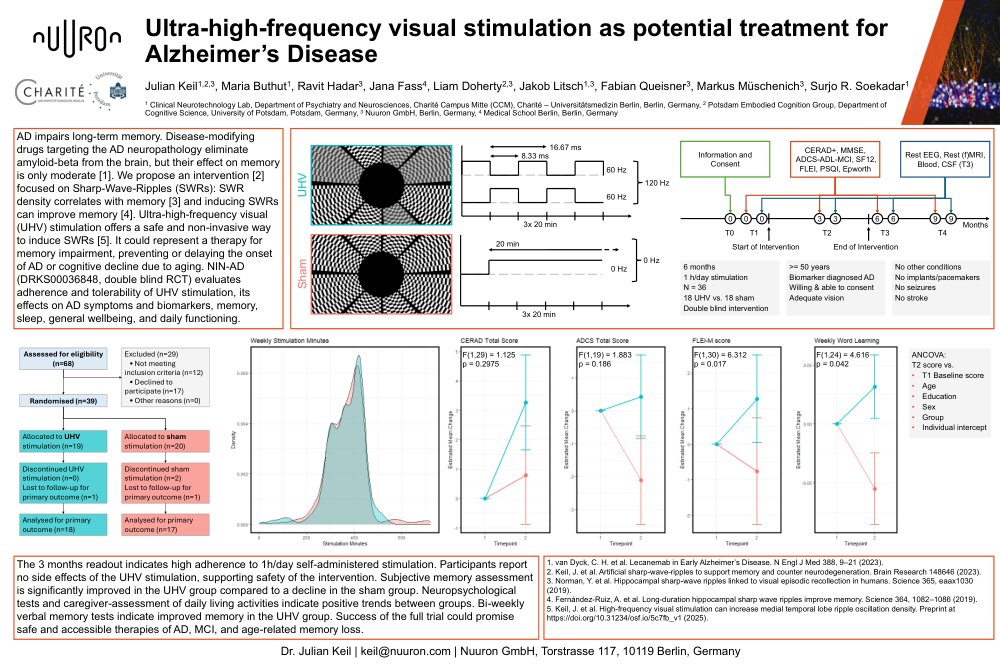
AD impairs long-term memory. Disease-modifying drugs targeting the AD neuropathology eliminate amyloid-beta from the brain, but their effect on memory is only moderate [1]. We propose an intervention [2] focused on Sharp-Wave-Ripples (SWRs): SWR density correlates with memory [3] and inducing SWRs can improve memory [4]. Ultra-high-frequency visual (UHV) stimulation offers a safe and non-invasive way to induce SWRs [5]. It could represent a therapy for memory impairment, preventing or delaying the onset of AD or cognitive decline due to aging. NIN-AD (DRKS00036848, double blind RCT) evaluates adherence and tolerability of UHV stimulation, its effects on AD symptoms and biomarkers, memory, sleep, general wellbeing, and daily functioning.
The 3 months readout indicates high adherence to 1h/day self-administered stimulation. Participants report no side effects of the UHV stimulation, supporting safety of the intervention. Subjective memory assessment is significantly improved in the UHV group compared to a decline in the sham group. Neuropsychological tests and caregiver-assessment of daily living activities indicate positive trends between groups. Bi-weekly verbal memory tests indicate improved memory in the UHV group. Success of the full trial could promise safe and accessible therapies of AD, MCI, and age-related memory loss.
1. van Dyck, C. H. et al. Lecanemab in Early Alzheimer’s Disease. N Engl J Med 388, 9–21 (2023).
2. Keil, J. et al. Artificial sharp-wave-ripples to support memory and counter neurodegeneration. Brain Research 148646 (2023).
3. Norman, Y. et al. Hippocampal sharp-wave ripples linked to visual episodic recollection in humans. Science 365, eaax1030 (2019).
4. Fernández-Ruiz, A. et al. Long-duration hippocampal sharp wave ripples improve memory. Science 364, 1082–1086 (2019).
5. Keil, J. et al. High-frequency visual stimulation can increase medial temporal lobe ripple oscillation density. Preprint at https://doi.org/10.31234/osf.io/5c7fb_v1 (2025).
Comments
Email is required but is not shown publicly.
Loading comments...