4,068 posters, 219 videos, 101 topics, 69 sessions, 14,365 authors, 6,128 institutions
ePostersLive by SciGen Technologies S.A. All rights reserved.
Alzheimer's Association International Conference 2026
July 12-15, 2026 | London, United Kingdom, and Online

9302
Understanding Participatory Arts Among Persons Living With Dementia_A Case Study Of The Garden Trolley Program
Poster Presenter
Authors
Funmi Akindejoye, Azam Bazooband, Leigh Tesch, Duncan Sinclair, Bec Stevens, Pauline Marsh
Affiliations
Wicking Dementia Research and Education Centre, University of Tasmania, Tasmania Australia, Menzies Institute for Medical Research, University of Tasmania, Tasmania Australia, Inscape Tasmania, Tasmania Australia
Part of Topic
Video
We know that connecting to nature reduces stress, restores attention and improves the quality of life of persons living with dementia.
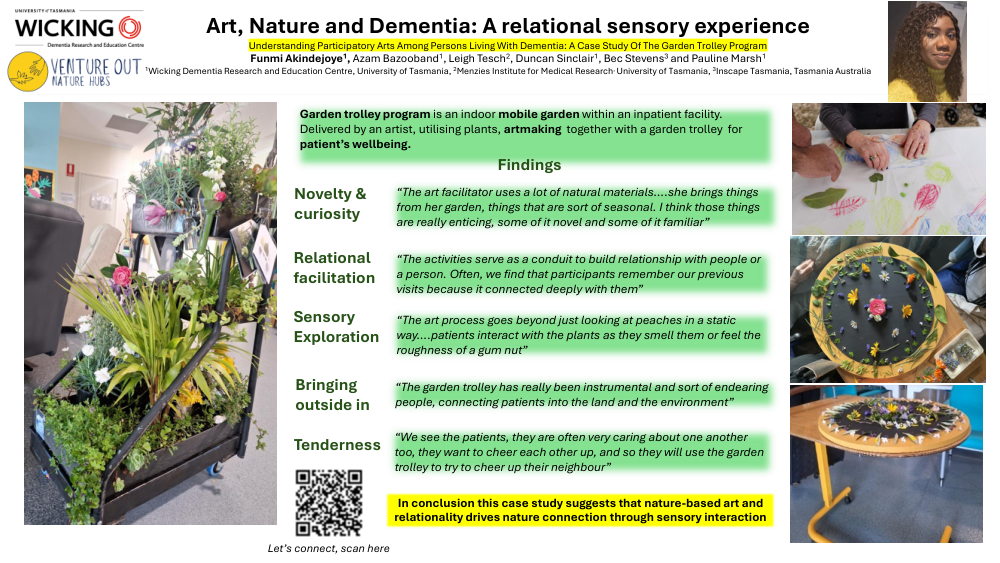
Interestingly the Garden Trolley Program which utilises an indoor mobile garden (as seen on the image on your left) enables persons living with dementia admitted into long term care, connect with nature.
The program is delivered by an artist, who utilises plants, artmaking and a garden trolley to improve the wellbeing of patients (as seen on the images to your right).
Having spent 21 hours of observation and 270 minutes of interviews at this inpatient facility, I discovered that:
- First, the novel and unusual use of familiar nature materials for art, captured participants curiosity to create nature-based art.
- Also, the artist relational approach guided by trust, respect and compassion bridged the art activities and connection to nature through sensory interaction.
- Building on that, the program enabled and motivated patients to venture out into the facility’s outdoor garden spaces.
- Finally, the quiet, soothing and calm atmosphere conveyed by plants and nature, was believed to trigger participant’s tendency to care and nurture, as well as influence the facility’s organisational culture.
In conclusion, this case study suggest that nature-based art and relationality drives nature connection through sensory interaction.
Thank you, for listening.
Comments
Email is required but is not shown publicly.
Loading comments...