4,068 posters, 219 videos, 101 topics, 69 sessions, 14,365 authors, 6,128 institutions
ePostersLive by SciGen Technologies S.A. All rights reserved.
Alzheimer's Association International Conference 2026
July 12-15, 2026 | London, United Kingdom, and Online

8609
Dual-path Memory-guided Swin Transformer For Interpretable Alzheimer’s Magnetic Resonance Imaging Slice Classification
Poster Presenter
Authors
Affiliations
Part of Topic
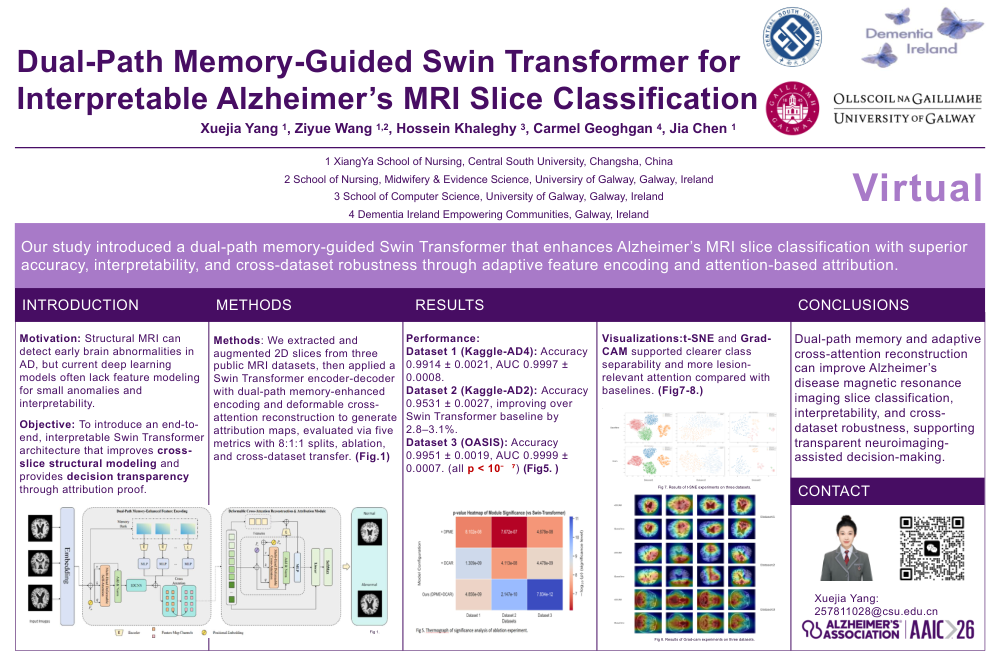
Dual-Path Memory-Guided Swin Transformer for Interpretable Alzheimer’s Magnetic Resonance Imaging Slice Classification
Background
Structural magnetic resonance imaging can detect early brain abnormalities in Alzheimer's disease, a prevalent neurodegenerative disease. However, contemporary deep learning algorithms frequently lack feature modelling for small anomalies and interpretability, reducing clinician confidence in model outputs. A new end-to-end, interpretable Swin Transformer architecture improves cross-slice structural modelling and provides decision transparency attribution proof.
Methods
An encoder–decoder model featuring Dual-Path Memory-Enhanced Feature Encoding and Deformable Cross-Attention Reconstruction and Attribution modules was created. The Dual-Path Memory-Enhanced Feature Encoding module improves fine-grained discrimination and cross-slice structural consistency with a dynamic memory bank and gated fusion of a primary local feature stream and a memory-guided global Deformable cross-layer attention, multi-scale feature fusion, and attention backtracking produce image-space-aligned attribution maps in the Deformable Cross-Attention Reconstruction and Attribution module. In tests, two-dimensional slice extraction, 224x224 resizing, rotation, flipping, brightness/gamma perturbation, and Gaussian noise were applied to three public magnetic resonance imaging datasets (two Kaggle and one Open Access Series of Imaging Studies). Splitting training, validation, and testing data 8:1:1. Accuracy, precision, recall, F1-score, and AUC were evaluated. We tested module ablation and cross-dataset transfer.
Results
On the four-class Kaggle dataset (Dataset 1), the proposed method achieved an accuracy of 0.9914±0.0021 and an area under the curve of 0.9997±0.0008, outperforming multiple convolutional neural network and Transformer comparators. On the binary Kaggle dataset (Dataset 2), it achieved an accuracy of 0.9531±0.0027 and an area under the curve of 0.9634±0.0021, improving over the Swin Transformer baseline by approximately 2.8–3.1% across core metrics. On the Open Access Series of Imaging Studies dataset (Dataset 3), it achieved an accuracy of 0.9951±0.0019 and an area under the curve of 0.9999±0.0007. Ablation confirmed complementary benefits of Dual-Path Memory-Enhanced Feature Encoding and Deformable Cross-Attention Reconstruction and Attribution (all p-values <10⁻⁷). Feature-space and saliency visualisations (t-distributed Stochastic Neighbour Embedding and Gradient-weighted Class Activation Mapping) supported clearer class separability and more lesion-relevant attention compared with the baseline.
Conclusions
Dual-path memory and adaptive cross-attention reconstruction can improve Alzheimer’s disease magnetic resonance imaging slice classification, interpretability, and cross-dataset robustness, supporting transparent neuroimaging-assisted decision-making.
Comments
Email is required but is not shown publicly.
Loading comments...