4,068 posters, 219 videos, 101 topics, 69 sessions, 14,365 authors, 6,128 institutions
ePostersLive by SciGen Technologies S.A. All rights reserved.
Alzheimer's Association International Conference 2026
July 12-15, 2026 | London, United Kingdom, and Online

10482
Brexpiprazole As A Modifier Of Cardiovascular Risk In The Management Of Agitation In Dementia: A Real-world Study
Poster Presenter
Authors
Amanda Carneiro Rodrigues, Carolina Braga Moura, Gabriella Chinaglia Zanin, Yngrid Ferreira, Ana Carolina Gomes, Sephora Almeida, Anderson MP Silva, Diogo Haddad Santos
Affiliations
Faculdade de Ciências Médicas da Santa Casa de São Paulo, São Paulo, Brazil, Cognitive and Behavioral Neurology, Irmandade da Santa Casa de Misericórdia de São Paulo, São Paulo, Brazil, Physiology and Pharmacology, Federal University of Pernambuco, Recife, Brazil
Part of Topic
Background
Agitation in dementia is frequently managed with antipsychotic medications, despite well-documented cardiovascular adverse effects. Brexpiprazole, a serotonin-dopamine activity modulator, has been approved for the treatment of agitation associated with Alzheimer's disease. However, evidence regarding its cardiovascular safety in routine clinical practice remains limited.
Methods
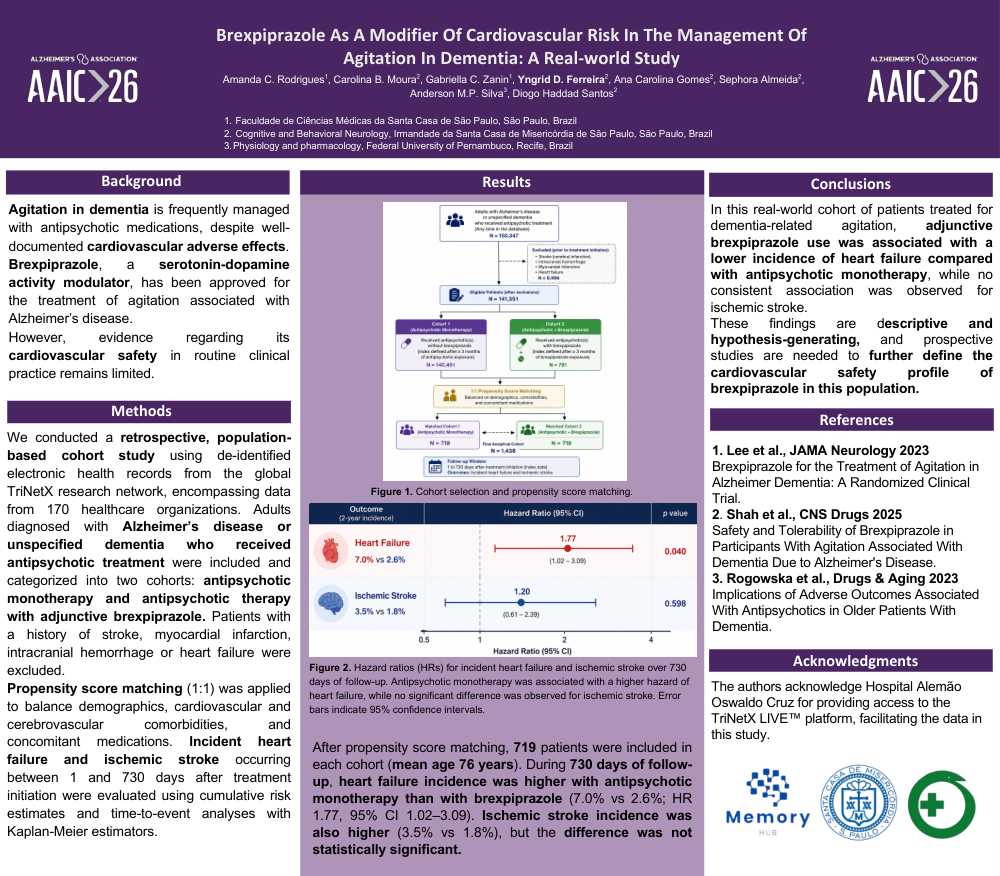
We conducted a retrospective, population-based cohort study using de-identified electronic health records from the global TriNetX research network, encompassing data from 170 healthcare organizations. Adults diagnosed with Alzheimer's disease or unspecified dementia who received antipsychotic treatment were included and categorized into two cohorts: antipsychotic monotherapy and antipsychotic therapy with adjunctive brexpiprazole. Patients with a history of stroke, myocardial infarction, intracranial hemorrhage or heart failure were excluded.
Propensity score matching (1:1) was applied to balance demographics, cardiovascular and cerebrovascular comorbidities, and concomitant medications. Incident heart failure and ischemic stroke occurring between 1 and 730 days after treatment initiation were evaluated using cumulative risk estimates and time-to-event analyses with Kaplan-Meier estimators.
Results
After propensity score matching, 719 patients were included in each cohort (mean age 76 years). During 730 days of follow-up, heart failure incidence was higher with antipsychotic monotherapy than with brexpiprazole (7.0% vs 2.6%; HR 1.77, 95% CI 1.02–3.09). Ischemic stroke incidence was also higher (3.5% vs 1.8%), but the difference was not statistically significant (HR 1.20, 95% CI 0.61–2.39; p=0.598).
Conclusions
In this real-world cohort of patients treated for dementia-related agitation, adjunctive brexpiprazole use was associated with a lower incidence of heart failure compared with antipsychotic monotherapy, while no consistent association was observed for ischemic stroke. These findings are descriptive and hypothesis-generating, and prospective studies are needed to further define the cardiovascular safety profile of brexpiprazole in this population.
References
Lee et al., JAMA Neurology 2023. Brexpiprazole for the Treatment of Agitation in Alzheimer Dementia: A Randomized Clinical Trial.
Shah et al., CNS Drugs 2025. Safety and Tolerability of Brexpiprazole in Participants With Agitation Associated With Dementia Due to Alzheimer's Disease.
Rogowska et al., Drugs & Aging 2023. Implications of Adverse Outcomes Associated With Antipsychotics in Older Patients With Dementia.
Acknowledgments
The authors acknowledge Hospital Alemão Oswaldo Cruz for providing access to the TriNetX LIVE™ platform, facilitating the data in this study.
Comments
Email is required but is not shown publicly.
Loading comments...