4,068 posters, 219 videos, 101 topics, 69 sessions, 14,365 authors, 6,128 institutions
ePostersLive by SciGen Technologies S.A. All rights reserved.
Alzheimer's Association International Conference 2026
July 12-15, 2026 | London, United Kingdom, and Online

6368
Interpretable Digital Twins For Optimizing Alzheimer's Disease Drug Trial Sample Sizes For Sex-Specific Efficacy Analyses
Poster Presenter
Authors
Affiliations
Department of Biomedical Engineering, McGill University, Montreal, Canada; McConnell Brain Imaging Centre, Montreal Neurological Institute, McGill University, Montreal, Canada, Department of Biomedical Engineering, McGill University, Montreal, Canada; McConnell Brain Imaging Centre, Montreal Neurological Institute, McGill University, Montreal, Canada; Department of Neurology & Neurosurgery, McGill University, Montreal, Canada
Part of Topic
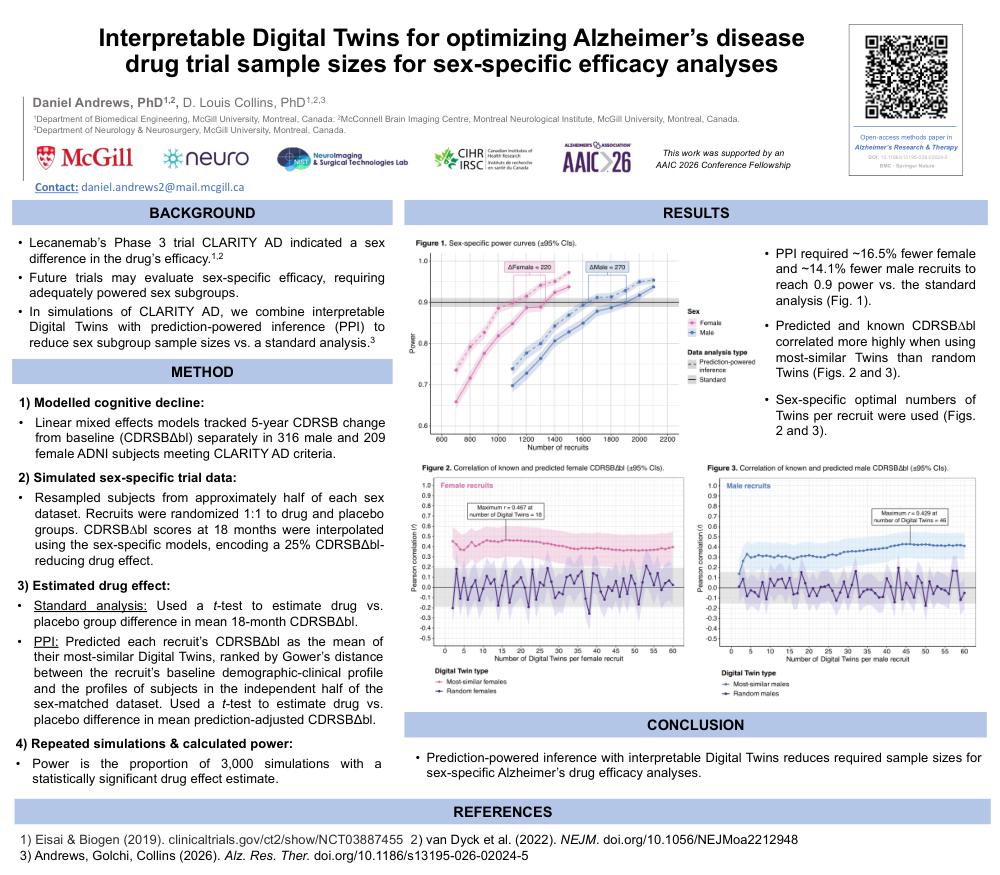
Background: Lecanemab’s phase 3 clinical trial, CLARITY AD, indicated a potentially higher clinical benefit in male Alzheimer’s disease (AD) patients compared to female patients. Future trials may evaluate sex-specific drug efficacy, requiring adequately powered but minimally sized sex subgroups to minimize the added recruitment burden. The present work uses trial simulations constrained by CLARITY AD’s design to calculate sex-specific sample sizes required for a standard data analysis, and for prediction-powered inference leveraging interpretable, sex-specific Digital Twin models of cognitive decline to reduce sample size requirements.
Methods: Linear mixed effects models tracked 5-year CDRSB change from baseline (CDRSBΔbl) in subsets of 316 male and 209 female ADNI subjects satisfying CLARITY AD inclusion criteria. Sex-specific trials were simulated by resampling subjects from approximately half of each sex dataset, creating target trial sample sizes of recruits randomized 1:1 to drug and placebo groups. Recruits’ 18-month CDRSB∆bl scores were interpolated using the sex-specific mixed effects models, which encoded a 25% CDRSB∆bl-reducing drug effect. For the standard analysis, a t-test evaluated drug versus placebo group mean difference in CDRSB∆bl. For prediction-powered inference, each recruit’s CDRSB∆bl was first predicted as the mean from the recruit’s most-similar Digital Twins, identified by ranking Gower’s distance between a recruit’s baseline demographic-clinical profile and that of each subject in the independent half of the sex-matched dataset. A t-test evaluated drug versus placebo group mean difference in recruits’ prediction-adjusted CDRSB∆bl. Power is the proportion of 3,000 simulations with statistically significant effect estimates.
Results: Prediction-powered inference required ~16.5% fewer female and ~14.1% fewer male recruits to reach 0.9 power compared to standard analysis (Figure 1: Female: ~1,110 vs. ~1,330; Male: ~1,640 vs. ~1,910). Sex-specific optimal numbers of Twins per recruit were used (Figures 2-3: Female: 16; Male: 46), with recruits’ Twins-predicted and known CDRSB∆bl correlating significantly more highly when using most-similar Twins compared to random Twins.
Conclusions: Prediction-powered inference with interpretable Digital Twins reduces required sample sizes for sex-specific AD drug efficacy analyses.
Comments
Email is required but is not shown publicly.
Loading comments...