4,068 posters, 219 videos, 101 topics, 69 sessions, 14,365 authors, 6,128 institutions
ePostersLive by SciGen Technologies S.A. All rights reserved.
Alzheimer's Association International Conference 2026
July 12-15, 2026 | London, United Kingdom, and Online

5368
Brain-gut Stimulation As A Novel Therapeutic Approach In Alzheimer’S Disease: Updates From The Light4life Pivotal Trial
Poster Presenter
Authors
Julien Delrieu, Marie-Noëlle Cufi, Claire Paquet, Louise Naccache, Hermine Lenoir, Mélodie Fouillen, Guillaume Blivet, Jacques Touchon
Affiliations
CHU de Toulouse, Toulouse, France, CHIC Castres-Mazamet, Castres, France, Université Paris Cité, GHU APHP Nord, Hôpital Lariboisière, IHU ReConnect, Paris, France, CH de Lavaur, Lavaur, France, Hôpital Broca AP-HP, Centre-Université Paris Cité, Paris, France, RCTs, Lyon, France, REGEnLIFE, Paris, France, Université de Montpellier, Montpellier, France
Part of Topic
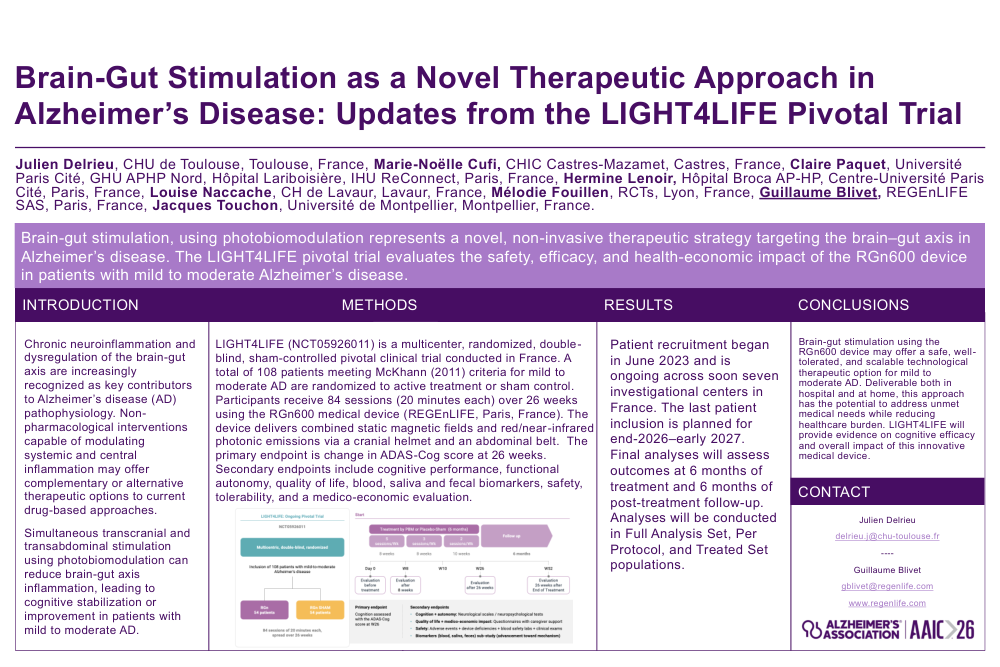
Brain-gut stimulation, using photobiomodulation represents a novel, non-invasive therapeutic strategy targeting the brain–gut axis in Alzheimer’s disease. The LIGHT4LIFE pivotal trial evaluates the safety, efficacy, and health-economic impact of the RGn600 device in patients with mild to moderate Alzheimer’s disease
INTRODUCTION
Chronic neuroinflammation and dysregulation of the brain-gut axis are increasingly recognized as key contributors to Alzheimer’s disease (AD) pathophysiology. Non-pharmacological interventions capable of modulating systemic and central inflammation may offer complementary or alternative therapeutic options to current drug-based approaches.
Simultaneous transcranial and transabdominal stimulation using photobiomodulation can reduce brain-gut axis inflammation, leading to cognitive stabilization or improvement in patients with mild to moderate AD.
METHODS
LIGHT4LIFE (NCT05926011) is a multicenter, randomized, double-blind, sham-controlled pivotal clinical trial conducted in France. A total of 108 patients meeting McKhann (2011) criteria for mild to moderate AD are randomized to active treatment or sham control. Participants receive 84 sessions (20 minutes each) over 26 weeks using the RGn600 medical device (REGEnLIFE, Paris, France). The device delivers combined static magnetic fields and red/near-infrared photonic emissions via a cranial helmet and an abdominal belt. The primary endpoint is change in ADAS-Cog score at 26 weeks. Secondary endpoints include cognitive performance, functional autonomy, quality of life, blood, saliva and fecal biomarkers, safety, tolerability, and a medico-economic evaluation.
RESULTS
Patient recruitment began in June 2023 and is ongoing across soon seven investigational centers in France. The last patient inclusion is planned for end-2026–early 2027. Final analyses will assess outcomes at 6 months of treatment and 6 months of post-treatment follow-up. Analyses will be conducted in Full Analysis Set, Per Protocol, and Treated Set populations.
CONCLUSIONS
Brain-gut stimulation using the RGn600 device may offer a safe, well-tolerated, and scalable technological therapeutic option for mild to moderate AD. Deliverable both in hospital and at home, this approach has the potential to address unmet medical needs while reducing healthcare burden. LIGHT4LIFE will provide evidence on cognitive efficacy and overall impact of this innovative medical device.
Comments
Email is required but is not shown publicly.
Loading comments...