4,068 posters, 219 videos, 101 topics, 69 sessions, 14,365 authors, 6,128 institutions
ePostersLive by SciGen Technologies S.A. All rights reserved.
Alzheimer's Association International Conference 2026
July 12-15, 2026 | London, United Kingdom, and Online

10532
Rates Of Aria And Infusion-related Adverse Events From The Use Of Lecanemab And Donanemab In A Regional Medical Center
Poster Presenter
Authors
Lisa Shields, Hannah Hust, Theresa Kluthe, Rachel Hart, Andrew Thaliath, Brandon Dennis, Stephanie Freeman, Jessica Cain, Whoy Shang, Kendall Wasz, Adam Orr, Christopher Shields, Shirish Barve, Kenneth Pugh
Affiliations
Norton Neuroscience Institute, Norton Healthcare, Norton Research Institute, Norton Healthcare and Department of Pediatrics, University of Louisville School of Medicine, Norton Neuroscience Institute, Norton Healthcare and Department of Medicine, University of Louisville School of Medicine
Part of Topic
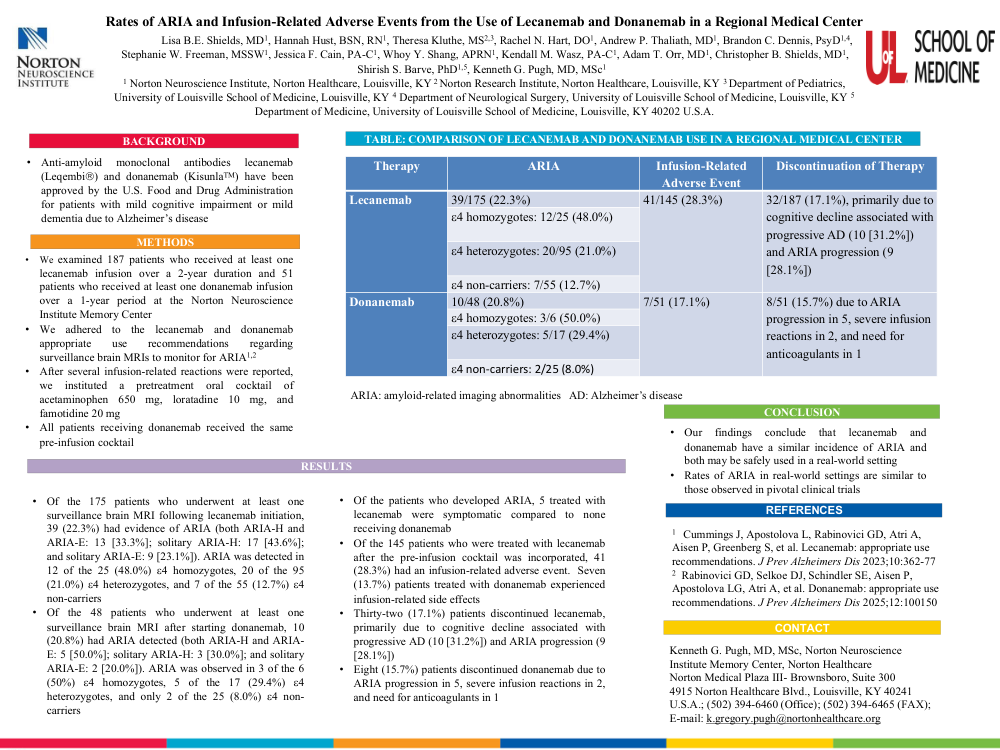
Background: Anti-amyloid monoclonal antibodies lecanemab (Leqembiâ) and donanemab (KisunlaTM) have been approved by the U.S. Food and Drug Administration for patients with mild cognitive impairment or mild dementia due to Alzheimer’s disease.
Methods: We examined 187 patients who received at least one lecanemab infusion over a 2-year duration and 51 patients who received at least one donanemab infusion over a 1-year period at the Norton Neuroscience Institute Memory Center. We adhered to the lecanemab and donanemab appropriate use recommendations regarding surveillance brain MRIs to monitor for ARIA.1,2 After several infusion-related reactions were reported, we instituted a pretreatment oral cocktail of acetaminophen 650 mg, loratadine 10 mg, and famotidine 20 mg. All patients receiving donanemab received the same pre-infusion cocktail.
Results: Of the 175 patients who underwent at least one surveillance brain MRI following lecanemab initiation, 39 (22.3%) had evidence of ARIA (both ARIA-H and ARIA-E: 13 [33.3%]; solitary ARIA-H: 17 [43.6%]; and solitary ARIA-E: 9 [23.1%]). ARIA was detected in 12 of the 25 (48.0%) e4 homozygotes, 20 of the 95 (21.0%) e4 heterozygotes, and 7 of the 55 (12.7%) e4 non-carriers. Of the 48 patients who underwent at least one surveillance brain MRI after starting donanemab, 10 (20.8%) had ARIA detected (both ARIA-H and ARIA-E: 5 [50.0%]; solitary ARIA-H: 3 [30.0%]; and solitary ARIA-E: 2 [20.0%]). ARIA was observed in 3 of the 6 (50%) e4 homozygotes, 5 of the 17 (29.4%) e4 heterozygotes, and only 2 of the 25 (8.0%) e4 non-carriers. Of the patients who developed ARIA, 5 treated with lecanemab were symptomatic compared to none receiving donanemab. Of the 145 patients who were treated with lecanemab after the pre-infusion cocktail was incorporated, 41 (28.3%) had an infusion-related adverse event. Seven (13.7%) patients treated with donanemab experienced infusion-related side effects. Thirty-two (17.1%) patients discontinued lecanemab, primarily due to cognitive decline associated with progressive AD (10 [31.2%]) and ARIA progression (9 [28.1%]). Eight (15.7%) patients discontinued donanemab due to ARIA progression in 5, severe infusion reactions in 2, and need for anticoagulants in 1
Conclusion: Our findings conclude that lecanemab and donanemab have a similar incidence of ARIA and both may be safely used in a real-world setting. Rates of ARIA in real-world settings are similar to those observed in pivotal clinical trials.
References: 1 Cummings J, Apostolova L, Rabinovici GD, Atri A, Aisen P, Greenberg S, et al. Lecanemab: appropriate use recommendations. J Prev Alzheimers Dis 2023;10:362-77.
2 Rabinovici GD, Selkoe DJ, Schindler SE, Aisen P, Apostolova LG, Atri A, et al. Donanemab: appropriate use recommendations. J Prev Alzheimers Dis 2025;12:100150.
Comments
Email is required but is not shown publicly.
Loading comments...