4,068 posters, 219 videos, 101 topics, 69 sessions, 14,365 authors, 6,128 institutions
ePostersLive by SciGen Technologies S.A. All rights reserved.
Alzheimer's Association International Conference 2026
July 12-15, 2026 | London, United Kingdom, and Online

3907
Anti-amyloid Drugs For Patients With Idiopathic Normal Pressure Hydrocephalus And Positive Alzheimer’S Disease Biomarkers?
Poster Presenter
Authors
Part of Topic
Anti-amyloid drugs for patients with idiopathic Normal Pressure Hydrocephalus and positive Alzheimer’s disease biomarkers?
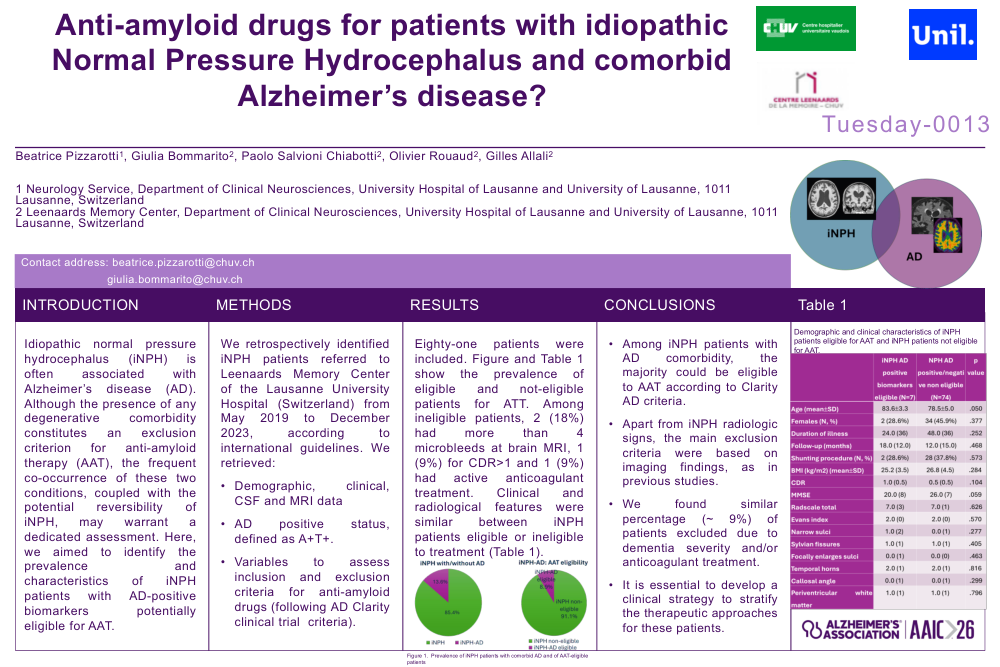
Background: Anti-amyloid monoclonal antibodies have been recently approved for Alzheimer’s disease (AD). Idiopathic normal pressure hydrocephalus (iNPH) is often associated with AD. Although the presence of any degenerative comorbidity constitutes an exclusion criterion for anti-amyloid therapy, the frequent co-occurrence of these two conditions, coupled with the potential reversibility of iNPH, may warrant a dedicated assessment
We aimed to identify the prevalence and characteristics of iNPH patients with AD-positive biomarkers potentially eligible for anti-amyloid treatments.
Methods: We retrospectively identified iNPH patients according to international criteria. Demographic, clinical, CSF and MRI data were collected. AD positive status was defined as A+T+ and exclusion criteria for anti-amyloid drugs were evaluated.
Results: Among 81 iNPH patients (78.9 y.o (5.1)) referred from Neurosurgery Service to Leenaards Memory Center of the Lausanne University Hospital (Switzerland) from May 2019 to December 2023, 11 (13.6%) of iNPH patients presented AD positive biomarkers and 7 (8.6%) were eligible for anti-amyloid drugs. Among ineligible patients, 2 (18%) had more than 4 microbleeds at brain MRI, 1 (9%) for CDR>1 and 1 (9%) had active anticoagulant treatment. Clinical and radiological features were similar between iNPH patients eligible or ineligible to treatment.
Conclusions: Among iNPH patients with AD comorbidity, the majority could be eligible to AAT according to Clarity AD inclusion criteria. Apart from iNPH radiologic signs, the main exclusion criteria were based on imaging findings, as in previous studies; we found similar percentage (around 9%) of patients excluded due to dementia severity and/or anticoagulant treatment. Our study did not find any clinical or radiological features that correlate with the presence of AD biomarkers in iNPH. To conclude, while only a minority of iNPH patients qualify for anti-amyloid drugs, it is essential to develop a clinical strategy to stratify the therapeutical approaches for these patients.
Comments
Email is required but is not shown publicly.
Loading comments...