4,068 posters, 219 videos, 101 topics, 69 sessions, 14,365 authors, 6,128 institutions
ePostersLive by SciGen Technologies S.A. All rights reserved.
Alzheimer's Association International Conference 2026
July 12-15, 2026 | London, United Kingdom, and Online

3492
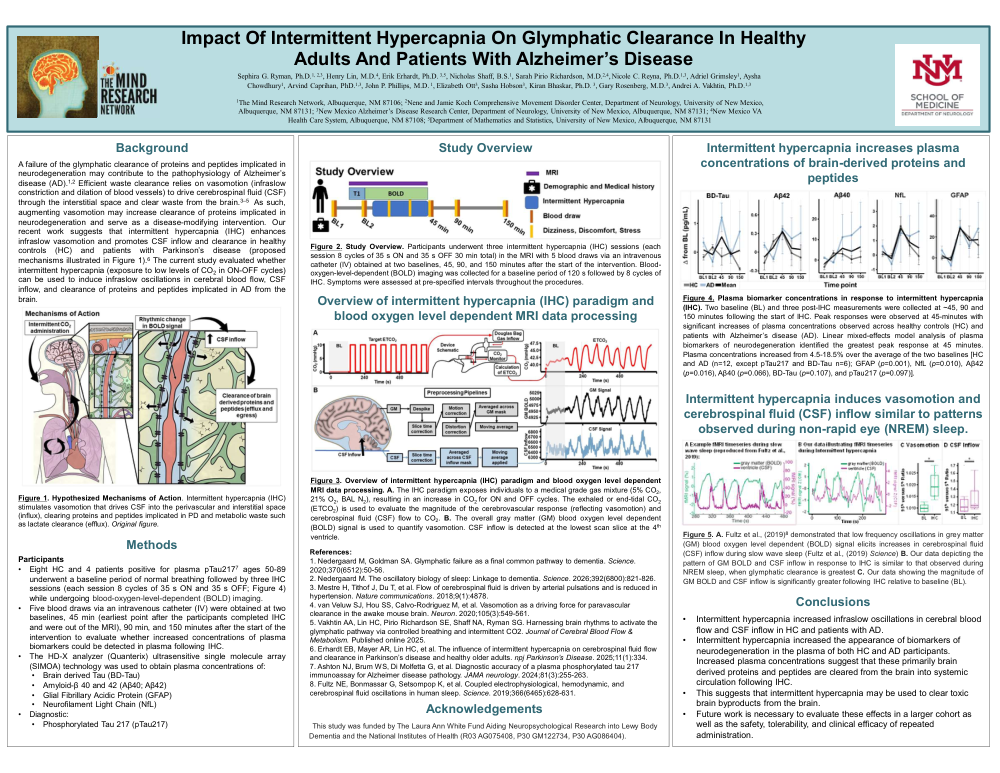
Impact Of Intermittent Hypercapnia On Glymphatic Clearance In Healthy Adults And Patients With Alzheimer’s Disease
Poster Presenter
Authors
Sephira Ryman, Henry Lin, Erik Erhardt, Nicholas Shaff, Sarah Pirio Richardson, Nicole Reyna, Adriel Grimsley, Aysha Chowdhury, Arvind Caprihan, John Phillips, Elizabeth Ott, Sasha Hobson, Kiran Bhaskar, Gary Rosenberg, Andrei Vakhtin
Affiliations
Mind Research Network and University of New Mexico, University of New Mexico and New Mexico VA Health Care System, University of New Mexico, Mind Research Network, University of New Mexico and Mind Research Network
Part of Topic
Background: A failure of the glymphatic clearance of proteins and peptides implicated in neurodegeneration may contribute to the pathophysiology of Alzheimer’s disease (AD).1,2 Efficient waste clearance relies on vasomotion (infraslow constriction and dilation of blood vessels) to drive cerebrospinal fluid (CSF) through the interstitial space and clear waste from the brain.3–5 As such, augmenting vasomotion may increase clearance of proteins implicated in neurodegeneration and serve as a disease-modifying intervention. Our recent work suggests that intermittent hypercapnia (IHC) enhances infraslow vasomotion and promotes CSF inflow and clearance in healthy controls (HC) and patients with Parkinson’s disease (proposed mechanisms illustrated in Figure 1).6 The current study evaluated whether intermittent hypercapnia (exposure to low levels of CO2 in ON-OFF cycles) can be used to induce infraslow oscillations in cerebral blood flow, CSF inflow, and clearance of proteins and peptides implicated in AD from the brain.
Methods
- Eight HC and 4 patients positive for plasma pTau2177 ages 50-89 underwent a baseline period of normal breathing followed by three IHC sessions (each session 8 cycles of 35 s ON and 35 s OFF; Figure 4) while undergoing blood-oxygen-level-dependent (BOLD) imaging.
- Five blood draws via an intravenous catheter (IV) were obtained at two baselines, 45 min (earliest point after the participants completed IHC and were out of the MRI), 90 min, and 150 minutes after the start of the intervention to evaluate whether increased concentrations of plasma biomarkers could be detected in plasma following IHC.
- The HD-X analyzer (Quanterix) ultrasensitive single molecule array (SIMOA) technology was used to obtain plasma concentrations of:
- Brain derived Tau (BD-Tau)
- Amyloid-β 40 and 42 (Aβ40; Aβ42)
- Glial Fibrillary Acidic Protein (GFAP)
- Neurofilament Light Chain (NfL)
- Diagnostic:
- Phosphorylated Tau 217 (pTau217)
- Figure 1. Hypothesized Mechanisms of Action. Intermittent hypercapnia (IHC) stimulates vasomotion that drives CSF into the perivascular and interstitial space (influx), clearing proteins and peptides implicated in PD and metabolic waste such as lactate clearance (efflux). Original figure.
- Figure 2. Study Overview. Participants underwent three intermittent hypercapnia (IHC) sessions (each session 8 cycles of 35 s ON and 35 s OFF 30 min total) in the MRI with 5 blood draws via an intravenous catheter (IV) obtained at two baselines, 45, 90, and 150 minutes after the start of the intervention. Blood-oxygen-level-dependent (BOLD) imaging was collected for a baseline period of 120 s followed by 8 cycles of IHC. Symptoms were assessed at pre-specified intervals throughout the procedures.
- Figure 3. Overview of intermittent hypercapnia (IHC) paradigm and blood oxygen level dependent MRI data processing. A. The IHC paradigm exposes individuals to a medical grade gas mixture (5% CO2, 21% O2, BAL N2), resulting in an increase in CO2 for ON and OFF cycles. The exhaled or end-tidal CO2 (ETCO2) is used to evaluate the magnitude of the cerebrovascular response (reflecting vasomotion) and cerebrospinal fluid (CSF) flow to CO2. B. The overall gray matter (GM) blood oxygen level dependent (BOLD) signal is used to quantify vasomotion. CSF inflow is detected at the lowest scan slice at the 4th ventricle.
- Figure 4. Plasma biomarker concentrations in response to intermittent hypercapnia (IHC). Two baseline (BL) and three post-IHC measurements were collected at ~45, 90 and 150 minutes following the start of IHC. Peak responses were observed at 45-minutes with significant increases of plasma concentrations observed across healthy controls (HC) and patients with Alzheimer’s disease (AD). Linear mixed-effects model analysis of plasma biomarkers of neurodegeneration identified the greatest peak response at 45 minutes. Plasma concentrations increased from 4.5-18.5% over the average of the two baselines [HC and AD (n=12, except pTau217 and BD-Tau n=6); GFAP (p=0.001), NfL (p=0.010), Aβ42 (p=0.016), Aβ40 (p=0.066), BD-Tau (p=0.107), and pTau217 (p=0.097)].
- Figure 5. A. Fultz et al., (2019)8 demonstrated that low frequency oscillations in grey matter (GM) blood oxygen level dependent (BOLD) signal elicits increases in cerebrospinal fluid (CSF) inflow during slow wave sleep (Fultz et al., (2019) Science) B. Our data depicting the pattern of GM BOLD and CSF inflow in response to IHC is similar to that observed during NREM sleep, when glymphatic clearance is greatest C. Our data showing the magnitude of GM BOLD and CSF inflow is significantly greater following IHC relative to baseline (BL).
- Intermittent hypercapnia increased infraslow oscillations in cerebral blood flow and CSF inflow in HC and patients with AD.
- Intermittent hypercapnia increased the appearance of biomarkers of neurodegeneration in the plasma of both HC and AD participants. Increased plasma concentrations suggest that these primarily brain derived proteins and peptides are cleared from the brain into systemic circulation following IHC.
- This suggests that intermittent hypercapnia may be used to clear toxic brain byproducts from the brain.
- Future work is necessary to evaluate these effects in a larger cohort as well as the safety, tolerability, and clinical efficacy of repeated administration.
Comments
Email is required but is not shown publicly.
Loading comments...