4,068 posters, 219 videos, 101 topics, 69 sessions, 14,365 authors, 6,128 institutions
ePostersLive by SciGen Technologies S.A. All rights reserved.
Alzheimer's Association International Conference 2026
July 12-15, 2026 | London, United Kingdom, and Online

9458
Associations Between Smartphone-based Cognitive Performance And Vascular, Metabolic, And Plasma Biomarkers
Poster Presenter
Authors
Amy Wise, Ashley Heywood, Melissa Sotelo, Eden Barragan, Ray Fregly, Emily Paolillo, Hilary Heuer, Mark Sanderson-Cimino, Jack Taylor, Rachel Nosheny, Michael Weiner, Scott Mackin, Winnie Kwang, Monica Camacho, Krista Navarro, Katherine Possin, Stephen Cubbellotti, Vanessa Guzman, Desiree Byrd, Monica Rivera-Mindt, Gil Rabinovici, Adam Boxer, Adam Staffaroni
Affiliations
Department of Neurology, Memory and Aging Center, Weill Institute for Neurosciences, University of California, San Francisco, Department of Neurology, the Icahn School of Medicine at Mount Sinai, New York, NY, Department of Neurology, the Icahn School of Medicine at Mount Sinai, New York, NY; Department of Psychology, Fordham University, New York, NY, USA
Part of Topic
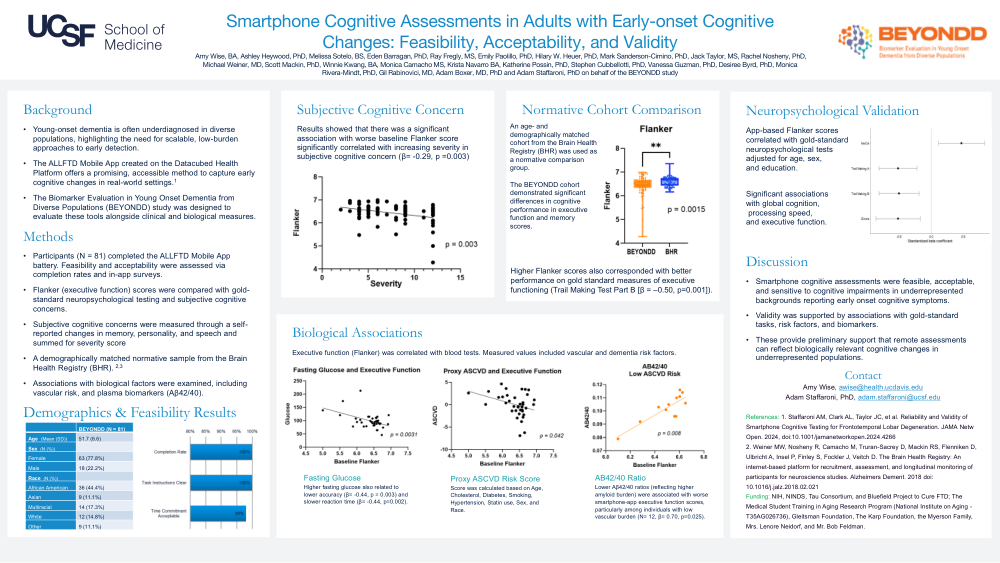
Background: This project evaluated the feasibility, acceptability, and validity of smartphone app cognitive assessments in a multisite study designed to validate blood and digital biomarkers of early-onset cognitive changes in underrepresented populations.
Method: Eighty-one participants (mean age 52 ± 6.6 years; 78% female) from a racially and ethnically diverse cohort (42% Black, 30% multiracial, 15% White, 11% Asian; 37.5% Latino/Hispanic) remotely completed a ~30-minute battery of cognitive and motor tasks on their personal smartphones. Analyses focused on the flanker task as a measure of executive function. Participants completed questionnaires on technology familiarity, user experience, and subjective cognitive decline. A subset completed blood draws (N=37) for plasma Alzheimer’s disease biomarkers (Aβ42/40), as well as vascular (total and HDL cholesterol) and metabolic (fasting glucose) labs, from which a vascular risk score was derived using published methods. Another subset (N=36) completed in-person neuropsychological testing. Descriptive statistics summarized participant characteristics and user experience. Linear regressions adjusted for age, sex, and education examined associations between flanker performance, neuropsychological measures, vascular risk, and Alzheimer’s disease biomarkers.
Results: Participants completed 100% of available smartphone assessments. Technology familiarity was high (100%), with most preferring mobile assessments over pen-and-paper testing (78%). Greater subjective cognitive concerns were associated with worse total scores on the smartphone executive functioning task (β= -0.29, p=0.005), and higher scores corresponded with better performance on gold standard measures of executive functioning (e.g. Trail Making Test Part B [β = –0.50, p = 0.001]).
Elevated vascular risk scores were associated with reduced flanker accuracy (β= -0.33, p= 0.04) and slower reaction times (β= -0.38, p=0.02). Higher fasting glucose related to lower accuracy (β= -0.44, p = 0.003) and slower reaction time (β= -0.44, p=0.002).
Lower Aβ42/40 ratios (reflecting higher amyloid burden) were associated with worse smartphone-app executive function scores, particularly among individuals with low vascular burden (N= 12, β= 0.70, p=0.025).
Conclusions: Smartphone cognitive assessments were feasible, acceptable, and sensitive to subjective cognitive impairments within a diverse midlife cohort. Validity was supported by associations with gold-standard tasks, risk factors, and biomarkers. These provide preliminary support that remote assessments can reflect biologically relevant cognitive changes in underrepresented populations.
Comments
Email is required but is not shown publicly.
Loading comments...