4,068 posters, 219 videos, 101 topics, 69 sessions, 14,365 authors, 6,128 institutions
ePostersLive by SciGen Technologies S.A. All rights reserved.
Alzheimer's Association International Conference 2026
July 12-15, 2026 | London, United Kingdom, and Online

5822
Lexical-level Predictors In A Connected Speech Task In Patients With Primary Progressive Aphasia
Part of Topic
Abstract Title: Lexical-level predictors in a connected speech task in patients with Primary Progressive Aphasia
Keywords: LEXICAL PREDICTORS - CONNECTED SPEECH - LANGUAGE
Theme: Clinical manifestations
Background:
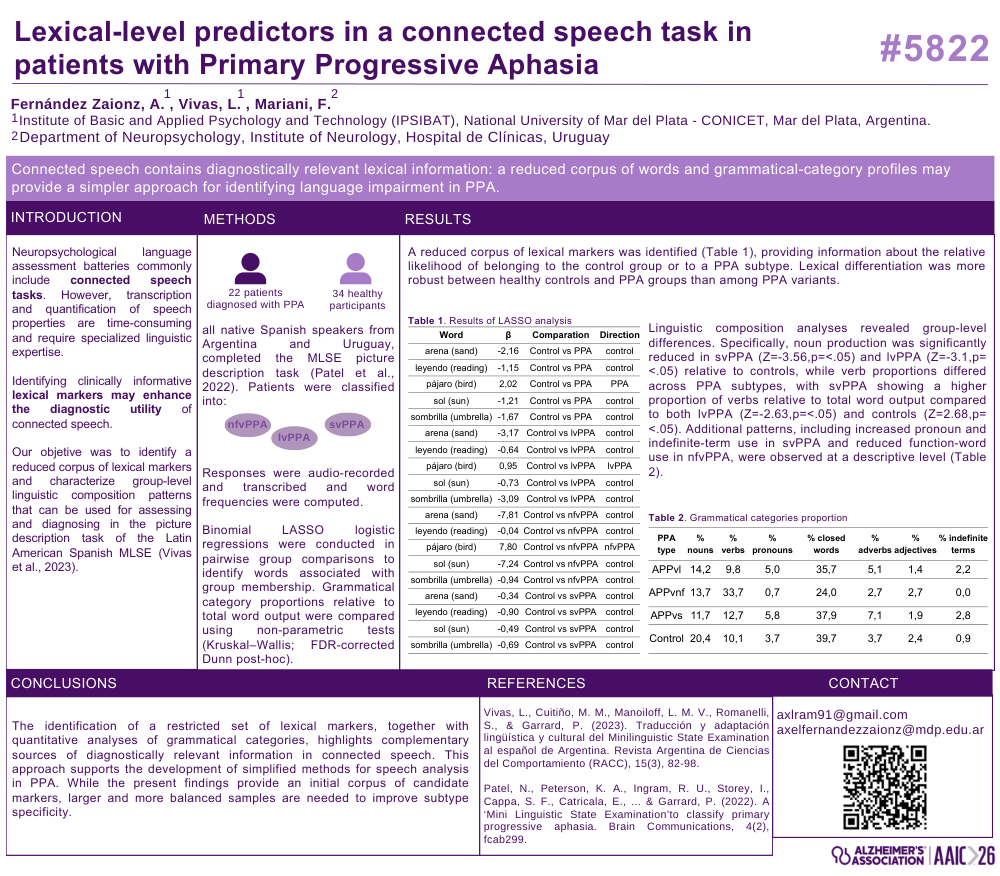
Neuropsychological language assessment batteries commonly include connected speech tasks. However, transcription and quantification of speech properties are time-consuming and require specialized linguistic expertise. Identifying clinically informative lexical markers may enhance the diagnostic utility of connected speech. Objective: To identify a reduced corpus of lexical markers and characterize group-level linguistic composition patterns that can be used for assessing and diagnosing in the picture description task of the Latin American Spanish MLSE (Vivas et al., 2023).
Methods:
Twenty-two patients with PPA, semantic (svPPA), non-fluent (nfvPPA), and logopenic (lvPPA), and 34 healthy controls, all native Spanish speakers from Argentina and Uruguay, completed the MLSE picture description task (Patel et al., 2022). Responses were audio-recorded and transcribed and word frequencies were computed. Binomial LASSO logistic regressions were conducted in pairwise group comparisons to identify words associated with group membership. Grammatical category proportions relative to total word output were compared using non-parametric tests (Kruskal–Wallis; FDR-corrected Dunn post-hoc).
Results:
A reduced corpus of lexical markers was identified (Table 1), providing information about the relative likelihood of belonging to the control group or to a PPA subtype. Lexical differentiation was more robust between healthy controls and PPA groups than among PPA variants. Linguistic composition analyses revealed group-level differences. Specifically, noun production was significantly reduced in svPPA (Z=-3.56,p=<.05) and lvPPA (Z=-3.1,p=<.05) relative to controls, while verb proportions differed across PPA subtypes, with svPPA showing a higher proportion of verbs relative to total word output compared to both lvPPA (Z=-2.63,p=<.05) and controls (Z=2.68,p=<.05). Additional patterns, including increased pronoun and indefinite-term use in svPPA and reduced function-word use in nfvPPA, were observed at a descriptive level (Table 2).
Conclusions:
The identification of a restricted set of lexical markers, together with quantitative analyses of grammatical categories, highlights complementary sources of diagnostically relevant information in connected speech. This approach supports the development of simplified methods for speech analysis in PPA. While the present findings provide an initial corpus of candidate markers, larger and more balanced samples are needed to improve subtype specificity.
Comments
Email is required but is not shown publicly.
Loading comments...